
The Moral Imperative Against Child Euthanasia: A Catholic Bioethical Response to Colombia’s Resolution 0813-2026
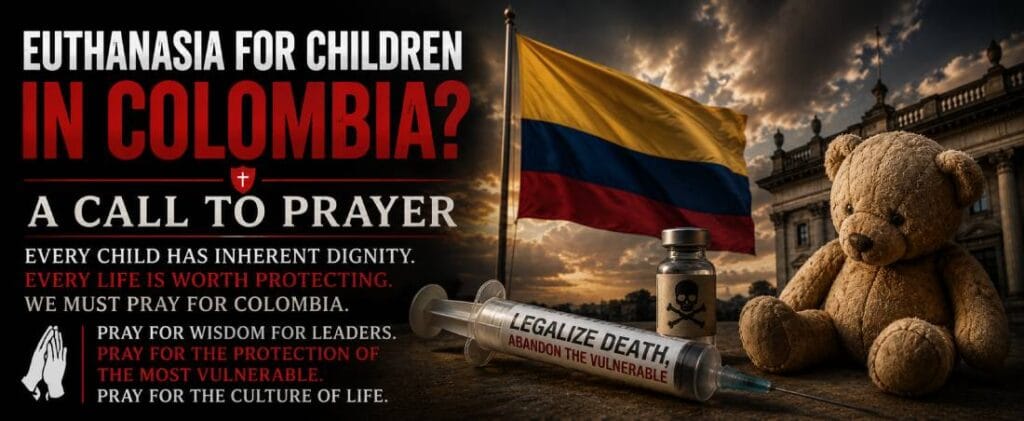
On April 28, 2026, Colombia’s Ministry of Health issued Resolution 0813-2026 under the administration of President Gustavo Petro, marking a critical juncture in South American public health and bioethics. Building upon previous Constitutional Court rulings—including Sentence T-540/17 and Resolution 825/18—the new regulation broadens access to euthanasia beyond terminal illness to encompass non-terminal conditions, psychiatric disorders, and severe bodily injuries. Most alarmingly, the regulatory framework legalizes direct lethal interventions for minors. Adolescents aged 12 and older may request euthanasia under adult criteria, while children between six and twelve years old may qualify if deemed to possess “exceptional neurocognitive and psychological development”.
This policy represents a direct challenge to human dignity and the sacredness of life. From a secular perspective, proponents frame the measure as an exercise in progressive autonomy. However, Catholic moral theology, Sacred Scripture, and the authoritative Magisterium of the Roman Catholic Church reveal this framework as a grave moral failure that threatens the most vulnerable.
1. Dogmatic & Moral Framework: Why Euthanasia Is Intrinsece Malum
Public discussions surrounding Resolution 0813-2026 often center on minor maturity and decision-making capacity. Critics frequently object that six-year-old children lack the intellectual development to provide informed consent. While developmental psychology confirms that young children cannot comprehend the permanent nature of mortality, placing the primary objection on subjective maturity creates a dangerous theological loophole. It inadvertently suggests that if an individual does possess cognitive maturity, they hold the legitimate right to end their own life.
Catholic moral theology firmly rejects this premise. Direct euthanasia—the intentional ending of a human life to eliminate suffering—is an intrinsic moral evil (intrinsece malum). It can never be justified by age, developmental capacity, subjective intention, or administrative mandate. As the Catechism of the Catholic Church states:
“Whatever its motives and means, direct euthanasia consists in putting an end to the lives of handicapped, sick, or dying persons. It is morally unacceptable.” (CCC 2277)
In his landmark encyclical Evangelium Vitae, Pope St. John Paul II reaffirmed this absolute prohibition with full magisterial authority:
“I confirm that euthanasia is a grave violation of the law of God, since it is the deliberate and morally unacceptable killing of a human person.” (Evangelium Vitae, 65)
Furthermore, claims that human life possesses “infinite value” require dogmatic precision. Creation is finite; God alone is infinite. As clarified by the Dicastery for the Doctrine of the Faith in its 2024 Declaration Dignitas Infinita, human beings possess an intrinsic, sacred, and inviolable dignity rooted in being created in the imago Dei (Image of God) and redeemed by Jesus Christ (CCC 2258). This dignity is ontological—it belongs to every human person by virtue of their existence and remains intact regardless of physical illness, disability, or developmental status.
In the Summa Theologiae (II-II, q. 64, a. 5), St. Thomas Aquinas outlines three fundamental reasons why suicide and deliberate self-destruction violate moral law:
- Natural Law: Everything naturally loves itself and seeks to preserve its own existence.
- Social Charity: Every individual belongs to the community, and taking one’s life harms the common good.
- Divine Sovereignty: Life is God’s gift; He alone holds ultimate power over life and death.
2. Scriptural Foundations: Divine Sovereignty and the Protection of the Weak
Sacred Scripture continuously affirms God’s exclusive authorship over creation and mandates the protection of the innocent. In Psalm 139:13–14, the Psalmist writes: “For you created my inmost being; you knit me together in my mother’s womb. I praise you because I am fearfully and wonderfully made.” Life is not an accident of biology or a commodity governed by state utility; it is a direct result of divine intention.
Throughout His earthly ministry, Jesus Christ demonstrated a profound defense of children, highlighting their spiritual value and vulnerable place in society. When the disciples attempted to turn children away, Christ commanded: “Let the little children come to me, and do not hinder them, for the kingdom of heaven belongs to such as these” (Matthew 19:14). Christ’s actions establish an absolute standard for Catholic healthcare: children are to be protected, cherished, and brought into loving care, never subjected to lethal measures.
Furthermore, Scripture imposes an unequivocal moral obligation upon society to defend those who cannot defend themselves: “Speak up for those who cannot speak for themselves, for the rights of all who are destitute” (Proverbs 31:8). Sick and disabled children represent the most defenceless members of the human family. Subjecting them to state-sanctioned lethal injection under vague criteria like “exceptional development” violates both justice and charity.
Finally, the Book of Job reminds humanity of the boundaries of human authority: “The Lord gave and the Lord has taken away; may the name of the Lord be praised” (Job 1:21). Neither the state, nor medical professionals, nor parents hold the moral authority to terminate an innocent human life.
3. Palliative Care vs. The Culture of Death: Authentic Catholic Medical Bioethics
Catholic bioethics draws a clear distinction between the deliberate termination of life and the administration of authentic palliative care. In the letter Samaritanus Bonus (2020), the Congregation for the Doctrine of the Faith emphasizes that genuine compassion demands holistic palliative care, pain management, and medical accompaniment:
“Palliative care is an authentic expression of the human and Christian activity of providing care, a tangible symbol of the compassionate ‘showing up’ at the side of the suffering person.” (Samaritanus Bonus, V)
Catholic moral teaching allows for the use of painkillers to relieve severe suffering, even if such treatment may indirectly shorten life, provided that death is neither willed nor intended as an end or a means (CCC 2279). What Catholic moral law prohibits is the direct, intentional termination of a patient.
Resolution 0813-2026 undermines authentic medicine by placing healthcare professionals in direct conflict with their ethical duties. Medical practitioners are bound by natural law and the Hippocratic tradition to preserve life and alleviate suffering without inflicting harm. Forcing medical personnel to participate in minor euthanasia severely infringes upon rights of conscience.
Under Canon Law (Cann. 1136) and natural law, parents are the primary guardians and educators of their children. While parents must protect their children’s physical and spiritual well-being, parental authority is delegated by God and bounded by divine law. Parents do not possess the moral right to authorize the termination of their child’s life.
4. Summary Bioethical Matrix: Secular Regulation vs. Catholic Magisterium
| Dimension | Resolution 0813-2026 (Secular Framework) | Authentic Catholic Teaching (Magisterium) |
| Source of Dignity | Subjective autonomy and cognitive function. | Ontological imago Dei; inviolable dignity from conception to natural death (Dignitas Infinita, 1). |
| Moral Status of Euthanasia | A personal “right to die with dignity”. | An intrinsic moral evil (intrinsece malum) that violates divine law (CCC 2277). |
| Role of Healthcare | Service provider supplying requested lethal interventions. | Minister of healing, palliative care, and life preservation (Samaritanus Bonus, V). |
| Authority over Life | Delegated to individual autonomy and state oversight. | Reserved exclusively to God Almighty (Job 1:21; Summa Theologiae II-II, q. 64, a. 5). |
5. Frequently Asked Questions
No. Direct euthanasia is intrinsically evil regardless of the intensity of suffering (CCC 2277). Catholic bioethics supports comprehensive palliative care and aggressive pain management to alleviate physical suffering, provided the intent is to soothe pain rather than cause death (CCC 2279).
Morally, no parent possesses the authority to consent to the intentional termination of their child’s life. Natural law and Catholic teaching dictate that parental authority exists to safeguard life, not destroy it (Evangelium Vitae, 65).
Catholic healthcare personnel must exercise conscientious objection. Participating in direct euthanasia is a grave sin against the Fifth Commandment, and medical professionals are morally obligated to refuse cooperation with intrinsic moral evils.
6. Pastoral Action and Civic Response
Reversing the expansion of euthanasia requires a unified response rooted in prayer, political engagement, and authentic healthcare support.
- Intercession & Spiritual Warfare: Catholic faithful must intercede regularly for ill children, families facing medical crises, and legislators involved in healthcare policy.
- Defending Conscience Rights: Legal and social support must be provided to doctors, nurses, and medical personnel who refuse to participate in lethal procedures.
- Expanding Pediatric Palliative Care: The Catholic Church and Christian institutions must invest in advanced palliative care centers that offer real comfort, pain relief, and family support.
By standing firm on Sacred Scripture, Sacred Tradition, and magisterial teaching, the Church offers a hopeful alternative to the culture of death—one that honors God’s sovereignty and guards every human life.
Source: Zenit
Continue Your Faith Journey
Catholic Church Teaching on IVF: Doctrine, Dignity, and Moral Alternatives
Explore the Catholic Church's official teaching on IVF, rooted in the dignity of human life and marital union. Learn about licit alternatives…
Venerable Jérôme Lejeune, Pope Leo XIV, and the Inviolable Dignity of Human Life
Explore how Venerable Jérôme Lejeune's scientific witness and Catholic teaching defend the sacred dignity of human life against modern programmed death. Learn…
Dobbs Decision Anniversary: Why the Battle for Life Has Moved from the Courts to the Heart
On the Dobbs decision anniversary, the pro-life mission shifts from courtrooms to human hearts. Discover how Catholic teaching and Evangelium Vitae call…