
Unjust Laws and Public Witness: A Catholic Analysis of Northern Ireland’s Buffer Zone Conviction
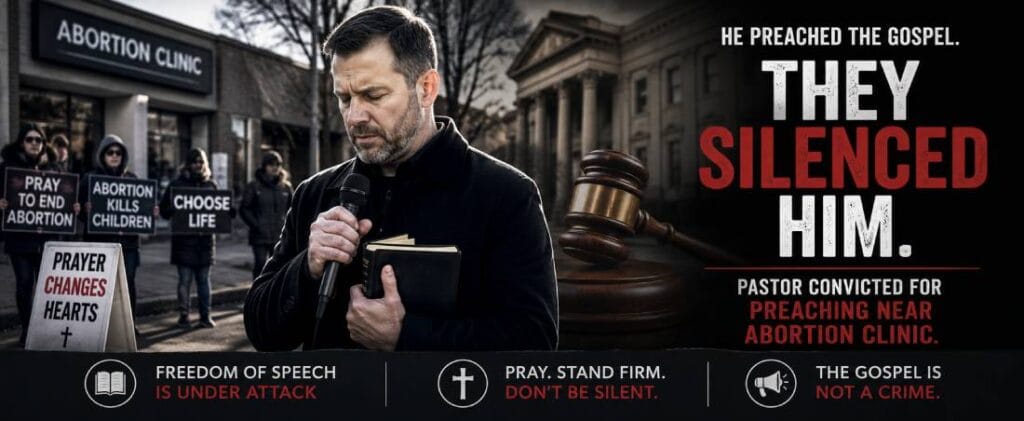
In May 2026, Coleraine Magistrates’ Court in Northern Ireland convicted 78-year-old retired minister Clive Johnston under the Abortion Services (Safe Access Zones) Act 2023. The conviction did not stem from acts of violence, physical obstruction, or personal harassment. On July 7, 2024, Johnston conducted a peaceful open-air religious service on a public grassy area separated by a dual carriageway from Causeway Hospital in Coleraine. Standing near a wooden cross, he read aloud from the Gospel of John—focusing on John 3:16—and led participants in singing traditional hymns. He made no mention of abortion, carried no pro-life placards, and did not approach individuals entering the medical facility.
Despite the absence of explicit pro-life messaging or anti-abortion speech, the court found Johnston guilty of two criminal counts and imposed a £450 fine. The prosecution argued that because the service occurred within a designated “safe access zone,” the public proclamation of Sacred Scripture and the display of a Christian cross constituted an unlawful attempt to “influence” protected persons accessing healthcare services.
Statutory Overreach and the Criminalization of Public Presence
This ruling represents a significant expansion in the statutory enforcement of abortion buffer zones across the United Kingdom. Under Northern Ireland’s 2023 Act—which established 100-to-150-meter zones around facilities providing abortion services—it is a criminal offense to engage in conduct intended to, or reckless as to whether it does, “influence, impede, or cause distress” to protected persons. By interpreting the term “influence” so broadly as to encompass standard Christian preaching and scripture reading, state authorities effectively enforce zones of secular silence in public spaces.
Similar legal precedents have emerged across Great Britain under the Public Order Act 2023, where citizens have faced criminal charges for silent prayer or peaceful presence near healthcare clinics. When administrative law criminalizes non-violent prayer and public reading of the Bible, civil governance surpasses its legitimate mandate. For faithful Catholics, these developments necessitate a rigorous evaluation grounded in Catholic moral theology, natural law, and the official teachings of the Magisterium.
Natural Law and Civil Authority: Aquinas and the Catechism
To evaluate buffer zone legislation morally, one must examine the fundamental purpose and limits of civil authority. Catholic theology, drawing from Sacred Scripture and the scholastic synthesis of St. Thomas Aquinas, teaches that human law derives its binding authority strictly from its conformity with right reason, natural law, and the objective moral order.
In the Summa Theologiae, St. Thomas Aquinas explicitly outlines the moral limits of human legislation: “Human law has the character of law to the extent that it accords with right reason… If, however, a law is at variance with reason, it is called an unjust law; out of such a framework, it has not the character of law, but rather a species of violence” (ST I-II, q. 96, a. 4). Aquinas further emphasizes that civil enactments that contradict divine commands or fundamental justice exceed human legislative power and fail to bind the human conscience.
This Thomistic principle is codified in the Catechism of the Catholic Church: “Authority is exercised legitimately only if it seeks the common good of the society concerned and if it employs morally licit means to attain it. If rulers were to enact unjust laws or take measures contrary to the moral order, such arrangements would not be binding in conscience” (CCC 1903).
Because every human life possesses intrinsic dignity from the moment of conception, abortion remains a grave intrinsic moral evil that no state authority can rightfully legitimize (CCC 2270–2272; Pope John Paul II, Evangelium Vitae 57). Consequently, statutes designed to suppress peaceful public witness against abortion or to penalize public religious proclamation contradict natural justice and cannot annul divine law (CCC 2273).
Religious Liberty and Public Proclamation: Dignitatis Humanae
The penalization of public scripture reading near medical facilities infringes upon the fundamental right to religious freedom defined by the Catholic Church. In the landmark Declaration on Religious Freedom (Dignitatis Humanae), the Second Vatican Council proclaimed that the human person has an inherent right to religious liberty, grounded in the dignity of the human person created by God (DH 2).
Vatican II specifically affirmed that religious liberty cannot be restricted to private belief or behind church doors: “Religious communities also have the right not to be hindered, either by legal measures or by administrative action on the part of their government, in the public teaching and witness to their faith” (DH 2).
When civil authorities enforce administrative buffer zones that treat peaceful prayer, hymn singing, or the proclamation of John 3:16 as criminal activity, they usurp rights inherent to human nature. As Pope John Paul II observed in Evangelium Vitae, when civil law validates the destruction of unborn life and suppresses peaceful public opposition, it assumes a tyrannical character (Evangelium Vitae 72). Statutory measures that shield abortion facilities from peaceful moral witness contradict the proper scope of civil governance.
Moral Resistance, Civil Disobedience, and Sacramental Renewal
When human legislation directly contradicts divine law, believers must adhere to the apostolic principle recorded in the Acts of the Apostles: “We must obey God rather than human beings” (Acts 5:29). The Catechism of the Catholic Church explicitly affirms the duty of moral resistance when civil mandates violate fundamental moral principles: “The citizen is obliged in conscience not to follow the directives of civil authorities when they are contrary to the demands of the moral order, to the fundamental rights of persons or the teachings of the Gospel” (CCC 2242).
In his encyclical Evangelium Vitae, Pope John Paul II reinforced this obligation, noting that there is “a grave and clear obligation to oppose” laws that permit or facilitate anti-life practices through civil disobedience and conscience-based refusal (Evangelium Vitae 73).
Christian witness against unjust laws must always be carried out with charity, fortitude, and adherence to truth. Throughout history, the Church has grown through faithful perseverance amid civil opposition. As Tertullian declared, “The blood of the martyrs is the seed of the Church” (Apologeticus 50). When state power penalizes public witness, divine Providence utilizes these trials to awaken secularized societies to the sanctity of life and the moral law (CCC 852, 2273).
Ultimately, genuine societal transformation requires more than courtroom challenges or legislative advocacy. It demands authentic spiritual conversion (conversio), the reception of divine grace through the Sacraments (CCC 1129), and an unyielding commitment to defending human life from conception to natural death (CCC 2270; Evangelium Vitae 57).
Statutory Buffer Zones vs. Catholic Moral Framework
| Analytical Category | Statutory Buffer Zone Legislation | Catholic Moral & Legal Framework |
| Primary Legislative Objective | Prohibits speech, prayer, or presence deemed capable of “influencing” clinic visitors. | Defends natural law, protects unborn human life, and upholds religious freedom (CCC 2270, DH 2). |
| Moral Validity of Enacted Statute | Civilly enforceable with criminal fines and police powers. | Invalid and non-binding in conscience if contrary to natural law (CCC 1903; Aquinas ST I-II, q. 96, a. 4). |
| Scope of Public Religious Expression | Restricted or penalised within designated 100–150m zones. | Recognized as an inviolable public right rooted in human dignity (Vatican II, Dignitatis Humanae 2). |
| Moral Obligation of the Citizen | Mandates legal compliance under threat of statutory penalties. | Obligates conscience to resist mandates that violate divine law (CCC 2242; Acts 5:29). |
Frequently Asked Questions
Catholic moral theology teaches that civil laws contrary to the natural moral order or fundamental human rights do not bind the human conscience (CCC 1903, 2242). When a statute penalizes peaceful prayer or public witness against abortion, it lacks moral authority because it contradicts divine law and natural justice (Summa Theologiae I-II, q. 96, a. 4; Evangelium Vitae 73).
No. Natural law and Catholic teaching affirm that public scripture reading and peaceful witness are fundamental exercises of religious freedom (Dignitatis Humanae 2). Classifying generic scripture reading as unlawful protest represents an overreach of administrative power that misinterprets basic religious expression as civil disturbance.
Believers are called to pair persistent prayer and sacramental life with legal defense and civic advocacy. Faithful Christians must obey God rather than human authorities (Acts 5:29), maintaining peaceful witness to the gospel while defending the sanctity of life and authentic religious freedom (CCC 852).
Source: LifeSiteNews
Continue Your Faith Journey
Venerable Jérôme Lejeune, Pope Leo XIV, and the Inviolable Dignity of Human Life
Explore how Venerable Jérôme Lejeune's scientific witness and Catholic teaching defend the sacred dignity of human life against modern programmed death. Learn…
Dobbs Decision Anniversary: Why the Battle for Life Has Moved from the Courts to the Heart
On the Dobbs decision anniversary, the pro-life mission shifts from courtrooms to human hearts. Discover how Catholic teaching and Evangelium Vitae call…
What the Catholic Church Teaches About Surrogacy: Dignity, Marriage, and the Gift of Life
Explore what the Catholic Church teaches about surrogacy, human dignity, and the sacred marital covenant. Learn why the Magisterium protects children as…