
Purgatory: Catholic Teaching, Scripture, and Tradition Explained
Purgatory is the final purification of the elect. All who die in God’s grace and friendship, but still imperfectly purified, are assured of their eternal salvation; however, after death they undergo a purification to achieve the holiness necessary to enter the joy of heaven (CCC 1030).
Purgatory is not an intermediate third destination, a second chance for those who died in unrepented mortal sin, or a medieval folklore invention. It is the scriptural and dogmatic meeting point of God’s absolute justice and infinite mercy.
What Is Purgatory According to the Catholic Church?
The Catechism of the Catholic Church outlines the dogma of purgatory in paragraphs 1030 through 1032. This teaching rests on a foundational truth: nothing unclean shall enter the presence of God (Revelation 21:27).
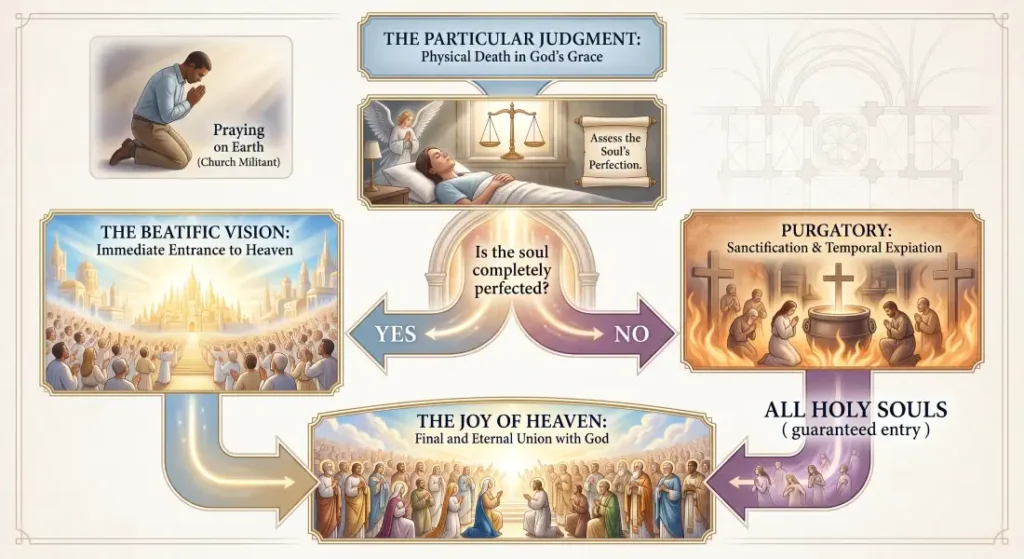
When a person dies in a state of sanctifying grace, their eternal salvation is secure. Yet many souls depart this life with venial sins, lingering disordered attachments to creatures, or unpaid temporal punishment due to forgiven sins. Purgatory is the process by which Christ cleanses and heals the soul before it enters the Beatific Vision.
The Two Dimensions of Purgatorial Suffering
Catholic theology, articulated by Doctors of the Church such as St. Thomas Aquinas (Summa Theologiae, Suppl., App. 2, a. 1–2) and affirmed at the Council of Florence (1439), distinguishes two primary aspects of purification in purgatory:
- The Pain of Loss (Poena Damni): The holy souls experience a temporary delay of the Beatific Vision. Having glimpsed God at their Particular Judgment, they are inflamed with a burning love and an intense desire to be united with Him, making the delay a profound spiritual longing.
- The Pain of Sense (Poena Sensus): The holy souls undergo an expiatory purification that burns away disordered attachments and satisfies the temporal punishment due to sin (reatus poenae) (CCC 1031).
This suffering is entirely distinct from the retributive torment of the damned. The holy souls in purgatory suffer in complete charity, filled with peace, absolute certainty of their salvation, and joy in God’s transforming love.
Purgatory vs. Hell vs. Heaven: Core Differences
The following table summarizes the doctrinal differences among the three post-mortem states:
| Dimension | Purgatory | Hell | Heaven |
| State of the Soul | Saved; dies in sanctifying grace but imperfectly purified | Damned; dies in unrepented mortal sin | Perfected in holiness and charity |
| Final Destiny | Guaranteed entrance into Heaven | Eternal separation from God | Direct, eternal Beatific Vision |
| Nature of Suffering | Expiatory purification and longing (poena temporalis) | Eternal retributive punishment and despair (poena aeterna) | None (complete and unending joy) |
| Efficacy of Prayers | Directly aided by the Mass, prayers, and indulgences | Cannot be aided or altered | Does not need aid; intercedes for the living |
| Duration | Temporary (ceases at the Final Judgment) | Eternal | Eternal |
The Scriptural Foundation for Purgatory
Although the word purgatory (from the Latin purgare, meaning “to cleanse”) is not found verbatim in Sacred Scripture, the reality of post-mortem purification and prayer for the dead is firmly rooted in both the Old and New Testaments.
1. Second Maccabees 12:38–46: Atonement for the Departed
The clearest Old Testament witness occurs when Judas Maccabeus discovers that fallen Jewish soldiers were carrying superstitious amulets. He takes up a collection and sends it to Jerusalem to provide for a sin offering:
“Therefore he made atonement for the dead, that they might be delivered from their sin.” (2 Maccabees 12:45, RSV-CE)
If the dead were either immediately in heaven (where no atonement is needed) or in hell (where no atonement can avail), praying for them would be meaningless. The Holy Spirit through Sacred Scripture praises this act as holy and devout.
2. First Corinthians 3:11–15: Saved, but Only as Through Fire
Writing to the Church at Corinth, St. Paul explains that every Christian builds upon the foundation of Jesus Christ with varying quality of materials:
“If any man’s work is burned up, he will suffer loss, though he himself will be saved, but only as through fire.” (1 Corinthians 3:15, RSV-CE)
The Church Fathers, including St. Augustine and St. Gregory the Great, interpreted this passage as pointing to a cleansing, post-mortem fire that purges venial imperfections while preserving the soul’s ultimate salvation.
3. Matthew 12:32: Forgiveness in the Age to Come
Jesus teaches: “Whoever speaks against the Holy Spirit will not be forgiven, either in this age or in the age to come.” From this statement, St. Gregory the Great observed that certain lesser faults can be remitted in the world to come (CCC 1031).
Magisterial Teaching: Florence, Trent, and the Catechism
The Catholic Church defined the dogma of purgatory across several Ecumenical Councils to preserve apostolic practice against theological errors.
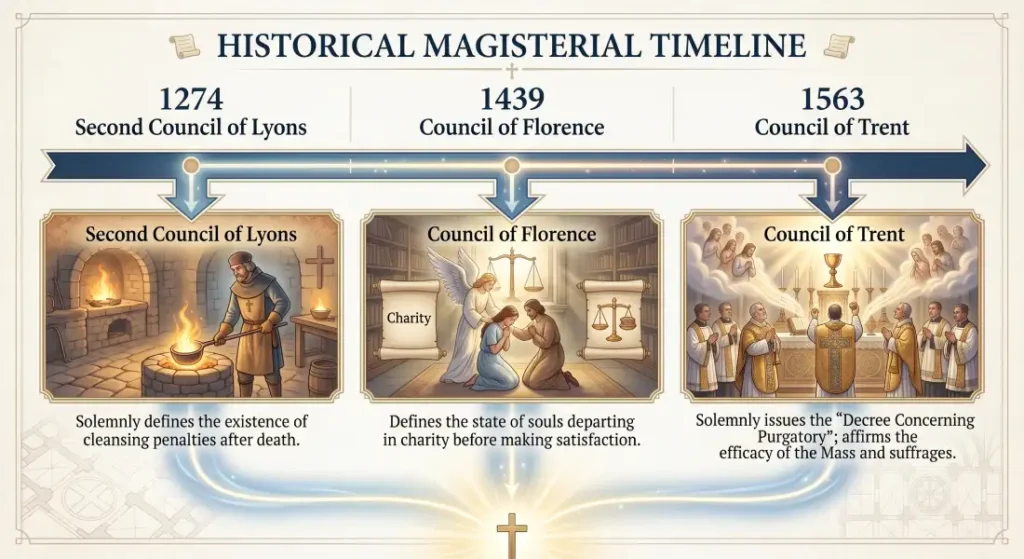
The Council of Trent (Session XXV, 1563)
In response to the Protestant Reformers who rejected the Deuterocanonical books and the traditional doctrine of suffrages, the Council of Trent issued its definitive Decretum de Purgatorio:
“The Catholic Church, instructed by the Holy Spirit, has, from the Sacred Scriptures and the ancient tradition of the Fathers, taught in sacred councils… that there is a Purgatory, and that the souls there detained are helped by the suffrages of the faithful, but principally by the acceptable sacrifice of the Altar.”
Trent also commanded bishops to prohibit speculative, curious, or superstitious notions, ensuring the doctrine is taught with pastoral sobriety and theological purity.
The Double Consequence of Sin: Eternal Guilt vs. Temporal Punishment
Understanding purgatory requires understanding Catholic moral theology regarding sin’s double consequence (CCC 1472):
- Eternal Punishment (Reatus Poenae Aeternae): Mortal sin ruptures communion with God and incurs eternal separation in hell. When a Catholic receives Sacramental Absolution in Confession with genuine contrition, the guilt of sin (reatus culpae) and eternal punishment are completely remitted.
- Temporal Punishment (Reatus Poenae Temporalis): Every sin, even venial, entails an unhealthy attachment to creatures that requires purification. This temporal debt must be expiated either in this life (through prayer, fasting, almsgiving, patient suffering, and indulgences) or in purgatory before entering heaven.
The Communion of Saints: How the Living Help the Holy Souls
The Church exists in three states across eternity:
- The Church Militant: The faithful on earth battling sin and striving for holiness.
- The Church Suffering: The holy souls undergoing purification in purgatory.
- The Church Triumphant: The saints and angels contemplating God face to face in heaven.
Because all three states form one single Body in Christ, charity crosses the threshold of death. The faithful on earth can assist the holy souls through specific spiritual works of mercy:
- The Holy Sacrifice of the Mass: Having a Mass offered for a departed soul is the most efficacious suffrage, uniting the deceased directly with Christ’s infinite sacrifice on Calvary.
- Gaining Indulgences: By fulfilling the prescribed conditions (Confession, Holy Communion, prayers for the Pope, and detachment from sin), Catholics can apply plenary or partial indulgences to the souls in purgatory.
- Almsgiving, Fasting, and Prayers: Offering daily rosaries, chaplets, mortifications, and charitable works relieves the holy souls and hastens their entry into heavenly glory (CCC 1032).
Prayers for the Faithful Departed
The Church sets aside November, beginning with All Souls’ Day on November 2nd, as a dedicated season of prayer for the dead, though intercession should remain a daily discipline.
The Traditional Requiem Prayer
Requiem aeternam dona eis, Domine, et lux perpetua luceat eis. Requiescant in pace. Amen.
(Eternal rest grant unto them, O Lord, and let perpetual light shine upon them. May they rest in peace. Amen.)
Invocations for Daily Prayer
- To Jesus Christ: Lord Jesus, by Your Sacred Passion and precious Blood, have mercy on the holy souls in purgatory; absolve their remaining debt and bring them swiftly into the joy of Your Kingdom.
- To the Eternal Father: Eternal Father, we offer You the Body and Blood, Soul and Divinity of Your dearly beloved Son, our Lord Jesus Christ, in atonement for our sins and the relief of the souls awaiting Your glory.
- To the Blessed Virgin Mary: Holy Mother of God, Comforter of the Afflicted and Queen of All Saints, intercede for our departed brothers and sisters, that they may soon behold the face of your Son.
Frequently Asked Questions
No. Catholic dogma teaches that a person’s eternal destiny is irrevocably settled at the moment of death during their Particular Judgment (CCC 1022). Purgatory is exclusively for those who have died in a state of grace and are already guaranteed heaven.
While sacramental confession forgives eternal guilt, it leaves temporal consequences: disordered attachments and unperformed penance (CCC 1472). Purgatory provides the necessary expiatory purification to remove every trace of sin before the soul encounters God’s absolute holiness.
Scripture affirms purgatory implicitly and explicitly, most notably in 2 Maccabees 12:45 (praying that the dead be delivered from sin) and 1 Corinthians 3:15 (a believer being saved “only as through fire”). It is also supported by Matthew 12:32.
The Holy Sacrifice of the Mass is the most powerful suffrage for the holy souls. Because the Mass applies the infinite merits of Christ’s sacrifice on Calvary, it provides the greatest spiritual assistance and relief to the faithful departed (CCC 1032).
Continue Your Faith Journey
Why Do Catholics Have Statues? Church Teaching, Scripture, and Sacred Art
Do Catholics worship statues? Explore the biblical foundation, Church councils, and theological distinctions between latria and dulia that explain why sacred images…
Catholic Prayer for Toxic Family Conflict: A Faithful Guide to Boundaries, Healing, and Charity
Navigating family conflict, estrangement, and narcissistic behavior requires balancing Christian charity with prudent boundaries. Discover how Catholic doctrine, Sacred Scripture, and daily…

Why Do Catholics Abstain From Meat on Fridays?
Discover why Catholics abstain from meat on Fridays through Canon Law, Sacred Scripture, and apostolic tradition. Learn the rules for Lent and…