
Why Do Catholics Abstain From Meat on Fridays?
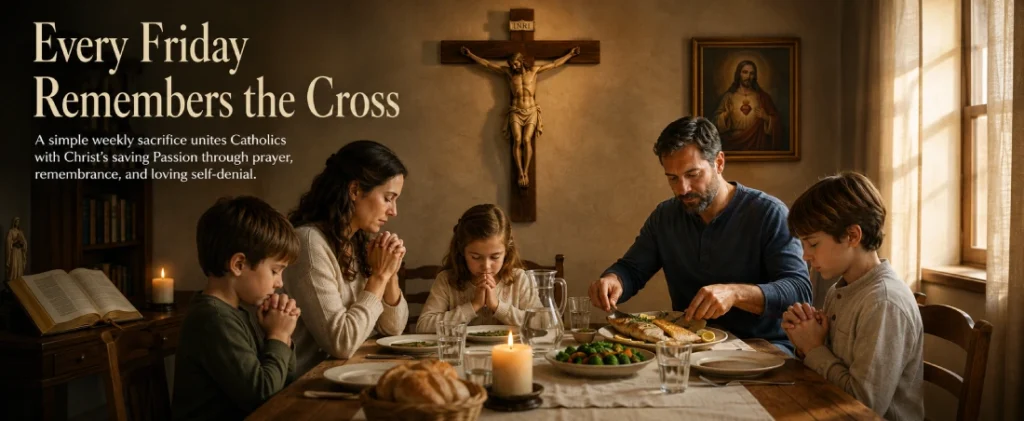
Catholics abstain from meat on Fridays as a corporate act of penance to commemorate the Passion and Crucifixion of Jesus Christ, who gave His life on Good Friday. By sacrificing festive food, the faithful practice self-denial, discipline bodily desires, and unite their daily mortifications with the cross of Christ.
| Obligation Type | Who It Applies To | When It Applies | Permitted Substitutions (USA) |
| Mandatory Meat Abstinence | Catholics aged 14 and older | Ash Wednesday and all Fridays of Lent | None permitted (strictly binding) |
| Universal Friday Penance | All baptized Catholics | All Fridays throughout the entire year | Permitted outside Lent (acts of prayer, charity, or alternative fasting) |
The Biblical and Theological Foundations of Friday Penance
The Catholic Church designates every Friday of the year as a memorial of the Passion of Jesus Christ. Just as every Sunday is a “little Easter” celebrating the Resurrection, every Friday serves as a “little Good Friday” calling the faithful to personal mortification and remembrance of Calvary.
The Catechism of the Catholic Church explains:
“The interior penance of the Christian can be expressed in many and various ways. Scripture and the Fathers insist above all on three forms, fasting, prayer, and almsgiving, which express conversion in relation to oneself, to God, and to others.” (CCC 1434)
Sacrifice is an indispensable requirement of authentic Christian discipleship. Sacred Scripture reveals that bodily self-discipline sharpens the soul for spiritual battle. When the Apostles struggled to cast out an unclean spirit, Jesus instructed them:
“This kind can come out by nothing, but by prayer and fasting.” (Mark 9:28, Douay-Rheims; cf. Matthew 17:20)
St. Paul emphasized the necessity of subduing physical appetites to attain spiritual mastery, writing, “I pommel my body and subdue it, lest after preaching to others I myself should be disqualified” (1 Cor 9:27).
Catholic mortification is not dualistic hatred of the body. As St. Thomas Aquinas teaches in the Summa Theologiae (II-II, q. 147), fasting is practiced for three primary reasons: to bridle the lusts of the flesh, to raise the mind freely to contemplate sublime realities, and to satisfy for sins.
Ancient Apostolic Roots: Fasting Through Church History
Abstaining from food on Fridays is not a medieval invention; it originated in the earliest decades of Christianity. The Didache (The Teaching of the Twelve Apostles), composed in the first century, commanded:
“Let not your fasts be with the hypocrites, for they fast on Mondays and Thursdays, but you shall fast on Wednesdays and Fridays.” (Didache, Ch. 8)
Wednesday fasting recalled the betrayal of Jesus by Judas Iscariot, while Friday fasting honored Christ’s Crucifixion. Over centuries, Latin Christianity formalized Friday abstinence from meat. Flesh meat (caro) from warm-blooded animals was historically viewed as a food of celebration, luxury, and physical stimulation. Forgoing meat served as an accessible, universal sign of sorrow and mourning.
The Catechism confirms the ongoing validity of this corporate witness:
“The seasons and days of penance in the course of the liturgical year (Lent, and each Friday in memory of the death of the Lord) are intense moments of the Church’s penitential practice.” (CCC 1438)
Canon Law: What the Church Formally Requires
The universal law governing Friday penance is set forth in the 1983 Code of Canon Law:
- Canon 1250: “The penitential days and times in the universal Church are every Friday of the whole year and the season of Lent.”
- Canon 1251: “Abstinence from meat, or from some other food as determined by the Episcopal Conference, is to be observed on all Fridays, unless a solemnity should fall on a Friday.”
- Canon 1252: “The law of abstinence binds those who have completed their fourteenth year.”
Canon Law Exceptions and Solemnities
Abstinence is explicitly lifted whenever a liturgical Solemnity falls on a Friday (such as the Solemnity of the Annunciation, the Sacred Heart, or the Nativity of the Lord). In Catholic liturgy, a Solemnity represents the highest rank of feast day, demanding celebration rather than penance.
The United States Norms: Understanding Friday Penance Outside Lent
Many Catholics labor under the misconception that the Second Vatican Council abolished Friday penance outside of Lent. This is incorrect.
In 1966, Pope St. Paul VI issued the Apostolic Constitution Paenitemini, which reaffirmed the divine precept of penance while allowing national bishops’ conferences to adapt specific observances to local cultures.
In response, the National Conference of Catholic Bishops (now the USCCB) issued their Pastoral Statement on Penance and Abstinence:
- Lenten Fridays: Abstinence from meat remains strictly mandatory for all Catholics aged 14 and older on Ash Wednesday and all Fridays of Lent.
- Fridays Throughout the Year: The bishops removed the binding obligation under pain of sin specifically regarding meat abstinence, permitting the faithful to substitute an alternative penance.
- The Precept of Penance Remains: The bishops explicitly maintained the expectation that all Fridays remain days of penance. Catholics who eat meat on non-Lenten Fridays are expected to substitute an alternate act of mortification, prayer, or charity.
The USCCB strongly encourages the faithful to retain traditional meat abstinence as a visible sign of shared Catholic identity and devotion to the Cross.
Meaningful Substitutes for Friday Penance Outside Lent
If you choose to consume meat on a Friday outside of Lent, you are called to intentionally perform an alternative act of penance.
- Works of Prayer: Praying the Rosary, reading Sacred Scripture, praying the Stations of the Cross, or spending thirty minutes in Eucharistic Adoration.
- Acts of Self-Denial: Fasting from desserts, coffee, alcohol, social media, or other forms of digital entertainment.
- Works of Mercy & Almsgiving: Donating to a local food pantry, volunteering at a homeless shelter, visiting the sick or elderly, or financially supporting pregnancy resource centers.
Uniting Friday Penance with Christian Charity
True Christian penance must transform how we love our neighbor. The Prophet Isaiah delivered God’s indictment against empty ritualism:
“Is not this the fast that I choose: to loose the bonds of wickedness, to undo the thongs of the yoke, to let the oppressed go free, and to break every yoke? Is it not to share your bread with the hungry, and bring the homeless poor into your house?” (Isaiah 58:6–7)
When Catholics forgo meat on Fridays, the money saved should ideally be directed toward almsgiving. Abstaining from meat is an embodied reminder that millions around the world experience involuntary hunger every day.
Prayers for Friday Abstinence
An Act of Offering on Friday
Lord Jesus Christ, I offer You this small sacrifice of Friday abstinence in honor of Your holy Cross and Passion. Grant me the grace to master my physical desires and to surrender my will to Your divine law. May this penance make reparation for my sins and draw souls to Your merciful heart. Amen.
Prayer to the Mother of Sorrows
Most Holy Virgin Mary, you stood faithfully beneath the Cross on Calvary as your Son redeemed the world. Intercede for me, that I may never treat the sacrifice of Christ lightly. Help me embrace daily self-denial with joy and love. Amen.
Frequently Asked Questions
Church tradition distinguishes between the flesh of warm-blooded land animals and birds (which are forbidden on days of abstinence) and cold-blooded sea creatures. Fish has historically been simple, non-luxurious sustenance rather than festive fare, making it permissible during penitential seasons.
Eating meat on Ash Wednesday or the Fridays of Lent with full knowledge and deliberate consent is a grave matter (CCC 1857). Outside of Lent, Catholics in the U.S. may substitute another act of penance without committing a sin.
Under Canon 1252 of the Code of Canon Law, the obligation to abstain from meat begins at age fourteen and continues throughout life. Unlike the law of fasting (which ends at age fifty-nine), there is no upper age limit for meat abstinence, though illness excuses anyone from the discipline.
Yes. For the purposes of Catholic abstinence, “meat” includes the flesh of all mammals and fowl (such as beef, pork, chicken, turkey, and duck). Only cold-blooded creatures such as fish, shellfish, reptiles, and amphibians are permitted.
Continue Your Faith Journey

Carlo Acutis, Patron Saint of the Internet: Catholic Guide to Digital Holiness
Discover the inspiring life of Carlo Acutis, the patron saint of the internet. Learn how this tech-savvy saint combined Eucharistic devotion with…
Why Do Catholics Have Statues? Church Teaching, Scripture, and Sacred Art
Do Catholics worship statues? Explore the biblical foundation, Church councils, and theological distinctions between latria and dulia that explain why sacred images…
Purgatory: Catholic Teaching, Scripture, and Tradition Explained
Explore the authentic Catholic teaching on purgatory through Sacred Scripture, Church Fathers, and the Catechism. Learn the theological basis for purification and…