
Why Do Catholics Have Statues? Church Teaching, Scripture, and Sacred Art
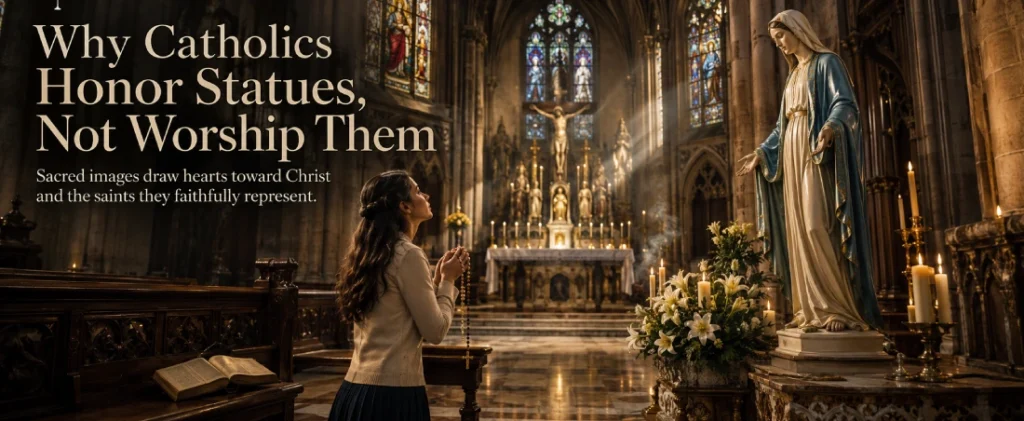
Catholics do not worship statues. In Catholic theology, sacred statues and icons are holy visual reminders of Jesus Christ, the Blessed Virgin Mary, and the saints. Catholic prayer is never directed to plaster, wood, or stone, but to the heavenly prototype whom the image portrays (Catechism of the Catholic Church 2132).
For centuries, visitors entering a Catholic parish have observed statues of Christ, the Virgin Mary holding the Infant Jesus, and various saints flanked by flickering vigil candles. Non-Catholic Christians frequently ask whether these sacred images violate the biblical prohibition against graven images found in the Ten Commandments.
The Catholic Church’s use of statues is rooted in Sacred Scripture, confirmed by the ancient ecumenical councils, and centered upon the theological reality of the Incarnation—the historical truth that the invisible God took on a visible human body in Jesus Christ.
1. Worship (Latria) vs. Veneration (Dulia and Hyperdulia)
To understand Catholic sacred art, one must understand the precise theological terms defined by the Church Fathers and Doctors. The Catholic Church draws an absolute distinction between the adoration due to the Creator and the honor given to His holy servants.
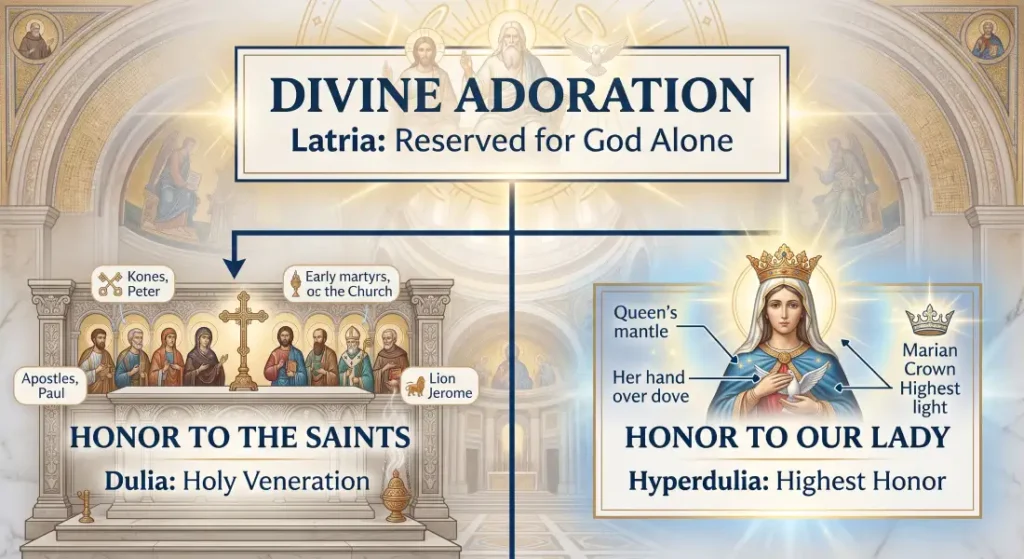
The Three Levels of Honor in Catholic Theology
- Latria (Adoration / Supreme Worship): This is the unreserved worship, adoration, and praise owed exclusively to the Almighty Triune God—Father, Son, and Holy Spirit. To offer latria to any creature, statue, or created object is the mortal sin of idolatry (CCC 2112–2114).
- Dulia (Veneration): This is the honor and reverence paid to the holy angels and human saints who have run the race before us and now dwell in heavenly glory. When Catholics venerate a saint through a statue, they honor God’s grace manifested in a human life and ask for that saint’s intercessory prayers (CCC 2132, 2141).
- Hyperdulia (Special Veneration): As St. Thomas Aquinas explains in the Summa Theologiae (III, q. 25, a. 5), the Blessed Virgin Mary, because of her unique divine maternity as the Theotokos (Mother of God), receives the highest created honor, distinct from and superior to dulia, yet infinitely beneath the latria due to God alone.
Quick Reference: Catholic Distinctions on Honor and Worship
| Theological Term | Meaning | Recipient | Magisterial / Scriptural Reference |
| Latria | Adoration / Supreme Worship | The Holy Trinity alone | Exodus 20:3–5; CCC 2096–2097 |
| Hyperdulia | Highest Created Honor | The Blessed Virgin Mary | Luke 1:48; Summa Theol. III, q. 25, a. 5 |
| Dulia | Veneration / Reverence | The Holy Angels and Saints | CCC 2132, 2141; Revelation 8:3–4 |
| Iconoclasm | The Heretical Destruction of Images | Heretical position | Second Council of Nicaea (787 AD) |
2. Does the Bible Forbid All Religious Statues?
A common misunderstanding arises from Exodus 20:4–5, where God commands: “You shall not make for yourself a graven image, or any likeness of anything that is in heaven above, or that is in the earth beneath… you shall not bow down to them or serve them.”
If this command were an absolute prohibition against sculpting or carving any material shape, God would have contradicted Himself later in the Old Testament. What Exodus 20 forbids is the creation of idols—carvings designed to be worshipped as gods in place of the Lord.
When images are used to point the human soul to heavenly realities, God not only permits them; He explicitly commands their construction.
God Commands Sacred Statues for the Tabernacle
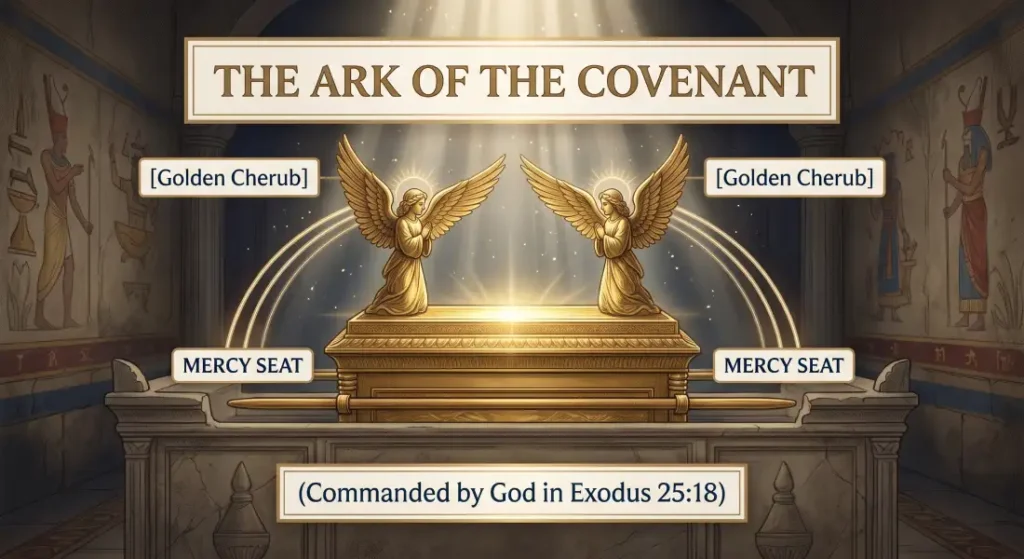
In the very book where the Ten Commandments are revealed, the Lord commands Moses to sculpt religious images for the innermost sanctuary of Israel’s worship:
“And you shall make two cherubim of gold; of hammered work shall you make them, on the two ends of the mercy seat. Make one cherub on the one end, and one cherub on the other end; of one piece with the mercy seat shall you make the cherubim on its two ends.”
— Exodus 25:18–19 (RSV-CE)
These golden angels were placed directly atop the Ark of the Covenant, the holiest place on earth. The high priest entered this sanctuary and bowed before the Ark. The statues were not idols to be worshipped; they were sacred signs reminding Israel that the invisible God dwells amid His heavenly host.
Religious Art in Solomon’s Temple
When King Solomon built the Temple in Jerusalem under divine inspiration, he filled the sanctuary with carved statues, reliefs, and representations of living creatures:
“In the inner sanctuary he made two cherubim of olivewood, each ten cubits high… He carved all the walls of the house round about with carved figures of cherubim and palm trees and open flowers, in the inner and outer rooms.”
— 1 Kings 6:23, 29 (RSV-CE)
Solomon also constructed a massive bronze basin supported by twelve sculpted oxen (1 Kings 7:25). God consecrated this Temple with His visible glory (1 Kings 8:10–11), confirming that three-dimensional religious artwork used in true worship does not violate His commandments.
3. The Second Council of Nicaea and the Theology of the Incarnation
In the eighth century, a heresy known as Iconoclasm (“image-breaking”) arose in the Eastern Church. Influenced by imperial decrees and misunderstandings of Old Testament law, iconoclasts destroyed sacred images, whitewashed church frescoes, and persecuted monks who defended Christian art.
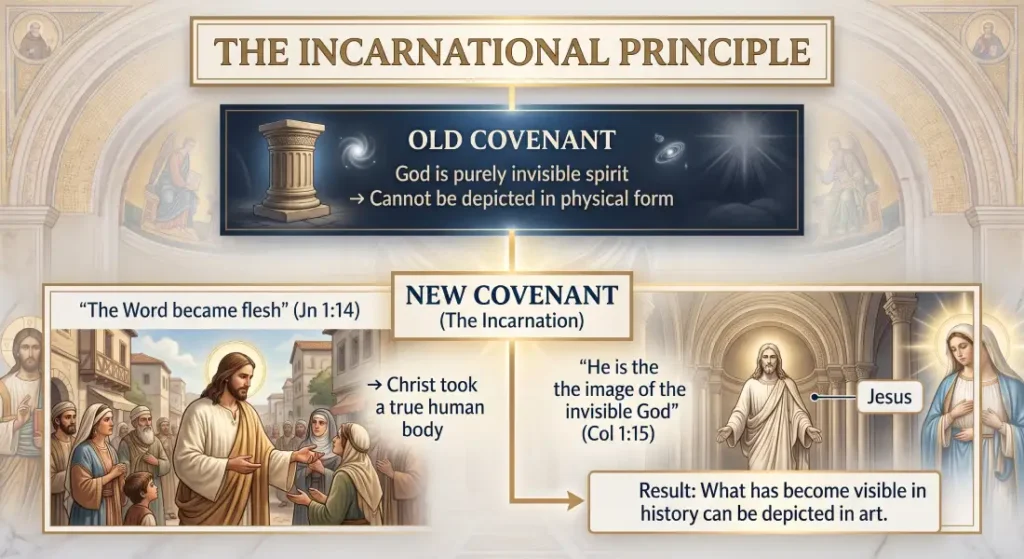
The Church settled this controversy definitively at the Second Council of Nicaea (787 AD), the Seventh Ecumenical Council. The Council Fathers proclaimed that Christian iconography is directly tied to the central dogma of the Christian faith: the Incarnation of Jesus Christ.
As Doctor of the Church St. John of Damascus argued during the crisis:
“I do not worship matter, I worship the Creator of matter, who became matter for my sake and deigned to inhabit matter, who through matter effected my salvation.”
— Apologia Against Those Who Decry Holy Images
Because Jesus Christ took on authentic human flesh, matter has been sanctified. The invisible God made Himself visible in history (Colossians 1:15). To reject all images of Christ is to subtly deny that He possessed a real, visible, and tangible human body (cf. 1 John 4:2–3).
The Principle of the Prototype
The Second Council of Nicaea adopted the famous patristic maxim articulated by St. Basil the Great: “The honor rendered to an image passes to its prototype” (De Spiritu Sancto, 18.45).
The Catechism summarizes this conciliar dogma:
“The Christian veneration of images is not contrary to the first commandment which proscribes idols. Indeed, ‘the honor rendered to an image passes to its prototype,’ and ‘whoever venerates an image venerates the person portrayed in it.’ The honor paid to sacred images is a ‘respectful veneration,’ not the adoration due to God alone.”
— Catechism of the Catholic Church, no. 2132
When a Catholic kneels before a crucifix, the act of reverence is not directed at the wood, metal, or paint. The heart moves past the physical medium to adore the Savior who died upon the Cross.
4. Why Statues Matter for Christian Life and Prayer
Sacred images are not mere architectural ornaments. The Council of Trent (1563, Session 25) reiterated that the images of Christ, the Virgin Mother of God, and the saints are to be retained in churches because of the profound benefits they confer upon believers:
- Sacred Memory and the Communion of Saints: Statues remind us that we are members of a living Church. As Hebrews 12:1 affirms, we are “surrounded by so great a cloud of witnesses.” Just as a person keeps a photograph of a deceased spouse or parent on their desk out of love and remembrance, Catholics display images of the saints who remain alive in Christ and intercede for the Church on earth.
- Catechesis for the Senses: Historically termed the “Bible of the illiterate,” sacred statues and stained-glass windows teach the mysteries of salvation history visually. Catholic sacramental theology recognizes that human beings are composite creatures of body and soul. God communicates invisible grace through visible, tangible signs: water in Baptism, oil in Confirmation, and bread and wine in the Holy Eucharist. Sacred art engages the bodily senses to elevate the mind toward eternal truths.
- Consolation in Suffering: A believer enduring deep grief finds solidarity kneeling near an image of Our Lady of Sorrows. A soul battling temptation looks to a statue of the Sacred Heart and is visually anchored in the infinite mercy of Christ.
5. Practical Reverence in the Catholic Home
The Church encourages the faithful to integrate sacred art into daily family life, establishing the home as an authentic “domestic church” (CCC 1666).
- Establish a Home Prayer Corner: Dedicate a quiet table or shelf in your living space with a crucifix, a statue of Our Lady, and the Holy Scriptures. This physical space acts as a visual anchor that calls the family back to daily prayer.
- Avoid the Two Extremes: Catholic teaching avoids both iconoclasm (rejecting sacred art as evil) and superstition (treating an image as a magical talisman with power inherent to the material). Treat statues with dignity and respect, recognizing them as sacred signs that point our gaze toward Christ.
- Teach the Faith to Children: Use statues to teach children about the virtues of the saints. Explain that lighting a candle before an image of St. Anthony or St. Thérèse is an outward sign of a prayer rising to heaven, asking a holy friend to intercede before the throne of God.
Closing Prayers for Sacred Art
Prayer to Christ, the Divine Image
Lord Jesus Christ, You are the image of the invisible God. Through Your holy Incarnation, You sanctified the material world and made Yourself visible to human eyes. Grant that whenever we gaze upon Your holy images, our hearts may be drawn to adore You in Spirit and in Truth, and that we may follow faithfully in the footsteps of Your saints. Amen.
Intercession of the Queen of Heaven
Holy Mary, Mother of God and Queen of Heaven, you stood faithful at the foot of the Cross. Look with maternal care upon all who seek your prayers. As we honor your image in our homes and parishes, point our hearts ever toward your Divine Son, saying to us as you did at Cana: “Do whatever He tells you.” Amen.
Frequently Asked Questions
No. Catholics do not worship statues. Catholic doctrine strictly forbids giving adoration (latria) to any physical object or creature. Statues serve as visual reminders of Jesus Christ and the saints, directing prayer to the heavenly person portrayed, not the material plaster or wood (CCC 2132).
Bowing or lighting candles before a statue is an external sign of reverence (dulia) directed toward the saint represented, not the physical statue itself. As the Second Council of Nicaea defined in 787 AD, all honor shown to an image passes directly to its heavenly prototype.
Exodus 20:4 forbids carving idols intended to be worshipped as false gods. It does not forbid all religious art. In Exodus 25:18–22, God explicitly commanded Moses to sculpt two golden cherubim for the Ark of the Covenant, demonstrating that sacred images are permissible in true worship.
An idol is an object worshipped as a god or believed to possess divine power in its physical substance. A Catholic statue possesses no inherent power; it is purely a holy reminder that points the Christian’s mind and heart toward God and His saints (CCC 2112, 2132).
Continue Your Faith Journey
Purgatory: Catholic Teaching, Scripture, and Tradition Explained
Explore the authentic Catholic teaching on purgatory through Sacred Scripture, Church Fathers, and the Catechism. Learn the theological basis for purification and…
Why Do Catholics Abstain From Meat on Fridays?
Discover why Catholics abstain from meat on Fridays through Canon Law, Sacred Scripture, and apostolic tradition. Learn the rules for Lent and…
Carlo Acutis, Patron Saint of the Internet: Catholic Guide to Digital Holiness
Discover the inspiring life of Carlo Acutis, the patron saint of the internet. Learn how this tech-savvy saint combined Eucharistic devotion with…