
Bangladesh’s Sex-Selective Abortion Ban: Legal Victory and Catholic Theological Analysis
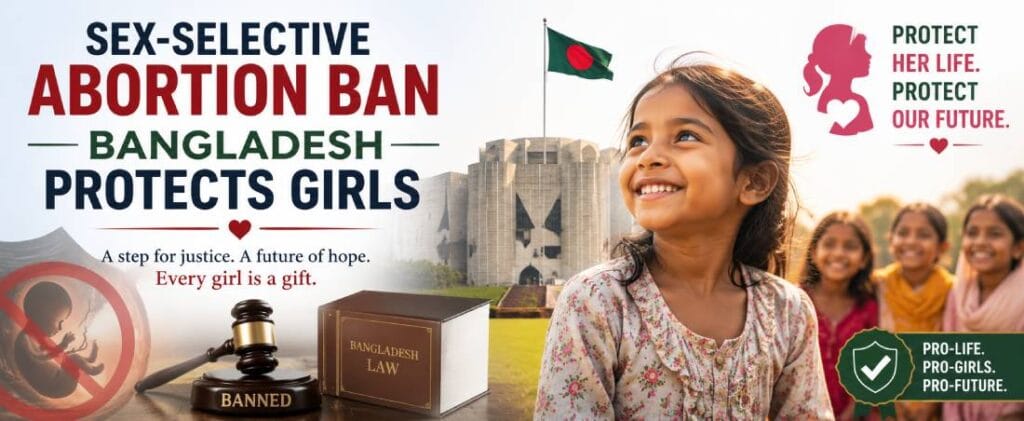
The Legal Ruling: Halting Prenatal Sex Determination
Bangladesh’s High Court issued a landmark ruling prohibiting healthcare providers from revealing a fetus’s sex during routine prenatal care. The court designated gender disclosure as an “immoral activity” when used to facilitate sex-selective abortion, citing its destructive impact on social balance and female dignity.
This decision targets an entrenched human rights crisis across South Asia. Demographers estimate that over 100 million females are missing globally due to gender-targeted prenatal termination and post-natal neglect. Neighboring nations such as India, China, and Pakistan have enacted similar restrictions with varying degrees of enforcement.
By imposing strict legal penalties on medical practitioners who disclose fetal sex, Bangladesh takes a legislative stance against gender discrimination in the womb. While Western nations like the United States struggle to enact uniform federal protections against sex-selective abortion, this predominantly Muslim nation has established a crucial legal boundary. The policy establishes that medical technology must serve healthcare rather than facilitate gender-based elimination.
Catholic Moral Theology on Fetal Sex Selection
The Catholic Church teaches that human life must be respected and protected absolutely from the moment of conception (Catechism of the Catholic Church, 2270). From the first moment of existence, the rights of the person must be recognized, chief among which is the inviolable right of every innocent human being to life (CCC 2270). Direct abortion, willed either as an end or a means, is gravely contrary to the moral law and constitutes an intrinsic evil (intrinsece malum) that no circumstance can justify (CCC 2271; Pope John Paul II, Evangelium Vitae, 57).
Sex-selective abortion adds a secondary gravity to an already intrinsically evil act. It combines the direct killing of an innocent human being with systemic gender discrimination. Moral theology emphasizes that no intention—whether societal preference, financial hardship, or cultural pressure—can alter the objective gravity of destroying innocent human life. Pope St. John Paul II affirmed in Evangelium Vitae (57) that “no circumstance, no purpose, no law whatsoever can ever make licit an act which is intrinsically illicit, since it is contrary to the Law of God.”
St. Thomas Aquinas explains in the Summa Theologiae (II-II, q. 64, a. 6) that taking the life of an innocent person is intrinsically evil because life is a gift from God over which human beings possess stewardship, not absolute dominion. When parents or medical personnel terminate an unborn child due to her gender, they attempt to exercise an arbitrary veto power over divine creation. The state’s duty, therefore, is not to create the right to life, but to recognize and enforce the natural law that already safeguards it.
Comparative Analysis: Legal Restrictions vs. Catholic Magisterium
To understand how secular legal measures intersect with divine and natural law, we must compare the legal principles of the Bangladesh High Court ruling with the moral doctrine of the Catholic Church.
| Dimension | Bangladesh High Court Ruling | Roman Catholic Magisterium |
| Primary Scope | Bans clinical ultrasound sex disclosure during pregnancy. | Condemns all direct abortion as intrinsically evil (CCC 2271). |
| Core Argument | Prevents gender discrimination and restores social balance. | Upholds the inviolable dignity of every human person from conception (EV 57). |
| Targeted Entity | Healthcare providers and medical technicians. | Mothers, fathers, medical personnel, and societal accomplices (CCC 2272). |
| Legal / Moral Status | Classified as an unlawful “immoral activity”. | Gravest violation of natural law, divine law, and the Fifth Commandment. |
| Anthropological Basis | Equal value of male and female children in society. | Sacred dignity of male and female created in God’s image (Genesis 1:27). |
St. Thomas Aquinas notes that human law is valid only in so far as it accords with right reason and natural law (Summa Theologiae, I-II, q. 95, a. 2). When human law forbids an evil act—such as sex determination intended for prenatal murder—it aligns with divine wisdom. However, while human legislation like Bangladesh’s ban focuses on maintaining social order and preventing female deficit, Catholic doctrine addresses the spiritual reality: every single human soul is created directly by God and possesses an eternal destiny.
Sacred Scripture and Divine Intent in the Womb
Sacred Scripture consistently affirms the divine craftsmanship and personal identity of the unborn child. Genesis 1:27 proclaims: “So God created man in his own image, in the image of God he created him; male and female he created them” (RSV-CE). Gender is not an arbitrary biological accident, but an essential aspect of human identity designed by the Creator. To target a fetus for termination because she is female is a direct rebellion against God’s created order.
The Book of Psalms reveals the intimate relationship between God and the developing child: “For thou didst form my inward parts, thou didst knit me together in my mother’s womb. I praise thee, for thou art fearful and wonderful” (Psalm 139:13-14, RSV-CE). Divine Providence active in the womb leaves no room for human selection based on gender bias. Every child is intentionally fashioned by God, receiving a unique identity, natural dignity, and immortal soul at conception.
Furthermore, the Old Testament Prophets and Wisdom Literature command active protection for the defenseless. Proverbs 31:8-9 commands the faithful: “Open your mouth for the dumb, for the rights of all who are left desolate. Open your mouth, judge righteously, maintain the rights of the poor and needy” (RSV-CE). The unborn, particularly female fetuses targeted for elimination, represent the most destitute and voiceless members of the human family. Defending them is a fundamental requirement of biblical justice, as Prophet Amos declared: “Let justice roll down like waters, and righteousness like an ever-flowing stream” (Amos 5:24, RSV-CE).
Authentic Catholic Feminism vs. Secular Contradictions
The reality of sex-selective abortion exposes a profound ideological contradiction within secular feminism and Western abortion advocacy. Secular movements frequently champion female empowerment while simultaneously defending an absolute right to abortion. This posture creates a paradoxical outcome: the legal right to abortion is utilized globally to eliminate tens of millions of unborn women before they are born. True protection for women cannot coexist with a legal framework that permits their destruction in the womb.
In response to this modern crisis, Catholic social teaching offers what Pope St. John Paul II termed the “new feminism” (Evangelium Vitae, 99). This authentic Catholic framework rejects the false premise that female equality requires the power to end unborn human life. Instead, the “new feminism” calls upon women and society to transform culture by affirming the innate dignity of motherhood, womanhood, and prenatal life.
As John Paul II wrote in Evangelium Vitae (99): “In transforming culture so that it supports life, women occupy a place, perhaps a primary place, in thought and action. Theirs is the task of specifying a ‘new feminism’ which rejects the temptation of imitating models of ‘domination’ in order to affirm a true love for others.” Sex-selective abortion represents the ultimate model of domination—the strong eliminating the weak based on utilitarian preference. Authentic Catholic feminism insists that female dignity begins at conception, protecting every girl at her most vulnerable stage.
Civic Duty, Intercession, and the Church Militant
Defending the unborn against sex-selective abortion requires a concerted response from the Christian faithful (christifideles). Members of the Church Militant are called to participate in both spiritual intercession and concrete public action. Prayer and penance must be paired with legislative support for policies that restrict abortion and protect expectant mothers from social pressure.
Catholic healthcare institutions, crisis pregnancy centers, and charitable organizations play a vital role in dismantling the economic and cultural pressures that lead to female feticide. In cultures where sons are preferred due to dowry systems or eldercare obligations, the Church must witness to the equal value of daughters through financial support, education, and moral leadership.
Ultimately, Bangladesh’s legal restriction on prenatal sex determination demonstrates that governments can act to curb the culture of death. While civil law alone cannot convert human hearts, sound legislation serves a vital pedagogical purpose by forming public conscience and restraining evil. The faithful must continue to intercede for all nations, working tirelessly until every civil authority recognizes the sacred value of human life from conception unto natural death.
Frequently Asked Questions
The Catholic Church holds that all direct abortion is intrinsically evil (CCC 2271). Sex-selective abortion compounds this gravity by adding unjust gender discrimination. Catholic moral theology teaches that every human person possesses inviolable dignity from the moment of conception, regardless of sex (Evangelium Vitae, 57).
Bangladesh’s High Court banned healthcare providers from disclosing fetal sex to stop sex-selective abortions targeting female babies. The court declared gender disclosure for termination an “immoral activity” that damages social balance and fuels systemic prejudice against women.
Pope St. John Paul II’s “new feminism” (Evangelium Vitae, 99) rejects models of domination and affirms the inherent dignity of womanhood from conception. It opposes sex-selective abortion by insisting that female rights and protection must begin in the womb, where unborn girls are most vulnerable.
Key passages include Genesis 1:27 (equal creation as male and female), Psalm 139:13-14 (God knitting life in the womb), and Proverbs 31:8-9 (commanding believers to speak for the voiceless). These scriptures confirm God’s intentional design and protection for every unborn child.
Source: LifeSiteNews
Continue Your Faith Journey
Why Do Catholics Abstain From Meat on Fridays?
Discover why Catholics abstain from meat on Fridays through Canon Law, Sacred Scripture, and apostolic tradition. Learn the rules for Lent and…
Carlo Acutis, Patron Saint of the Internet: Catholic Guide to Digital Holiness
Discover the inspiring life of Carlo Acutis, the patron saint of the internet. Learn how this tech-savvy saint combined Eucharistic devotion with…
Why Do Catholics Have Statues? Church Teaching, Scripture, and Sacred Art
Do Catholics worship statues? Explore the biblical foundation, Church councils, and theological distinctions between latria and dulia that explain why sacred images…