Choosing the best Catholic Bible depends on your study goals, spiritual maturity, and reading preference: beginner-friendly translations like the Revised Standard Version Second Catholic Edition (RSV-2CE) and the New American Bible Revised Edition (NABRE) offer optimal clarity and liturgical accuracy, while venerable translations like the Douay-Rheims provide rich traditional majesty for scholarly and contemplative prayer.
Scouring bookstores or browsing online often leaves believers overwhelmed by dozens of options—many lacking the full 73-book canon or carrying subtle secular biases. Selecting an ecclesiastical approved Catholic translation ensures you are reading the full canon inspired by God and safeguarded by the Magisterium.
The Spiritual Need: Why Your Bible Translation Matters for Salvation
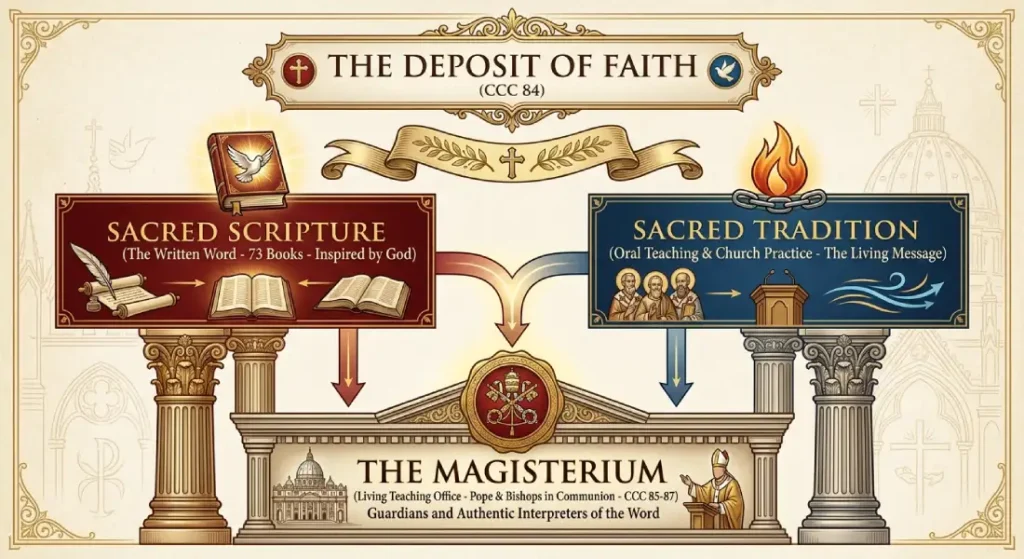
Sacred Scripture, as the written Word of God inspired by the Holy Spirit, is not a dead letter or a mere ancient historical record; it is living, active, and essential for the Christian life (Hebrews 4:12; cf. CCC 108). While the Christian faith is not a “religion of the book” but of the Word of God—Jesus Christ, the Incarnate Logos—the Scriptures faithfully communicate His truth without error.
“To ignore Scripture is to ignore Christ.”
— St. Jerome, Commentary on Isaiah (cited in CCC 133)
The Catholic Church teaches that God is the author of Sacred Scripture, inspiring its human authors to write without error those truths necessary for our salvation (CCC 105–107). To live an authentic life of Catholic discipleship and perform the Will of the Father (Matthew 7:21), we must nourish our souls on God’s Word within the living heart of the Church.
Biblical & Magisterial Foundation: The Catholic Canon
A complete Catholic Bible contains 73 books—46 in the Old Testament and 27 in the New Testament. Protestant Bibles contain only 66 books, having removed seven Old Testament books during the Reformation:
- Tobit
- Judith
- 1 Maccabees
- 2 Maccabees
- Wisdom
- Sirach (Ecclesiasticus)
- Baruch (including the Letter of Jeremiah)
- Portions of Esther and Daniel
These seven books are known as the Deuterocanonical (“second canon”) books. They belonged to the Greek Septuagint used by Christ and the Apostles, and were solemnly affirmed by the Councils of Rome (382 AD), Hippo (393 AD), Carthage (397 AD), Florence (1442 AD), and definitively at the Council of Trent (1546 AD).
The Catechism highlights three essential criteria for interpreting Scripture according to the Spirit (CCC 111–114):
- Be attentive to the content and unity of the whole Scripture.
- Read Scripture within the living Tradition of the whole Church.
- Be attentive to the analogy of faith (the harmony of dogmatic truths).
Quick-Match Guide: Which Bible Should You Buy?
| Reader Profile | Primary Goal | Recommended Bible |
| Beginner / RCIA Candidate | Easy reading, understanding salvation history | Great Adventure Bible or NABRE |
| Apologist / Theology Student | Doctrinal precision, strict word-for-word accuracy | Ignatius Bible (RSV-2CE) or Ignatius Study Bible |
| Traditional Latin Mass Goer | Reverent language, contemplative prayer (Lectio Divina) | Douay-Rheims (Challoner Revision) |
Detailed Reviews: The 7 Best Catholic Bibles
Every Catholic Bible falls into one of two translation styles: Formal Equivalence (literal, word-for-word accuracy ideal for study) or Dynamic Equivalence (thought-for-thought readability ideal for continuous devotional reading).
1. The Ignatius Bible (RSV-2CE) – Best Overall for Study & General Use
The Revised Standard Version Second Catholic Edition (RSV-2CE) is widely regarded by Catholic scholars, catechists, and apologists as the gold standard for English Catholic Bibles. It removed archaic English (“thee” and “thou”) while preserving exact formal equivalence and traditional liturgical phrasing.
- Translation Style: Formal Equivalence (Word-for-Word).
- Key Strengths: Translates parthenos in Isaiah 7:14 as “virgin” and kecharitomene in Luke 1:28 as “full of grace.” Free from modern gender-neutral rewrites that obscure messianic prophecies.
- Best For: Theological study, daily reading, and parish adult faith formation.
2. New American Bible Revised Edition (NABRE) – Best for Liturgy & Beginners
The NABRE is the official translation sponsored by the United States Conference of Catholic Bishops (USCCB). The readings proclaimed at Holy Mass in the United States are derived directly from the NAB tradition.
- Translation Style: Formal/Dynamic Hybrid.
- Key Strengths: Contains extensive historical notes and book introductions at the bottom of almost every page. Highly accessible prose matching US parish liturgy.
- Critical Consideration: Certain historical-critical footnotes in the Old Testament prioritize modern redactor theories over traditional patristic typology and spiritual senses (cf. CCC 115–117).
3. Douay-Rheims Bible (Challoner) – Best Traditional & Contemplative
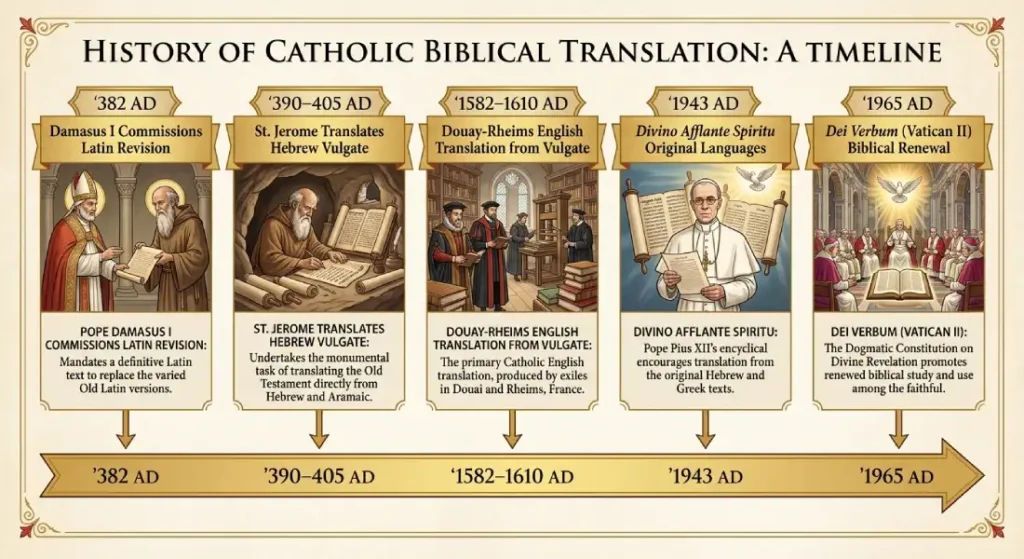
First translated from the Latin Vulgate by English scholars exiled in France (New Testament 1582, Old Testament 1609), the Douay-Rheims served as the standard English Catholic Bible for centuries. Bishop Richard Challoner modernized the text in 1750 into the edition used today.
- Translation Style: Strict Formal Equivalence (from St. Jerome’s Latin Vulgate).
- Key Strengths: Direct translation of the Church’s official Latin text. Majestic, sacred language elevates the mind during prayer and Lectio Divina.
- Best For: Traditional Latin Mass attendees, lovers of classic sacred literature, and deep contemplative prayer.
4. The Great Adventure Catholic Bible (RSV-2CE) – Best for Narrative & Layout
Designed around Jeff Cavins’ Bible Timeline learning system, this edition wraps the RSV-2CE text in a color-coded framework organizing the 73 books into 12 distinct historical periods.
- Translation Style: Formal Equivalence (RSV-2CE).
- Key Strengths: Clearly distinguishes the 14 narrative books driving salvation history from supplementary wisdom and prophetic books. Includes visual charts, timelines, and maps embedded in the text.
- Best For: Participants in Bible-in-a-Year reading plans and visual learners.
5. Ignatius Catholic Study Bible: New Testament – Best for In-Depth Exegesis
Edited by Dr. Scott Hahn and Curtis Mitch, this study Bible provides comprehensive commentary drawing directly upon the Church Fathers, the Catechism, Papal encyclicals, and sound linguistic scholarship.
- Translation Style: Formal Equivalence (RSV-2CE).
- Key Strengths: Features extensive patristic commentary, Greek and Hebrew word studies, and doctrinal indexes cross-referenced directly with CCC paragraphs.
- Best For: Catechists, seminarians, apologists, and advanced scholars.
6. The Jerusalem Bible (JB) – Best Literary & Dynamic Translation
Originally produced in French by the École Biblique in Jerusalem, the Jerusalem Bible (1966) was translated into English using vibrant, poetic prose. Famed author J.R.R. Tolkien served as a major contributor and translator for the Book of Jonah.
- Translation Style: Dynamic Equivalence (Thought-for-Thought).
- Key Strengths: Outstanding literary flow and poetic rhythm, making Hebrew poetry and narrative prose come alive.
- Best For: Personal devotional reading and literary appreciation.
7. CTS New Catholic Bible – Best Portable Liturgical Bible (UK/Commonwealth)
Published by the Catholic Truth Society in London, this edition combines the Jerusalem Bible text with the official Grail Psalms used in the Liturgy of the Hours.
- Translation Style: Dynamic / Formal Hybrid.
- Key Strengths: Replaces “Yahweh” with “the LORD” in accordance with Vatican directives (Liturgiam Authenticam). Compact, highly durable binding built for travel.
- Best For: Daily prayer, travel, and faithful outside North America.
Practical Application: The Daily Catholic “Battle Plan”
To move from passive reading to transformative prayer, use this classic 4-step Lectio Divina routine every morning:
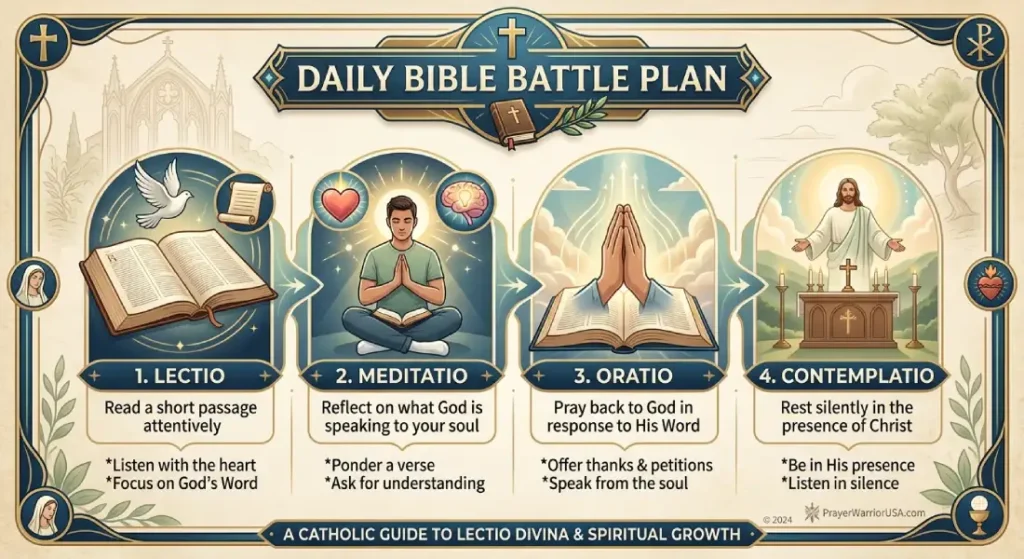
- Lectio (Read): Read a short passage (e.g., the daily Mass Gospel) slowly 2–3 times.
- Meditatio (Meditate): Ponder a specific word or phrase that touches your heart. Ask: What is God saying to me right now?
- Oratio (Pray): Speak candidly to God in response to the text, asking for graces to overcome temptation and grow in virtue.
- Contemplatio (Contemplate): Rest in silent adoration before the Lord, letting His peace transform your soul.
Recommended Spiritual Resources
To complement your daily Scripture reading, consider these faithful tools:
- Archival Bible Highlighters: Gel-based highlighters that mark key verses without bleeding through thin Bible paper.
- Catechism of the Catholic Church (Ascension Edition): The ultimate reference companion to cross-check biblical passages with official Catholic dogma.
- Paracord Rosary: A durable prayer tool to mediate on the mysteries of Christ alongside your daily Bible study.
Frequently Asked Questions
The readings proclaimed at Mass are taken from the official Lectionary for Mass. Lectionaries adapt approved translations (like the NABRE in the US or Jerusalem Bible in the UK) with minor liturgical adjustments, such as replacing pronoun references with explicit names (e.g., replacing “He said” with “Jesus said to His disciples”) for public audio clarity.
Nihil Obstat (Latin for “nothing hinders”) indicates that a Catholic censor audited the work and found no doctrinal or moral errors. Imprimatur (Latin for “let it be printed”) is the official authorization granted by a Catholic Bishop permitting the Bible or spiritual book to be published for the faithful (CCC 825).
Yes. The RSV-2CE updated archaic English phrasing (“thee” and “thou”) while correcting several controversial translation choices. It restored traditional messianic terminology—such as translating parthenos as “virgin” in Isaiah 7:14—and fully aligns with Vatican liturgical translation guidelines (Liturgiam Authenticam).
Catholics may consult Protestant Bibles for comparative scholarly study, but should rely on ecclesiastical approved Catholic translations for personal prayer and study. Protestant Bibles omit seven complete books of the Old Testament (the Deuterocanon) and can contain translation choices that obscure Catholic doctrines regarding grace, the sacraments, and the Blessed Virgin Mary.
Continue Your Faith Journey
What Is Eucharistic Adoration? A Catholic Guide to the Real Presence
Discover the rich Catholic tradition of Eucharistic adoration and the Real Presence of Christ. Learn how to make a transformative Holy Hour…
Feeling Like God Is Punishing You? A Catholic Guide to Suffering, Grace and Hope
If you are going through a trial and feeling like God is punishing you, Catholic theology offers hope, clarity, and peace. Discover…
Catholic Prayer for Toxic Family Conflict: A Faithful Guide to Boundaries, Healing, and Charity
Navigating family conflict, estrangement, and narcissistic behavior requires balancing Christian charity with prudent boundaries. Discover how Catholic doctrine, Sacred Scripture, and daily…