
What Is Eucharistic Adoration? A Catholic Guide to the Real Presence
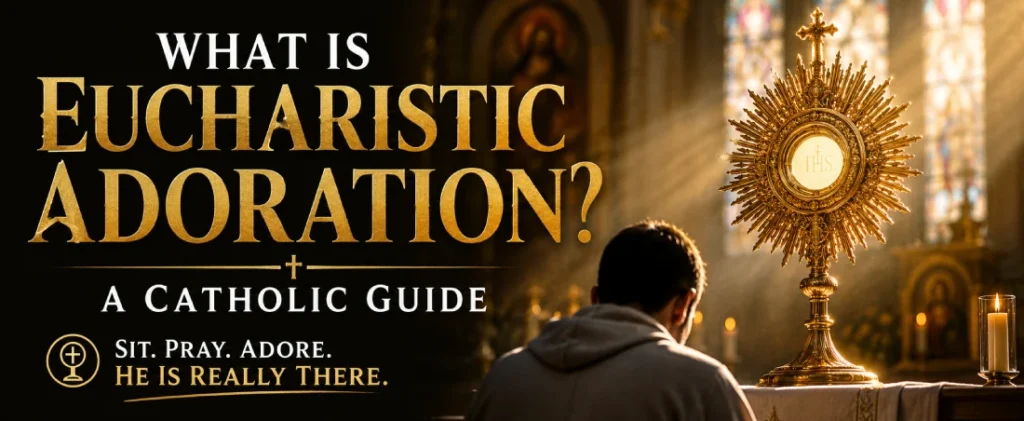
Eucharistic adoration is the Catholic practice of worshiping Jesus Christ who is truly, physically, and substantially present under the appearance of the consecrated bread. Kneeling before the Blessed Sacrament exposed in a monstrance or reserved in the tabernacle, the faithful offer Christ the worship of adoration (latria)—the supreme reverence due to God alone.
This devotion is not a symbolic ritual or an optional historical add-on. It flows directly from the Eucharistic sacrifice of the Holy Mass, extending the graces of the altar into the daily lives of believers.
The Dogmatic Foundation: Real Presence, Not a Symbol
At the Last Supper, Christ declared: “This is my body which is given for you” (Luke 22:19). The Catholic Church takes Jesus at His word. Through the power of the Holy Spirit and the words of consecration spoken by a validly ordained priest, transubstantiation occurs: the entire substance of the bread and wine becomes the Body, Blood, Soul, and Divinity of Jesus Christ, while only the outward physical properties (the “accidents” or species) remain.
The Lord emphasized this permanence in the Gospel of John:
“I am the living bread which came down from heaven; if any one eats of this bread, he will live for ever; and the bread which I shall give for the life of the world is my flesh.” (John 6:51, RSV-CE)
Because Jesus remains truly present as long as the Eucharistic species subsist, our adoration of the Blessed Sacrament is an encounter with the living God. As St. Thomas Aquinas observed (Summa Theologiae III, q. 75, a. 1), Christ’s true presence cannot be detected by the physical senses, but only through supernatural faith.
What the Catechism Teaches About Eucharistic Adoration
The Catechism of the Catholic Church clearly defines both the liturgical and devotional life surrounding the Blessed Sacrament:
- Worship of the Eucharist (CCC 1378): “In the liturgy of the Mass we express our faith in the real presence of Christ under the species of bread and wine by, among other ways, genuflecting or bowing deeply as a sign of adoration of the Lord.” Paragraph 1378 continues, citing Pope Paul VI’s encyclical Mysterium Fidei: “The Catholic Church has always offered and still offers to the sacrament of the Eucharist the cult of adoration, not only during Mass, but also outside of it, reserving the consecrated hosts with the utmost care, exposing them to the solemn veneration of the faithful, and carrying them in procession.”
- The Tabernacle as a Place of Prayer (CCC 1379): The reservation of the consecrated hosts originally ensured Holy Communion could be brought to the sick and absent outside of Mass. As the Church deepened her understanding of Christ’s silent presence, the tabernacle became a sanctuary for private adoration and silent prayer.
- The Necessity of Adoration (CCC 1380): “The Church and the world have a great need for Eucharistic worship. Jesus awaits us in this sacrament of love. Let us not refuse the time to go to meet him in adoration, in contemplation full of faith, and open to making amends for the serious offenses and crimes of the world. May our adoration never cease.”
The Biblical Roots of Adoration
The worship of God’s dwelling place is woven throughout Sacred Scripture:
The Old Testament Tabernacle
In the desert, God commanded Moses to build the Tabernacle so that His Divine Presence (Shekinah) could dwell in the midst of His people (Exodus 25:8). Whenever the pillar of cloud descended on the tent, the Israelites stood and worshiped, each at his tent door (Exodus 33:10).
The Incarnation and Perpetual Dwelling
In the New Testament, St. John writes: “And the Word became flesh and dwelt among us” (John 1:14). The Greek word for “dwelt” (eskēnōsen) literally translates to “pitched His tent” or “tabernacled.”
Christ did not abandon His people after the Ascension. In the Blessed Sacrament, Emmanuel—”God with us”—remains accessible to every believer who seeks His face.
Papal Teachings on the Power of Eucharistic Adoration
The popes of the modern era have continually summoned the faithful back to the foot of the altar.
In his 2003 encyclical Ecclesia de Eucharistia, Pope St. John Paul II wrote movingly of his personal experience with the Blessed Sacrament:
“It is pleasant to spend time with him, to lie close to his breast like the Beloved Disciple (cf. Jn 13:25) and to feel the boundless love present in his heart… How can we not feel a fresh need to spend time in spiritual converse, in silent adoration, in heartfelt love before Christ present in the Most Holy Sacrament? How often, dear brother and sisters, have I experienced this, and drawn from it strength, consolation and support!” (Ecclesia de Eucharistia, n. 25)
Pope Benedict XVI reaffirmed that adoration is not an alternative to the Mass, but its intrinsic completion: “Receiving the Eucharist means adoring Him whom we receive… Only in adoration can a profound and genuine reception mature.” (Sacramentum Caritatis, n. 66).
Practical Etiquette: How to Spend an Hour with the Blessed Sacrament
Entering a chapel for Eucharistic adoration can feel intimidating for beginners. Following traditional Catholic customs helps foster interior stillness and exterior reverence.
Step-by-Step Guide to Adoration Etiquette
| Stage / Action | Catholic Practice | Spiritual Meaning |
| Entering the Chapel | Genuflect toward the monstrance or tabernacle | An act of bodily homage (latria) recognizing Christ as King. |
| Beginning the Holy Hour | Make the Sign of the Cross and offer an opening prayer of praise | Entering consciously into the divine presence and silencing the senses. |
| During the Hour | Read Scripture, pray the Holy Rosary, or rest in contemplative silence | Engaging in discursive and affective prayer to align your will with God. |
| Overcoming Distractions | Gently redirect attention to the Host using a simple aspiration (e.g., “Jesus, I trust in You”) | Practicing spiritual recollection and patient humility before God. |
| Departing | Genuflect reverently before stepping out of the pew | Giving thanks for the graces received and preparing to live the Gospel. |
What to Do During a Holy Hour: Four Proven Ways to Pray
If you are unsure how to spend 30 or 60 minutes in silence, structure your time using authentic Catholic devotional traditions:
1. The A.C.T.S. Method of Mental Prayer
- Adoration: Praise God for His infinite majesty, goodness, and mercy.
- Contrition: Humbly acknowledge your sins, asking for pardon and the grace of conversion.
- Thanksgiving: Express genuine gratitude for specific blessings, trials, and unseen gifts.
- Supplication: Present your daily petitions, praying for your family, the Church, and the souls in Purgatory.
2. Praying the Scriptures (Lectio Divina)
Bring your Bible and slowly read the Gospels. Follow the classic four-step rhythm: read (lectio), meditate (meditatio), pray (oratio), and rest in contemplation (contemplatio).
3. The Holy Rosary or Chaplet of Divine Mercy
Lifting your beads in the presence of the Blessed Sacrament allows Our Lady to lead you directly to the Heart of her Son.
4. Silent Contemplation
As St. John Vianney recounted of a simple peasant praying before the tabernacle in Ars: “I look at Him and He looks at me.” Simple, silent gaze upon the Lord is often the most profound form of adoration.
Transforming Daily Life Through Eucharistic Adoration
Adoration is not an escape from reality; it is where our daily reality is sanctified. When you bring your family concerns, career decisions, anxieties, and fatigue before Christ, He replaces exhaustion with His peace (Matthew 11:28).
As you schedule your week, commit to spending regular time before the Blessed Sacrament. Whether it is a full Holy Hour or a brief fifteen-minute visit on your lunch break, time spent before the Real Presence will anchor your interior life and draw you into the mystery of Christ’s redeeming love.
Frequently Asked Questions
Holy Mass is the sacramental re-presentation of Christ’s sacrifice on Calvary, where the faithful actively participate in the liturgy and receive Holy Communion. Eucharistic adoration extends the graces of the Mass through prolonged, silent prayer before the reserved or exposed Blessed Sacrament.
During adoration, Catholics engage in silent prayer, read Sacred Scripture (Lectio Divina), pray the Rosary or the Divine Mercy Chaplet, read spiritual works by the Saints, or simply sit in silent contemplation before the Real Presence of Jesus Christ.
Yes, non-Catholics are welcome to visit the chapel, sit quietly, and pray during Eucharistic adoration. While receiving Holy Communion at Mass is reserved for Catholics in a state of grace, all people may participate in silent prayer before the Blessed Sacrament.
Exposition refers to placing the consecrated Host inside a monstrance for public veneration. Benediction is the formal liturgical rite concluding exposition, in which the priest blesses the congregation by making the Sign of the Cross over them with the monstrance.
Continue Your Faith Journey
The 7 Best Catholic Bibles for Beginners and Scholars: The Ultimate Guide to Faithful Scripture Study
Discover the best Catholic Bibles for beginners and scholars. Compare top translations like the RSV-2CE, NABRE, and Douay-Rheims to deepen your daily…
Catholic Prayer for Toxic Family Conflict: A Faithful Guide to Boundaries, Healing, and Charity
Navigating family conflict, estrangement, and narcissistic behavior requires balancing Christian charity with prudent boundaries. Discover how Catholic doctrine, Sacred Scripture, and daily…
What Is a Novena? The Biblical Meaning and How to Pray It
Discover the biblical origins of the Catholic nine-day prayer tradition and learn how to pray a novena effectively. Transform your prayer routine…