
When a sudden crisis shatters your life—whether an unexpected job loss, a devastating medical diagnosis, or the painful end of a relationship—a piercing question often haunts the soul: “Is God punishing me?” In moments of grief and confusion, it is remarkably easy to view the Almighty through a lens of fear, assuming every trial is a targeted blow from a vengeful Deity.
If you feel crushed under the weight of hardship, know this immediately: God has not abandoned you, nor is He targeting you with vindictive wrath. While Catholic theology acknowledges that God permits trials through His sovereign permissive will, He never causes moral evil or takes pleasure in your suffering (CCC 311). In the life of a baptized Christian living in a state of grace, hardship is not a sign of divine rejection, but an invitation to medicinal purification, fatherly discipline, and co-redemptive union with Jesus Christ on the Cross (CCC 1472, 1521).
Quick Reference: Discerning the Source of Your Trial
To process suffering fruitfully, you must discern what you are experiencing. The Catholic Church distinguishes between three distinct dimensions of earthly trial:
| Spiritual Category | Primary Source / Origin | Spiritual Purpose & Fruit | Immediate Catholic Action |
| Fatherly Discipline (Poena Medicinalis) | God’s Permissive Will (Hebrews 12:6) | Detachment from sin, growth in humility & virtue | Examination of Conscience, Sacramental Confession |
| Spiritual Warfare | Demonic Temptation / Oppression (1 Peter 5:8) | Isolation, despair, loss of faith & peace | St. Michael Prayer, Use of Sacramentals, Mass |
| Physical / Natural Evil | Fallen Creation & Human Frailty (CCC 400) | Patient endurance, co-redemptive merit | Redemptive Suffering (“Offering it up”), Anointing of the Sick |
The Theological Truth: Punishment vs. Fatherly Discipline
To find peace in times of suffering, you must understand how Catholic doctrine views pain. God is the absolute sovereign Ruler of the universe (Vatican Council I). Yet, Church Fathers and Doctors consistently distinguish between God’s active will—what He directly causes—and His permissive will (Providentia Dei). Through His permissive will, God allows physical evil in a fallen world to bring about a greater spiritual good (CCC 312; St. Thomas Aquinas, Summa Theologiae I, q. 19, a. 9).
Catholic dogma makes a vital distinction between retributive punishment (poena vindicativa) and remedial chastisement (poena medicinalis):
- Retributive punishment pertains to divine justice and eternal condemnation due to unforgiven mortal sin. Jesus Christ satisfied the demands of infinite divine justice through His death on Calvary. For the believer restored to grace through Sacramental Reconciliation, eternal punishment is entirely remitted.
- Remedial chastisement is the loving correction of a Father aiming to detach us from earthly idols and heal our spiritual wounds.
As the Epistle to the Hebrews reminds us:
“For the Lord disciplines him whom he loves, and chastises every son whom he receives.” — Hebrews 12:6 (RSV-2CE)
The Council of Trent (Session XIV, cap. 8) affirms that temporal satisfaction attached to forgiven sin is not an act of vindictive wrath, but medicinal penance intended to restore spiritual health.
In his Apostolic Letter Salvifici Doloris, Saint John Paul II explained that human suffering is not merely a mechanical penalty for specific personal sins. Jesus forcefully rejected this rigid retribution model in John 9:1–3 when asked if a man’s blindness was caused by his own sin or his parents’. Christ revealed that suffering often exists so “that the works of God might be made manifest in him.”
Wisdom from the Church Fathers and Doctors
Throughout Church history, the Saints faced severe suffering without falling into despair or viewing God as a tyrant.
St. Augustine of Hippo: God Extracts Good from Evil
St. Augustine observed that God, in His ultimate goodness, would never permit evil to exist unless He were powerful enough to draw good out of evil (Enchiridion, cap. 11). Physical trials act as a crucible, separating the gold of true faith from the dross of worldly attachment.
St. John of the Cross: The Purifying Dark Night
St. John of the Cross taught that when God withdraws sensible comfort and permits feelings of spiritual dryness or emotional distress, He is not punishing the soul. Instead, God is purifying the soul’s spiritual faculties through the “Dark Night,” preparing it for higher mystical union.
St. Alphonsus Liguori: Alignment with the Divine Will
St. Alphonsus Liguori, in Uniformity with the Will of God, wrote that true holiness consists in conforming our human will entirely to the Divine Will. When we accept life’s crosses with trust, we recognize that God disposes all circumstances for our ultimate salvation (Romans 8:28).
The Spiritual Battle Plan: 4 Catholic Steps When Suffering Strikes
When feelings of abandonment or divine punishment threaten your peace, implement this four-step battle plan to anchor your heart in Catholic truth.
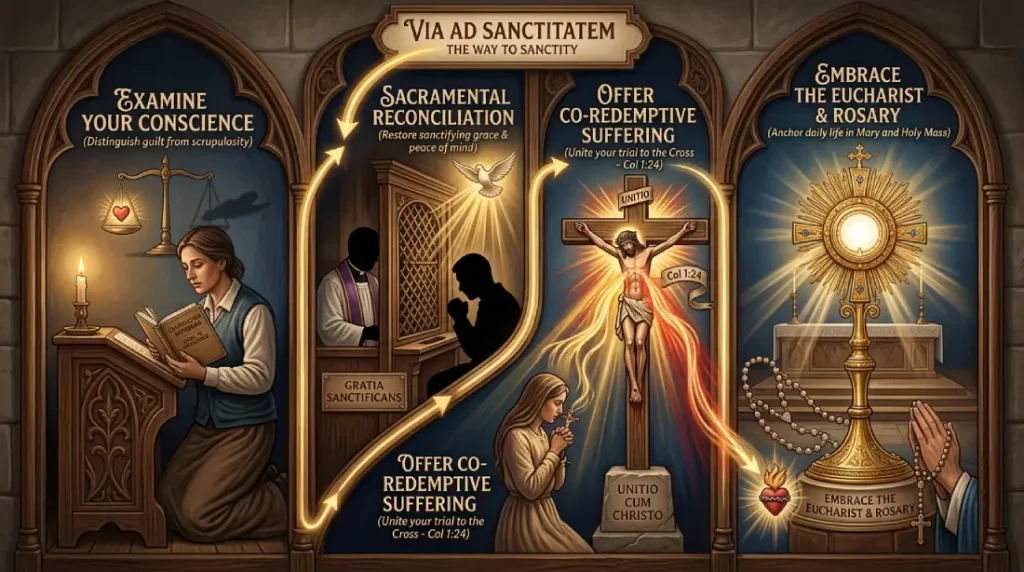
1. Examine Your Conscience Without Scrupulosity
Begin by assessing your soul through a structured examination of conscience. If unconfessed mortal sin exists, go to the Sacrament of Reconciliation immediately to restore sanctifying grace. However, if you are striving to live faithfully, reject scrupulous thoughts that attribute every life misfortune to a specific hidden fault.
2. Offer Up Your Suffering Co-Redemptively
Human suffering in itself has no power to save. Yet, when united to the infinite merit of Christ’s Passion in a state of grace, your pain becomes co-redemptive (CCC 618, 1521). As Saint Paul declares:
“I rejoice in my sufferings for your sake, and in my flesh I complete what is lacking in Christ’s afflictions for the sake of his body, that is, the church.” — Colossians 1:24
3. Anchor Your Mind in the Holy Sacrifice of the Mass
Bring your personal suffering directly to the altar during Holy Mass. When the priest offers bread and wine to the Father, mentally place your grief, diagnosis, or financial fear onto the paten. In doing so, your daily cross is elevated by grace and offered back to God as an agreeable sacrifice.
4. Surrender Control Through the Holy Rosary
Cling to the Blessed Virgin Mother, who stood faithfully at the foot of the Cross. Praying the Holy Rosary daily—especially the Sorrowful Mysteries—realigns your perspective with the Paschal Mystery, reminding you that Resurrection always follows Calvary.
Recommended Catholic Tools for the Journey
Equipping yourself with solid spiritual resources helps sustain faith during seasons of intense trial:
- The Ignatius Catholic Study Bible (RSV-2CE): Features extensive commentary from Church Fathers and modern scholars to help you interpret Scripture through an authentic Catholic lens.
- A Heavy-Duty Cord Rosary: A durable, combat-style rosary designed for daily spiritual warfare keeps you anchored to Our Lady during emotional turmoil.
- Trustful Surrender to Divine Providence (Book): This spiritual classic by Fr. Jean-Baptiste Saint-Jure and St. Claude de la Colombière offers profound comfort for anyone struggling to accept difficult life circumstances.
Frequently Asked Questions
No. For a Catholic in a state of grace, hardships are not vindictive punishments from God. While God permits physical evil through His permissive will, He uses trials as fatherly discipline (poena medicinalis) to purify our faith, detach us from sin, and draw us closer to Him (CCC 311–312).
Expressing honest grief, pain, or confusion to God in prayer—like the Psalms of Lament or Christ in Gethsemane—is not a sin. However, willfully nurturing bitterness, despair, or obstinate resentment against God’s divine will separates the soul from peace and grace.
A Catholic “offers up” suffering by consciously uniting personal pain to the Sacrifice of Christ on the Cross while in a state of sanctifying grace. Mention this intention during daily prayer or Holy Mass, converting your suffering into an act of co-redemptive intercession (Col 1:24, CCC 618).
Yes. Confession forgives eternal guilt, restores sanctifying grace, and grants sacramental grace to heal spiritual wounds. Receiving absolution assures the penitent of God’s mercy, dispelling scrupulous fears and replacing the terror of punishment with filial peace.
Continue Your Faith Journey

Are Intrusive Thoughts Mortal Sins in Catholic Teaching? Peace for the Anxious Soul
Struggling with sudden, uninvited blasphemous or impure thoughts? Discover what Catholic moral theology, the Catechism, and the saints teach about deliberate consent,…
Catholic Prayer for Toxic Family Conflict: A Faithful Guide to Boundaries, Healing, and Charity
Navigating family conflict, estrangement, and narcissistic behavior requires balancing Christian charity with prudent boundaries. Discover how Catholic doctrine, Sacred Scripture, and daily…
The 7 Best Catholic Bibles for Beginners and Scholars: The Ultimate Guide to Faithful Scripture Study
Discover the best Catholic Bibles for beginners and scholars. Compare top translations like the RSV-2CE, NABRE, and Douay-Rheims to deepen your daily…