
Are Intrusive Thoughts Mortal Sins in Catholic Teaching? Peace for the Anxious Soul
No, unwanted intrusive thoughts are not mortal sins in Catholic teaching. According to Catholic moral theology, a thought that enters your consciousness unbidden carries zero moral guilt because sin requires the deliberate consent of your free will. An intrusive thought is an involuntary temptation or psychological reflex, not an act of sin.
You have not severed your relationship with God. You have not committed an unforgivable offense, and Christ does not condemn you for thoughts that cause you acute pain and distress.
Quick Relief: The 3-Second Catholic Check
- Did you plan or intentionally summon the thought? No.
- Did the thought cause you distress, disgust, or fear? Yes.
- Do you wish the thought had never entered your mind? Yes.
Verdict: You did not give deliberate consent. There is no mortal sin. You remain in God’s grace.
1. Understanding Scrupulosity: Why You Feel False Guilt
Few interior trials are as exhausting as scrupulosity—often understood as the religious manifestation of Obsessive-Compulsive Disorder (Spiritual OCD). It leads a person to see sin where there is no sin, or grave sin where there is only an involuntary mental reflex.
When an offensive thought strikes—whether an insult directed at God, a graphic sexual image during prayer, or a violent impulse—the scrupulous conscience freezes in panic. You wonder: “How could I think that? Did I enjoy it for a split second? Did I consent?”
This panic stems from mistaking a mental event for a moral choice. The devil frequently exploits an earnest desire to please God, twisting it into self-absorbed anxiety.
Authentic Catholic discipleship is about obedience to the Father’s will (Matthew 7:21), not living in terror of unwanted cognitive noise. To restore interior peace, you must rely on the Church’s objective moral teaching rather than fluctuating emotions.
2. The Three Conditions for Mortal Sin (CCC 1857)
The Catholic Church does not leave the definition of mortal sin to subjective feelings or late-night panic.
According to the Catechism of the Catholic Church, all three of the following conditions must be present simultaneously for a sin to be mortal:
“Mortal sin is sin whose object is grave matter and which is also committed with full knowledge and deliberate consent.”
— CCC 1857
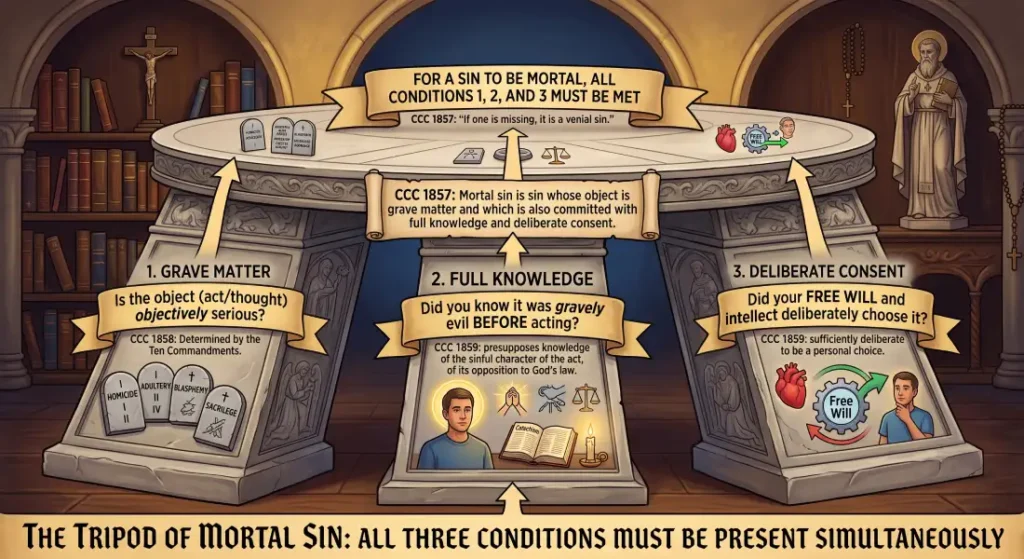
1. Grave Matter (CCC 1858)
Grave matter is specified by the Ten Commandments. Blasphemy, hatred, and unchaste desires do constitute serious matter. However, matter alone does not create a sin. An involuntary mental reflex contains no personal moral agency.
2. Full Knowledge (CCC 1859)
Mortal sin requires that you understand the sinful character of an act before performing it. Intrusive thoughts do not arrive because you planned them; they flash across your consciousness without invitation or premeditation.
3. Deliberate Consent (CCC 1859)
This requirement is where scrupulosity loses its power:
“It also implies a consent sufficiently deliberate to be a personal choice.”
— CCC 1859
The human brain constantly generates associations, memories, and sudden impulses. St. Thomas Aquinas distinguishes between the spontaneous first movements of the sensitive appetite (motus primo-primi) and deliberate acts of the rational will (Summa Theologiae, I-II, q. 74, a. 3).
These initial movements happen before reason can intervene. Because they do not originate from free choice, they carry no moral guilt.
Consent is not a feeling, an adrenaline spike, or a racing heartbeat. Consent is a clear, unimpeded decision of the will that says: “I recognize this is evil, and I choose to dwell on it anyway.”
If a thought repulses you, frightens you, or makes you pray for relief, you did not consent. Repulsion is the direct opposite of consent.
3. Biblical Foundation: Temptation Is Not Sin
Jesus Christ Himself experienced external temptation in the Judean desert (Matthew 4:1–11). The enemy presented images of pride, presumption, and idolatry directly to His mind:
“Again, the devil took him to a very high mountain, and showed him all the kingdoms of the world and their glory; and he said to him, ‘All these I will give you, if you will fall down and worship me.'”
— Matthew 4:8–9 (RSV-2CE)
Christ experienced the presentation of evil, yet He was entirely without sin. Experiencing a thought is simply temptation knocking at the door. Sin occurs only when the will opens the door and welcomes the thought inside.
The Apostle James outlines this progression with absolute clarity:
“Each person is tempted when he is lured and enticed by his own desire. Then desire when it has conceived gives birth to sin; and sin when it is full-grown brings forth death.”
— James 1:14–15 (RSV-2CE)
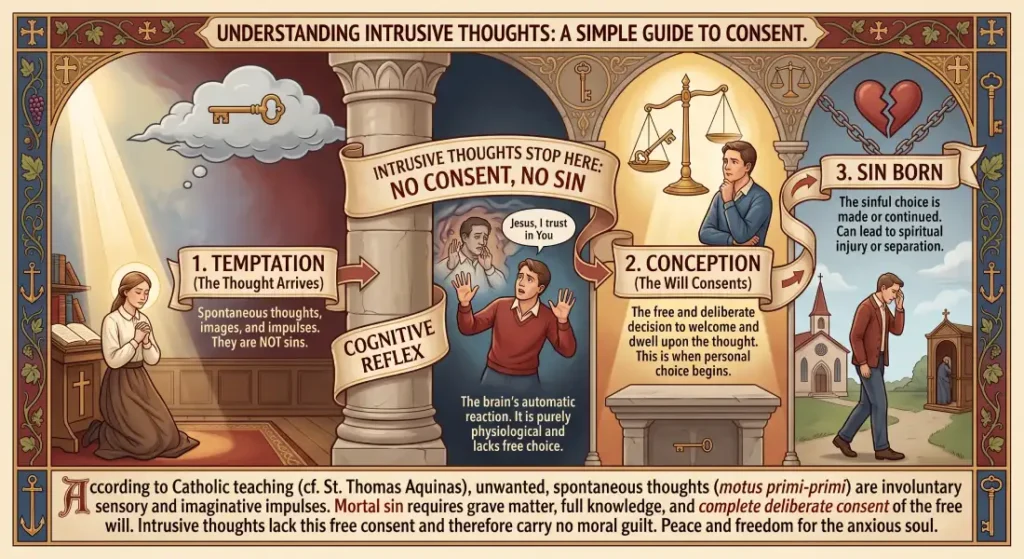
Intrusive thoughts stop at step one. Without the voluntary consent of the will, there is no conception, and therefore no sin.
4. Wisdom from the Saints and Doctors of the Church
Many of the greatest Catholic saints suffered through the agonizing trial of intrusive thoughts and scrupulosity.
St. Catherine of Siena: God’s Hidden Presence
St. Catherine of Siena endured prolonged spiritual assaults involving vile, blasphemous, and impure imagery. She spent days in profound misery, unable to force the thoughts away.
When the trial passed, our Lord appeared to her. She wept and asked: “Where were You, Lord, when my heart was filled with such foul thoughts?”
Christ replied:
“Catherine, I was in your heart. It was My grace that made those thoughts hateful to you. Had you taken pleasure in them, you would not have grieved.”
Your distress over these thoughts is tangible evidence of God’s sanctifying grace within you.
St. Francis de Sales: The Analogy of the Two Chambers
In his Introduction to the Devout Life (Part IV, Ch. 4), St. Francis de Sales compared the soul to a home with an upper and lower chamber. The lower faculties—the imagination, memory, and physical senses—can be thrown into disorder by unwanted thoughts.
However, as long as the upper room—the intellect and the free will—refuses to welcome the intruders, the soul remains entirely blameless before God.
St. Alphonsus Liguori: The Presumption of Grace
St. Alphonsus Liguori, Doctor of Moral Theology, laid down a universal rule for those burdened by scrupulosity:
“If you doubt whether you have consented to an evil thought, you must hold for certain that you have not consented.”
— St. Alphonsus Liguori, Moral Theology
Mortal sin is not an invisible trapdoor you fall into by accident. It requires a deliberate, intentional turning away from God. For someone striving to live a holy life, if consent is doubtful, it is certain that full consent was absent.
5. Practical Application: The 5-Point Spiritual Battle Plan
When intrusive thoughts surface, your natural reaction is to panic, analyze, or mentally argue. That approach feeds the anxiety loop. Follow this reliable battle plan instead:
1. Practice Passive Disregard
Never debate an intrusive thought. If you try to force yourself not to think of something, your mind will fixate on it. Treat the thought like background traffic outside your window. Acknowledge its presence without fear: “That is just an unwanted thought; I do not own it.” Then return your attention to your daily tasks.
2. Pray a Short, Peaceful Aspiration
Avoid long, frantic prayers to “cancel out” bad thoughts. Compulsive prayer rituals reinforce spiritual OCD. Instead, make a single, tranquil act of trust:
- “Sacred Heart of Jesus, I place my trust in You.”
- “Jesus, Mary, and Joseph.”
- “Lord, have mercy on me.”
3. Do Not Flee Holy Communion
Under Catholic moral theology and Canon Law (CIC Can. 916), only those who have moral certitude of unconfessed mortal sin must abstain from the Eucharist. Lingering doubt, panic, or intrusive mental imagery does not constitute consciousness of mortal sin.
St. Alphonsus teaches that unless you possess clear, unmistakable moral certainty of having given deliberate consent, you must presume you remain in the state of grace. Approach the Blessed Sacrament with confidence; the Eucharist is your medicine and strength (CCC 1394–1396; Council of Trent, Sess. XIII, Cap. 7).
4. Follow the “One Confessor” Rule
If you struggle with chronic scrupulosity:
- Choose one faithful, orthodox priest as your regular confessor.
- Obey his guidance on what constitutes sin for you.
- Do not re-confess past thoughts or seek second opinions when your anxiety spikes.
5. Recognize the Natural Realm (Gratia Supponit Naturam)
Grace builds upon nature. If intrusive thoughts are constant, debilitating, and accompanied by repetitive physical or mental checks, you may be experiencing clinical OCD or generalized anxiety.
Consulting a faithful Catholic mental health professional who utilizes evidence-based therapies like Exposure and Response Prevention (ERP) is sound Christian stewardship of your health (1 Corinthians 6:19).
Receive Your Free Prayer Guides
Choose the prayer guides you would like us to send you.
6. Recommended Resources for Peace of Mind
- The Didache Bible (RSV-2CE): Features line-by-line commentary keyed directly to the Catechism of the Catholic Church, preventing scrupulous misinterpretations of difficult scriptural passages.
- Combat Rosary / Rugged Paracord Rosary: A durable physical anchor for meditation on the Mysteries of Christ, moving your focus away from interior emotional panic.
- Understanding Scrupulosity (Fr. Thomas Santa, CSsR): A classic pastoral guide written specifically to untangle false guilt and spiritual anxiety through sound Catholic moral theology.
Rest Peacefully in God’s Care
Turn to the comforting words of Sacred Scripture:
“By this we shall know that we are of the truth, and reassure our hearts before him whenever our hearts condemn us; for God is greater than our hearts, and he knows all things.”
— 1 John 3:19–20 (RSV-2CE)
Your emotions can deceive you, and an exhausted mind can misfire. God looks upon your free will, not your neurological reflexes. He sees your desire to love Him, and He holds you secure in His peace.
Frequently Asked Questions
Physical reactions and bodily arousal are involuntary biological reflexes run by the nervous system. Unless your will intentionally welcomed and pursued that physical pleasure, bodily sensations carry no moral guilt.
Pausing when an intrusive thought appears is a standard response to shock and anxiety, not consent. Mortal sin requires deliberate, conscious choice (CCC 1859).
No. The Church defines blasphemy against the Holy Spirit (Matthew 12:31–32) as final impenitence—deliberately refusing God’s mercy until death (CCC 1864). An involuntary thought is not final impenitence.
No. Involuntary thoughts lack deliberate consent and are not sins. Confessing unbidden temptations reinforces scrupulosity and should be avoided unless your confessor advises otherwise.
Continue Your Faith Journey

The 7 Best Catholic Bibles for Beginners and Scholars: The Ultimate Guide to Faithful Scripture Study
Discover the best Catholic Bibles for beginners and scholars. Compare top translations like the RSV-2CE, NABRE, and Douay-Rheims to deepen your daily…

Catholic Prayer for Toxic Family Conflict: A Faithful Guide to Boundaries, Healing, and Charity
Navigating family conflict, estrangement, and narcissistic behavior requires balancing Christian charity with prudent boundaries. Discover how Catholic doctrine, Sacred Scripture, and daily…

How the Eucharist Transforms Us: What Pope Leo XIV and Vatican II Teach About Holy Communion
Discover how Pope Leo XIV and Vatican II explain the transforming power of the Holy Eucharist. Learn practical steps to prepare your…