
Why Do Catholics Confess Sins to a Priest Instead of Directly to God? Biblical Truth & Historical Roots
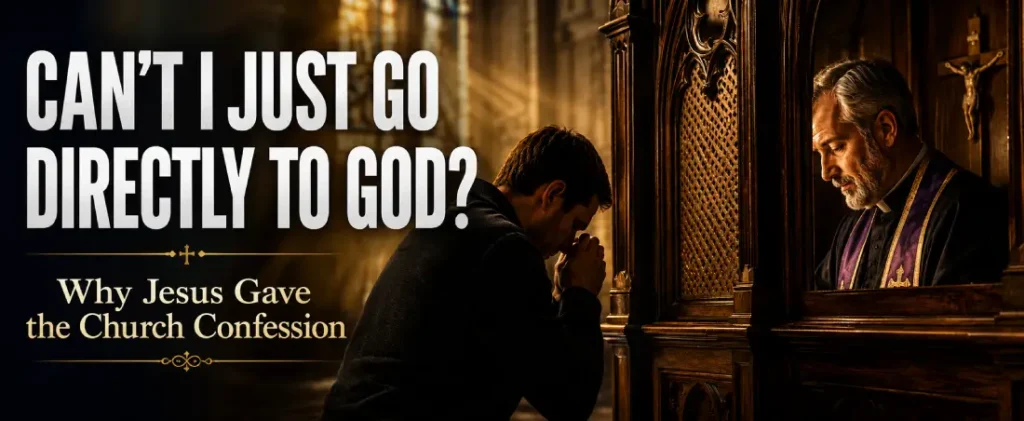
Why do Catholics confess sins to a priest instead of praying directly to God? The short answer is that Catholics do confess directly to God—but we do so through the visible ministry that Jesus Christ Himself established. When Jesus breathed on His Apostles and said, “If you forgive the sins of any, they are forgiven” (John 20:23), He gave human ministers authority to pronounce His divine mercy.
God certainly hears private prayers. However, Christ instituted the Sacrament of Reconciliation so that we could hear His authoritative voice of forgiveness spoken through an ordained priest.
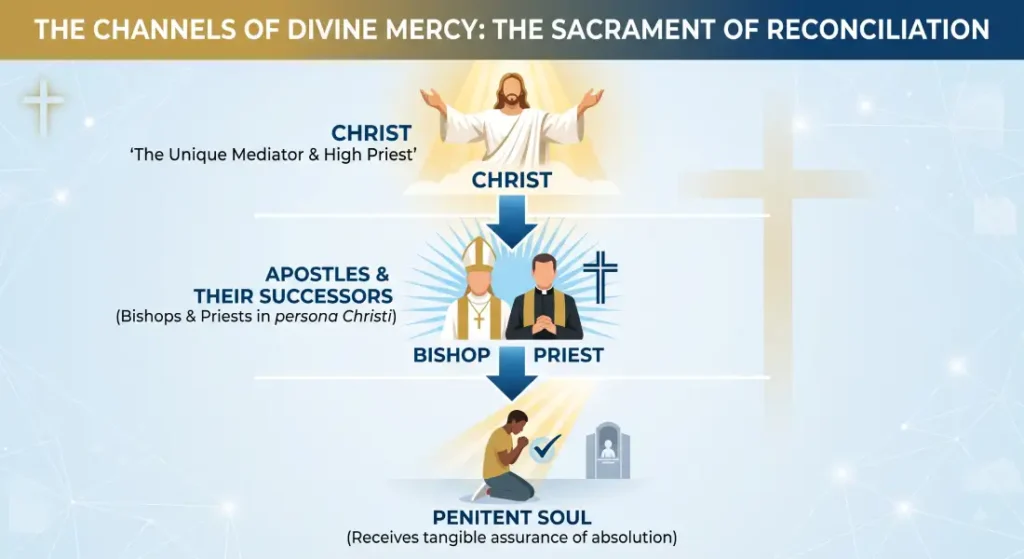
The Core Biblical Foundation: Did Jesus Give Men Authority to Forgive Sins?
Many Christians ask: “Can any man forgive sins except God alone?” (Mark 2:7). The Catholic Church wholeheartedly agrees that only God has the power to forgive sins. However, Sacred Scripture proves that God delegated this divine authority to human ministers.
1. The Easter Sunday Mandate (John 20:21–23)
“Jesus said to them again, ‘Peace be with you. As the Father has sent me, even so I send you.’ And when he had said this, he breathed on them, and said to them, ‘Receive the Holy Spirit. If you forgive the sins of any, they are forgiven; if you retain the sins of any, they are retained.'” — John 20:21–23, RSV-CE
This solemn moment on Easter evening is the cornerstone of the Sacrament of Reconciliation. Jesus did not simply command the Apostles to preach forgiveness; He conferred upon them the actual power to forgive or retain sins.
To exercise this power, the priest must hear the sins. A judge cannot pass judgment or grant clemency without hearing the facts of the case. Thus, vocal confession flows directly from Christ’s command.
2. The Ministry of Reconciliation (2 Corinthians 5:18–20)
“All this is from God, who through Christ reconciled us to himself and gave us the ministry of reconciliation… So we are ambassadors for Christ, God making his appeal through us.” — 2 Corinthians 5:18, 20, RSV-CE
St. Paul explains that God chose to exercise His reconciliation through human “ambassadors”. In the sacrament, the priest acts in persona Christi capitis (in the person of Christ the Head). As St. Thomas Aquinas taught, the priest serves as an instrumental cause of grace, while Christ remains the principal principal agent of forgiveness (Summa Theologiae III, q. 84, a. 3).
3. The Power of the Keys (Matthew 16:18–19; 18:18)
“I will give you the keys of the kingdom of heaven, and whatever you bind on earth shall be bound in heaven, and whatever you loose on earth shall be loosed in heaven.” — Matthew 16:19, RSV-CE
Christ granted the authority to bind and loose first to St. Peter, and subsequently to all the Apostles (Matthew 18:18). In Jewish Rabbinic tradition, “binding and loosing” signified authoritative judicial rulings. In Catholic theology, this includes the power to reconcile sinners with the Church and restore them to full communion with God.
Comparing Common Objections with Catholic Doctrine
| Common Protestant Objection | Scriptural & Catholic Reality | Theological Reference |
| “Only God can forgive sins.” | True. God alone forgives, but He acts through the priest as His delegated minister. | Mark 2:7; John 20:23 |
| “1 Timothy 2:5 says Jesus is the only mediator.” | True. Christ is the sole Mediator. Priests do not replace Him; they participate in His unique priesthood. | 2 Corinthians 5:18–20 |
| “Confession to priests is a medieval invention.” | False. The earliest Church Fathers documented sacramental confession as an apostolic mandate. | James 5:14–16; Didache |
| “Private prayer to God is enough for all sins.” | Private prayer forgives venial sin, but Christ instituted the sacrament for mortal sin. | 1 John 1:9; CCC 1456 |
The Biblical Witness of the Apostolic Church
Sacramental confession was not a late development; it was practiced by the earliest Christian communities under apostolic leadership.
Sacramental Anointing and Forgiveness (James 5:14–16)
“Is any among you sick? Let him call for the elders of the church, and let them pray over him, anointing him with oil in the name of the Lord; and the prayer of faith will save the sick man… and if he has committed sins, he will be forgiven.” — James 5:14–15, RSV-CE
Notice that James instructs the sick to call for the presbyters (priests) of the Church. The forgiveness of sins is tied directly to the sacramental ministry of these ordained elders.
While James 5:16 goes on to say “confess your sins to one another,” the Church has always distinguished mutual Christian accountability from the unique absolution granted by presbyters in verses 14–15 (CCC 1461).
The Shepherds of the Flock
- 1 Corinthians 4:1: “This is how one should regard us, as servants of Christ and stewards of the mysteries of God.”
- Hebrews 13:17: “Obey your leaders and submit to them; for they are keeping watch over your souls, as men who will have to give account.”
- Acts 20:28: “Take heed to yourselves and to all the flock, in which the Holy Spirit has made you overseers…”
Priests are spiritual fathers and stewards of God’s mysteries. Hearing confessions and applying the medicine of absolution is central to their duty of keeping watch over souls.
Why Human Confession Suits Human Nature
God instituted the Sacrament of Reconciliation knowing precisely how human psychology works.
1. Concrete Assurance of Forgiveness
When we confess silently in our minds, we are often left wondering: Am I really forgiven, or am I just convincing myself? In sacramental confession, we hear real, audible words spoken by Christ’s representative: “I absolve you from your sins in the name of the Father, and of the Son, and of the Holy Spirit.”
2. Healing for Soul and Psyche
Sin isolates us. Confession brings our hidden darkness into the light of Christ (1 John 1:7). Expressing our faults aloud fosters true humility and breaks the pride that keeps us trapped in habitual sin.
3. Reconciliation with the Whole Body
Every sin—even private sin—wounds the entire Church (CCC 1440). Because sin damages our relationship with the Mystical Body of Christ, reconciliation requires a visible, ecclesial act through the priest, who represents both God and the Church community.
“Individual, integral confession and absolution remain the only ordinary way for the faithful to reconcile themselves with God and the Church, unless physical or moral impossibility excuses from this kind of confession.” — Catechism of the Catholic Church, CCC 1484
Moving Beyond the Fear: How to Return to Confession
If you have been away from the Sacrament of Reconciliation for months or years, do not be afraid. The priest is bound by the Sacramental Seal—he can never reveal what you say under penalty of automatic excommunication.
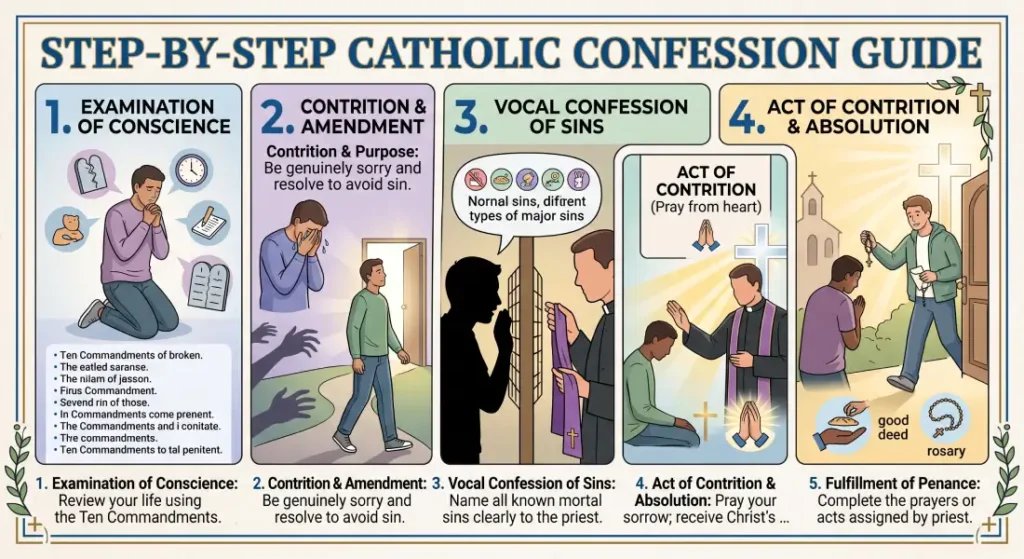
When you kneel in the confessional, you do not meet a fallible man; you meet the Good Shepherd who seeks the lost sheep (Luke 19:10). Step into the light of His mercy, and experience the peace that surpasses all understanding.
Frequently Asked Questions
No. Confessing venial sins is recommended for spiritual growth, but it is not strictly required (CCC 1458). Venial sins are forgiven through sincere prayer, fasting, acts of charity, and devout reception of the Holy Eucharist during Mass.
A priest who violates the Sacramental Seal incurs an automatic (latae sententiae) excommunication reserved strictly to the Holy See (Canon 1388). The secrecy of the confessional is absolute, inviolable, and permits no exceptions under any circumstances.
Yes. In John 20:21–23, the risen Jesus explicitly gave the Apostles authority to forgive or retain sins in His name. The Early Church continued this practice through ordained bishops and presbyters (priests) as stewards of God’s reconciliation (2 Corinthians 5:18).
A priest may withhold absolution only if a penitent lacks genuine contrition or refuses to make a firm purpose of amendment. If the penitent is truly sorry and willing to turn away from sin, the priest must impart Christ’s absolution.
Continue Your Faith Journey
Why Do Catholics Have Statues? Church Teaching, Scripture, and Sacred Art
Do Catholics worship statues? Explore the biblical foundation, Church councils, and theological distinctions between latria and dulia that explain why sacred images…
Purgatory: Catholic Teaching, Scripture, and Tradition Explained
Explore the authentic Catholic teaching on purgatory through Sacred Scripture, Church Fathers, and the Catechism. Learn the theological basis for purification and…
Why Does the Catholic Bible Have More Books Than the Protestant Bible?
Ever wonder why the Catholic Bible contains 73 books while Protestant Bibles have only 66? Discover the apostolic origins, historical councils, and…