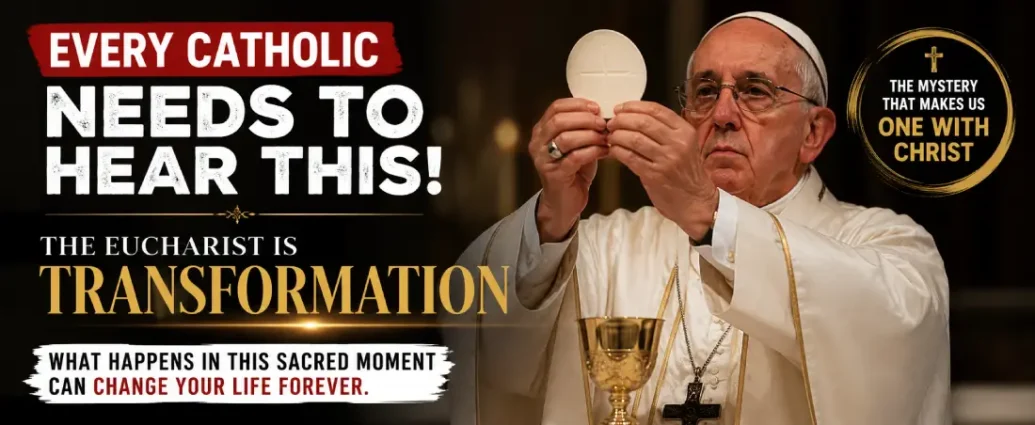
Pope Leo XIV spent his Wednesday General Audience reflecting on the Eucharist — and if you’re tempted to think, “Well, yes, we know the Eucharist is important,” you’ll want to stop right there. Because what the Holy Father unpacked from Sacrosanctum Concilium isn’t just that the Eucharist matters. It’s that the Eucharistic mystery transformation is the whole point of our faith. It’s how we adopt — as the Pope put it — “the very way of the Lord.”
That’s not abstract theology. It’s the difference between showing up for Mass out of obligation and walking out the church doors fundamentally different from who you were when you walked in. And right now, in this cultural moment when Catholics are being asked to give an account for what we actually believe, we need to understand what the Church has always taught: the Eucharist doesn’t just symbolize our union with Christ. It creates it.
What Sacrosanctum Concilium Teaches About Eucharistic Mystery Transformation
Vatican II’s Constitution on the Sacred Liturgy didn’t invent anything new about the Eucharist. It restated what the Church has always known: the liturgy is “the summit toward which the activity of the Church is directed” and “the fount from which all her power flows” (SC 10). Summit and source. Everything we do as Catholics flows from the Mass and points back to it.
This is why the Catechism calls the Eucharist “the source and summit of the Christian life” (CCC 1324). Not one source among many. *The* source. Because in the Eucharist, we receive the Body and Blood, Soul and Divinity of Jesus Christ — and that reception is supposed to change us. The Eucharistic mystery transformation isn’t about feeling warm and fuzzy during Communion. It’s about conforming our very selves to Christ, letting His life become our life.
The Sacred Liturgy Changes Everything About Who We Are and Transformation
Scripture doesn’t leave us guessing about what this transformation looks like. Saint Paul wrote to the Corinthians: “The cup of blessing which we bless, is it not a participation in the blood of Christ? The bread which we break, is it not a participation in the body of Christ? Because there is one bread, we who are many are one body, for we all partake of the one bread” (1 Corinthians 10:16-17, RSV-CE). Participation. Not observation, not commemoration — participation in Christ’s very life. When we receive the Eucharist, we’re united not just to Christ but to every other person who receives Him. That’s why Paul says we become one body. The Eucharist makes the Church.
What This Means for Catholics: Living the Eucharistic Mystery Transformation
And here’s the part that should shake us out of our routine: “Whoever, therefore, eats the bread or drinks the cup of the Lord in an unworthy manner will be guilty of profaning the body and blood of the Lord. Let a man examine himself, and so eat of the bread and drink of the cup” (1 Corinthians 11:27-28, RSV-CE). Paul isn’t being dramatic. He’s telling us that the Eucharist is so real, so powerful, that receiving it carelessly is a desecration. This is why the Church teaches that we must be in a state of grace — free from mortal sin — before approaching Communion (CCC 1385). The Eucharist transforms us, yes. But we have to receive it with reverence and preparation. We can’t sleepwalk through the most sacred thing we’ll ever touch.
Prayer Points for Eucharistic Mystery Transformation
The Pope’s reflection on Sacrosanctum Concilium reminds us that the liturgy itself is meant to form us. The prayers, the gestures, the readings — they aren’t just aesthetic choices. They’re the Church teaching us how to pray, how to worship, how to live. When we participate fully in the Mass — not just physically present but spiritually engaged — the Eucharistic mystery transformation begins to work in us. We start thinking like Christ. Acting like Christ. Loving like Christ.
That’s what it means to “adopt the very way of the Lord.” It isn’t imitation from a distance. It’s intimate union. It’s the kind of transformation that makes saints — not people who never struggle, but people who let the Eucharist remake them from the inside out.
So what does this look like in our everyday lives? First, it means we can’t treat Sunday Mass like an optional social gathering. The Eucharist is the source. If we’re skipping it, we’re cutting ourselves off from the very thing that gives us power to live as Christians. The precept of the Church requiring Sunday Mass attendance (CCC 2042) isn’t legalism — it’s the Church telling us we can’t survive spiritually without this food.
Second, it means we need to examine our hearts before Communion. Not in a scrupulous, anxious way, but honestly. Am I harboring unforgiveness? Living in serious sin? If so, the merciful thing to do is go to Confession before receiving the Eucharist again. The sacrament of Reconciliation isn’t a barrier to the Eucharist — it’s the gift that makes us ready to receive Him worthily. The transformation the Pope’s talking about can’t happen if we’re clinging to sin with one hand and reaching for Jesus with the other.
Third, Eucharistic adoration becomes essential. Spending time before the Blessed Sacrament — even ten minutes a week — lets the reality of Christ’s presence sink deeper into us. It’s there, in the silence, that the Eucharistic mystery transformation often does its quietest and most powerful work. You don’t have to feel anything dramatic. You just have to show up and let Him love you.
Finally, this transformation has to show up in how we treat other people. If we’re really becoming one body in Christ, then every person we encounter — especially the poor, the vulnerable, the unborn — is someone we’re united to in the Eucharist. Our pro-life work, our charity, our pursuit of justice — it all flows from that communion. We can’t receive the Body of Christ and then ignore His body suffering in our neighbors.
- Lord Jesus, help me approach the Eucharist with the reverence and preparation it deserves. Let me never receive You carelessly or out of routine, but always with a heart open to Your transforming grace.
- Holy Spirit, during Mass, keep me focused and present. Don’t let me drift through the liturgy thinking about my to-do list — draw my attention to what’s actually happening at the altar, the miracle unfolding before me.
- Father, show me any sin or unforgiveness I’m holding onto that keeps me from receiving the Eucharist worthily. Give me the courage to go to Confession and the humility to admit when I need Your mercy.
- Blessed Mother, teach me the kind of Eucharistic devotion you lived. You carried Jesus in your womb — help me carry Him in my heart after Communion and let His life transform everything I do.
- Lord, let the Eucharistic mystery transformation in me overflow into how I love others. Make me see Your face in the unborn, the elderly, the suffering, and everyone else I’m united to in Your Body.
📖 You Might Also Like
This is a faith commentary responding to reporting by VaticanNews. PrayerWarriorsUSA does not reproduce the original article — we offer a Christian perspective and call to prayer in response to current events.