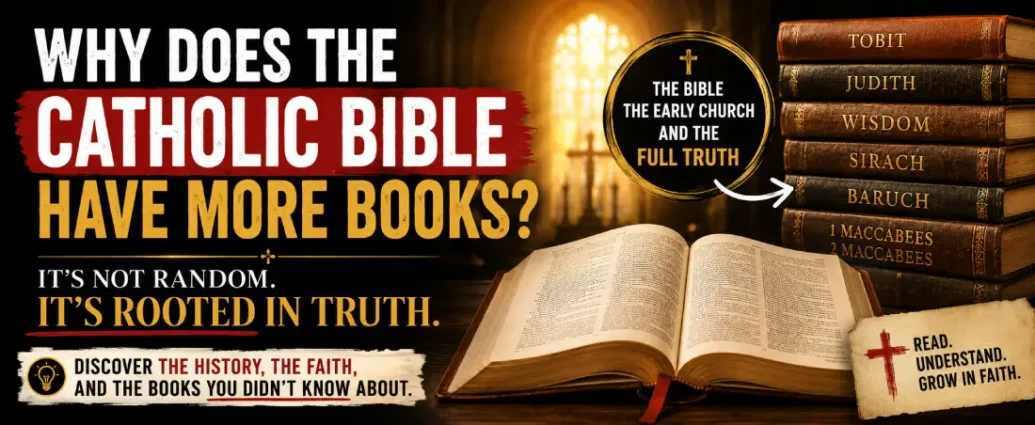
Why Does the Catholic Bible Have More Books Than the Protestant Bible? When someone picks up a Catholic Bible and compares it to a Protestant one, the first thing they notice is the difference in size. The Catholic Bible contains 73 books. The Protestant Bible contains 66 books. That’s seven more books in the Old Testament, plus additional passages in Esther and Daniel that Protestant Bibles either omit entirely or relegate to an appendix labeled Apocrypha. This isn’t a minor editorial decision or a matter of preference. The question of why the Catholic Bible has more books touches the very heart of how we understand revelation, authority, and the relationship between Scripture and the Church. The books in question are called the deuterocanonical books, a term meaning second canon, though this doesn’t mean secondary in authority. These seven books are Tobit, Judith, First Maccabees, Second Maccabees, Wisdom, Sirach (also called Ecclesiasticus), and Baruch, along with the Greek additions to Esther and Daniel. The Church has always regarded these texts as inspired Scripture, part of the canon settled by the authority Christ gave to His Church. Let me explain what I mean. The canon of Scripture didn’t fall from heaven as a table of contents. The Church, guided by the Holy Spirit, discerned which books were inspired and which were not. This process culminated in the regional councils of Hippo in 393 and Carthage in 397 and 419, which affirmed the 73-book canon. The Council of Trent in 1546 solemnly defined this same canon in response to Protestant reformers who had removed the deuterocanonical books. Understanding why the Catholic Bible has more books means understanding the authority of the Church herself to make this determination.
The Catholic Bible More Books Tradition Comes From the Early Church
The Deuterocanonical Books Catholic Teaching Affirms as Sacred Scripture
- The apostles and early Christians used the Septuagint, the Greek translation of the Hebrew Scriptures that included the deuterocanonical books.
When the New Testament authors quote the Old Testament, they most often quote from the Septuagint rather than the Hebrew text. This Greek translation, completed around 250 to 100 BC by Jewish scholars in Alexandria, contained the deuterocanonical books. The fact that the apostles used this expanded canon tells us something crucial about what the early Church considered Scripture. The Septuagint was the Bible of the diaspora Jews and the early Christian communities.
The Council of Trent Canon Settled the Question for All Time
- The Council of Carthage in 397 formally listed all 73 books as canonical Scripture under the authority of the Church.
This wasn’t a novel invention. The Council of Carthage Bible canon reflected what the Church had already been using and teaching. The bishops gathered under the guidance of the Holy Spirit and confirmed the books that had been read in the liturgy and accepted as inspired. Canon 24 of Carthage lists all the books we recognize today, including Tobit, Judith, Maccabees, Wisdom, and Sirach. The Church didn’t create Scripture, but she did recognize it with the authority Christ gave her.
Understanding the Catholic Protestant Bible Difference in Historical Context
- Saint Augustine of Hippo, writing around 397, defended the Church’s authority to determine the canon of Scripture.
Augustine famously wrote that he would not believe the Gospel except on the authority of the Catholic Church. This isn’t fideism or circular reasoning. It’s recognition that the same Church Christ established to teach all nations is the Church that identified which books belong in the Bible. Augustine accepted the deuterocanonical books without question because the Church had received them from the beginning. His teaching shaped Western Christianity for a thousand years.
- The New Testament itself references events and teachings found only in the deuterocanonical books.
Hebrews chapter 11, often called the great hall of faith, recounts Old Testament heroes. The author writes of those who were tortured, refusing to accept release, that they might rise again to a better life. This is a direct reference to Second Maccabees chapter 7, where the mother and her seven sons are tortured and killed for refusing to violate God’s law, expressing explicit faith in the resurrection. The New Testament authors knew these books and regarded them as authoritative.
- The early Church Fathers quoted the deuterocanonical books as Scripture in their writings and homilies.
Clement of Rome, writing around 96 AD, quotes from Wisdom and Judith. Polycarp quotes from Tobit. Irenaeus, Tertullian, Clement of Alexandria, Origen, and Cyprian all cite these books as inspired Scripture. This wasn’t controversial. The deuterocanonical books Catholic teaching upholds were part of the undivided Church’s Bible from the very beginning. When the Fathers wanted to teach doctrine or exhort the faithful, they turned to these books with the same confidence they brought to Genesis or Isaiah.
This passage from Tobit expresses the Catholic understanding that good works, done in grace, have real spiritual value. Almsgiving doesn’t earn salvation, but it cooperates with God’s grace and participates in our sanctification. The Book of Tobit teaches prayer, fasting, and almsgiving as expressions of authentic faith. The reformers removed this book, yet it contains profound teaching on marriage, angels, and providence.
Second Maccabees provides the clearest Old Testament teaching on praying for the dead, a practice the Church has maintained from apostolic times. Judas Maccabeus takes up a collection and sends it to Jerusalem to offer a sin offering for his fallen soldiers. The inspired author comments that this was a holy and pious thought, showing belief in resurrection and intercession. This passage grounds the Catholic doctrine of purgatory in Scripture, which explains why Protestant reformers rejected the book rather than their novel theology.
The Book of Wisdom, attributed to Solomon in its literary form though likely written later, contains profound reflections on divine wisdom and the immortality of the soul. This book speaks of the preexistence of souls and uses Greek philosophical categories to express Hebrew faith. The New Testament authors, especially Paul, draw on Wisdom’s language and concepts. To remove this book is to lose a crucial bridge between Old Testament revelation and New Testament fulfillment.
This verse captures the transcendence of God in language that anticipates the theology of creation ex nihilo, creation from nothing. The entire cosmos is as nothing compared to God’s infinite being. Yet the very next verse speaks of God’s mercy toward all creatures because He loves all that exists. This is Thomistic theology avant la lettre, recognizing both God’s utter transcendence and His intimate immanence in creation.
The Book of Sirach, also called Ecclesiasticus meaning church book because of its extensive liturgical use, contains practical wisdom for daily life rooted in fear of the Lord. Sirach covers topics from honoring parents to choosing friends, from avoiding gossip to caring for the poor. The early Church read this book constantly because it forms character in the life of grace. Its removal from Protestant Bibles impoverished moral catechesis for generations.
Here again we see the Catholic understanding that works of mercy, performed in a state of grace, participate in our sanctification. This isn’t Pelagianism, the heresy that we earn salvation by our own effort. Rather, it’s the biblical truth that God’s grace transforms us and enables us to cooperate in our salvation. Almsgiving doesn’t replace faith or the Cross, but it flows from living faith and expresses love of neighbor rooted in love of God.
The Book of Judith tells the story of a faithful widow who saves her people through courage, prayer, and strategic action. Judith combines contemplation and action, fasting and bold initiative. She’s a type of Mary, the woman who crushes the serpent’s head. Early Christians saw in Judith a model of the Church triumphant over her enemies through faith. The book’s historical details are symbolic rather than strictly chronological, which doesn’t diminish its inspired character but enhances its theological meaning.
- The Council of Trent in 1546 solemnly defined the canon of Scripture as containing 73 books, anathematizing anyone who rejected them.
This wasn’t the first time the Church defined the canon, but it was the most solemn and definitive. In response to Martin Luther and other reformers who removed the deuterocanonical books, Trent declared in its fourth session that all 73 books, in their entirety, are sacred and canonical. The Council stated that if anyone does not accept these books as sacred and canonical, with all their parts, let him be anathema. This isn’t harsh. It’s clarity. The Church was protecting the deposit of faith against innovation.
- The Council of Trent canon affirmed what the Church had always believed about the scope of inspired Scripture.
Trent didn’t add books to the Bible. The 73 books Catholic Bible had been the Church’s Bible for over a thousand years. What Trent did was respond to a new question, a question nobody had seriously raised before the 16th century. When the reformers appealed to Scripture alone as their authority, they had to define what counted as Scripture. They chose to rely on a late Palestinian Jewish canon that excluded the Greek books, even though the Christian Church had always used the fuller Septuagint canon.
- The deuterocanonical books were removed by Protestant reformers primarily because they contradicted Protestant theology, not for historical reasons.
Martin Luther called Second Maccabees unfit to be in the Bible because it taught praying for the dead. He wanted to remove James from the New Testament because it teaches that faith without works is dead. The reformers were working backward from their theology to their canon, rather than deriving their theology from the Church’s received canon. This is a fundamental inversion of proper method. We receive Scripture from the Church, and then we interpret Scripture within the Church.
- The Protestant reformers adopted the Palestinian Jewish canon fixed at Jamnia around 90 AD, after Christianity had already separated from Judaism.
After the destruction of the Temple in 70 AD, the rabbis gathered at Jamnia to determine which books would be considered authoritative for Judaism going forward. They excluded the deuterocanonical books, partly because they existed only in Greek and partly because they supported Christian claims about the Messiah, resurrection, and judgment. The Christian Church, already established and guided by apostolic tradition, didn’t follow this later Jewish decision. The reformers, by appealing to the Hebrew canon against the Church’s Septuagint canon, aligned themselves with post-Christian Judaism rather than apostolic Christianity.
- The Catholic Protestant Bible difference reflects a deeper disagreement about authority in the Church.
At root, the question isn’t really about seven books. It’s about who has authority to define Scripture. Protestants claim Scripture alone is the ultimate authority, but Scripture doesn’t contain its own table of contents. Someone has to decide what counts as Scripture. Catholics recognize that Christ gave this authority to His Church, the pillar and bulwark of truth. The Magisterium, the Church’s official teaching authority exercised by the Pope and bishops in communion with him, identified the canon under the guidance of the Holy Spirit.
- Saint Jerome initially had doubts about some deuterocanonical books but ultimately submitted to the Church’s judgment.
Jerome, the great Scripture scholar who translated the Bible into Latin, initially questioned whether books not in the Hebrew canon should be regarded as fully canonical. But Jerome wasn’t Protestant. When the Church, speaking through councils and popes, affirmed these books as Scripture, Jerome accepted that judgment. His doubts were scholarly and provisional, not a rejection of Church authority. This shows how even the greatest scholars must submit personal opinion to the Church’s definitive teaching.
- The deuterocanonical books contain doctrines essential to Catholic faith that are less clearly expressed elsewhere in Scripture.
These books teach the resurrection of the dead, the intercession of saints, the value of praying for the dead, the reality of purgatory, the merit of good works done in grace, and the role of angels in God’s providence. These aren’t peripheral doctrines. They’re central to how Catholics understand salvation, the communion of saints, and the life of grace. Removing these books didn’t just shorten the Bible. It removed scriptural foundations for essential Christian beliefs.
The soldiers prayed for their fallen comrades who had died with pagan amulets hidden under their tunics, a serious sin. Yet their prayer assumes these men were not lost forever but could be helped by the prayers and sacrifices of the living. This is purgatory in seed form, the understanding that some who die in God’s grace still need purification before entering heaven. The practice of praying for the dead appears in the earliest Christian inscriptions in the catacombs. It’s apostolic.
Judas Maccabeus wouldn’t have prayed for the dead if he thought they were either already in perfect bliss or lost in hell. His prayer reveals belief in an intermediate state of purification. The inspired author commends this as a noble and holy thought. The New Testament confirms this when Paul prays for Onesiphorus, apparently deceased, that the Lord grant him mercy on that Day. The deuterocanonical books and the New Testament agree: we can help the dead by our prayers.
- The 73 books Catholic Bible represents the fullness of divine revelation entrusted to the Church by Christ and the apostles.
To have the complete Bible is to have access to the full scope of written revelation. The Church didn’t arbitrarily include these seven books. She recognized them as inspired because they bore the marks of divine authorship, were used in the liturgy from ancient times, and taught doctrine consistent with apostolic tradition. Catholics can be confident that when we open our Bible, we’re reading everything God wanted preserved in written form for our instruction and salvation.
- The Council of Carthage Bible canon has been consistently affirmed by every ecumenical council that addressed the question.
Florence in 1442 reaffirmed the canon. Trent in 1546 defined it solemnly. Vatican I in 1870 repeated the same list. Vatican II in Dei Verbum affirmed the 73-book canon once again. This isn’t development of doctrine in the sense of adding something new. It’s the Church’s constant witness to what she has always received. Across sixteen centuries and multiple councils, the Catholic Church has never wavered in affirming these books as Scripture.
- Reading the deuterocanonical books enriches our understanding of salvation history and the development of doctrine in Israel.
These books cover the period between Malachi and Matthew, the so-called silent years when God sent no prophets. But God wasn’t silent. He was preparing His people for the coming Messiah. The Maccabean martyrs died rather than compromise their faith, showing that some things matter more than life itself. The wisdom literature in Sirach and Wisdom brought Greek philosophy into dialogue with Hebrew revelation. All of this prepared the ground for the Gospel. Without these books, we miss crucial chapters in the story of salvation.
- The deuterocanonical books Catholic tradition has always treasured continue to form saints today.
When we read Tobit, we learn about married love and family prayer. When we read Judith, we see courage rooted in faith. When we read Wisdom, we encounter Christ as divine Wisdom present in creation. When we read Sirach, we receive practical guidance for Christian life. When we read Maccabees, we see martyrdom as witness to truth. These books aren’t dead letters. They’re living words that continue to shape disciples. The saints read these books. We should too. Why This Matters for Every Catholic Today The question of why the Catholic Bible has more books isn’t just historical trivia. It goes to the heart of how we understand divine revelation and Church authority. If the Church can’t be trusted to identify which books are inspired Scripture, why should we trust her to interpret those books correctly? But if Christ established His Church as the pillar and bulwark of truth, then her identification of the canon carries divine authority. The Protestant reformers wanted Scripture alone as their authority, but they had to rely on Catholic councils to know what counted as Scripture in the first place. Then they removed books that contradicted their new theologies. This is a self-defeating position. Catholics, by contrast, recognize that Scripture and Tradition work together, both flowing from the same divine wellspring and both interpreted by the living Magisterium Christ established. When you pick up your Catholic Bible with its 73 books, you hold in your hands the complete written revelation entrusted to the Church. Every book is there for a reason. The deuterocanonical books aren’t optional or secondary. They’re part of the inspired word of God, confirmed by councils, read by saints, and treasured by the Church for two millennia. Read them with faith. Let them form your mind and heart. And thank God that He gave us a Church with the authority to preserve His word intact across the centuries. Let’s pray together for a deeper love of Sacred Scripture in its fullness, and for the grace to submit our minds and hearts to the Church’s teaching authority as we read God’s word. May the Holy Spirit, who inspired these sacred texts, guide us into all truth as we ponder them in faith.
📖 You Might Also Like