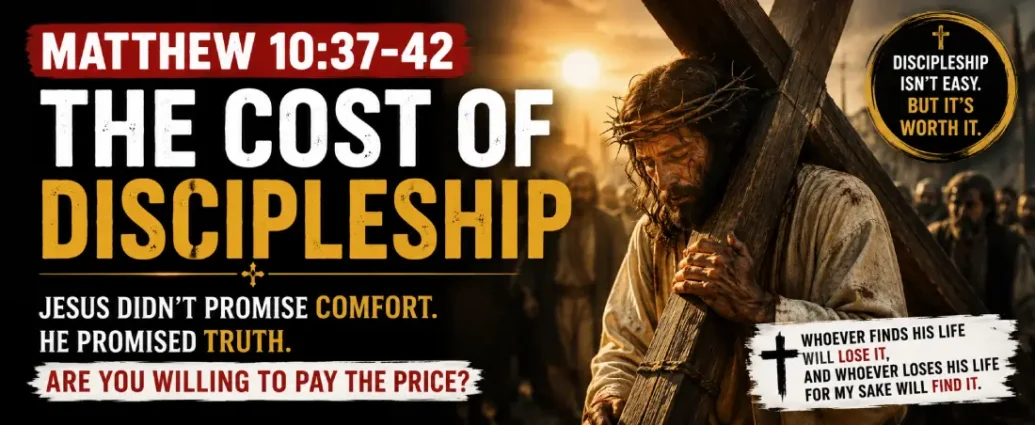
The Gospel reading for the 13th Sunday in Ordinary Time doesn’t ease us into anything. Jesus speaks with the kind of clarity that makes us uncomfortable, the kind that forces a choice. He tells the Twelve — and us — that following Him will cost everything we hold dear, and that the cost of discipleship Catholic tradition has always taught isn’t negotiable. It’s not a suggested donation. It’s the price of admission.
We live in a culture that wants Jesus without the Cross, resurrection without death, discipleship without sacrifice. But Christ refuses to let us have it both ways. In Matthew 10:37-42, He lays out terms that sound almost cruel until we understand what He’s actually offering in exchange.
Let me start with the verse that cuts deepest: “He who loves father or mother more than me is not worthy of me; and he who loves son or daughter more than me is not worthy of me” (Matthew 10:37, RSV-CE). Notice Jesus doesn’t say we shouldn’t love our families. The Greek word here is φιλέω (phileo), which means affectionate love, natural human attachment. Christ isn’t condemning that love. He’s establishing an order. A hierarchy. God first, then everything else finds its proper place.
The Cost of Discipleship Catholic Teaching Demands We Face
This isn’t about hating our parents or children. It’s about recognizing that every human love, no matter how pure, becomes disordered when it displaces God. Saint Thomas Aquinas taught that charity — supernatural love for God — must govern all our natural loves, directing them toward their proper end. When we love our family members rightly, we love them in God and for God, desiring their ultimate good, which is heaven. But when family loyalty trumps obedience to Christ, we’ve made an idol. We’ve chosen the creature over the Creator.
The verse that follows drives the point home: “and he who does not take his cross and follow me is not worthy of me” (Matthew 10:38, RSV-CE). In first-century Palestine, everyone knew what a cross meant. It wasn’t jewelry. It was an instrument of Roman execution, a public humiliation reserved for slaves and rebels. When Jesus spoke these words, He hadn’t yet been crucified — His disciples didn’t have the hindsight we do. They just heard their rabbi tell them to pick up the tool of their own death and walk behind Him.
The Catechism teaches that “the way of perfection passes by way of the Cross. There is no holiness without renunciation and spiritual battle” (CCC 2015). This isn’t optional equipment for advanced Catholics. It’s the path itself. First, Jesus demands we prefer Him above our closest human bonds. Second, He requires we embrace suffering and death as the means of following Him. Third — and this is where it gets paradoxical — He promises that losing our life is how we find it.
What Following Jesus Sacrifice Actually Looks Like in Matthew 10
“He who finds his life will lose it, and he who loses his life for my sake will find it” (Matthew 10:39, RSV-CE). The Greek word for “life” here is ψυχή (psyche), which means soul, the animating principle of a person. Jesus isn’t talking about physical survival strategies. He’s talking about the deepest part of who we are. When we cling to our psyche — our self-directed life, our autonomy, our plans — we strangle it. But when we surrender it completely to Christ, it comes alive in ways we couldn’t engineer ourselves.
Saint Augustine saw this clearly when he wrote in his Confessions that our hearts are restless until they rest in God. We spend our lives grasping at things we think will fulfill us — career success, family approval, financial security, romantic love — and every one of them, good as they are, leaves us hollow when we make them ultimate. Only God can bear the weight of being our everything. Only in losing ourselves to Him do we find the selves we were created to be.
But Jesus doesn’t leave us with demands alone. He closes this passage with promises: “He who receives you receives me, and he who receives me receives him who sent me” (Matthew 10:40, RSV-CE). Discipleship isn’t a lonely road. Christ identifies so completely with His followers that hospitality shown to them counts as hospitality shown to Him. This is the doctrine of the Mystical Body at work — we’re members of Christ, and what is done to us is done to Him.
What This Means for Catholics Today
Then comes the stunning detail: “And whoever gives to one of these little ones even a cup of cold water because he is a disciple, truly, I say to you, he shall not lose his reward” (Matthew 10:42, RSV-CE). Even a cup of water. Even the smallest act of kindness done for Christ’s sake carries eternal weight. The cost is everything, yes. But the economy of grace operates on a scale that makes no earthly sense. God doesn’t just match our sacrifice. He overwhelms it with gifts we couldn’t earn in a thousand lifetimes.
So what does this cost of discipleship Catholic teaching mean for us now, in ordinary American life where most of us won’t face literal crucifixion? It means we stop trying to negotiate with Christ. It means we examine where family loyalty, career ambition, political tribalism, or comfort-seeking has edged God out of first place. It means we name the cross we’re actually called to carry — the one He’s assigned to us, not the dramatic one we’d prefer.
For some Catholics, the cross is staying in a difficult marriage when divorce would be easier. For others, it’s speaking truth about life and marriage and sexuality when silence would cost less. For others still, it’s the daily death of caring for aging parents or special-needs children or chronic illness without recognition or relief. These aren’t lesser crosses than martyrdom. They’re the ones Christ has given us. Refusing them means refusing Him.
Prayer Points for Embracing the Cost of Discipleship Catholic
The sacramental life gives us what we need to carry these crosses. The Eucharist is Christ offering Himself to us so we can offer ourselves with Him. Confession restores us when we drop the cross and run. The grace of state — whether in marriage, religious life, or single life — equips us for the specific demands of our vocation. We’re not making this journey on willpower alone. We’re drawing on the infinite strength of God Himself, made available through the ordinary means He established.
And here’s the part we forget: the cost of discipleship includes blessings so real they make the sacrifice look small. The peace that comes from putting God first isn’t a feeling. It’s a deep settledness that survives chaos. The joy of living for something bigger than ourselves changes the flavor of every day. The communion with Christ that grows through surrender is better than anything we gave up. Ask the saints. They’ll tell you the cost was nothing compared to what they received.
- Lord Jesus, show me where I’ve put someone or something in the place that belongs to You alone, and give me the courage to reorder my loves according to Your will.
- Help me to embrace the cross You’ve given me — not the one I’d choose, but the one You know I need — and to carry it as a share in Your suffering that leads to resurrection.
- Give me the grace to lose my life in Your service, trusting that You will give it back transformed and more alive than I could make it on my own.
- Let me see Your face in the “little ones” You put before me, and give me generous hands to offer even a cup of cold water in Your name.
- Strengthen all Catholics who are paying the cost of discipleship today through persecution, family rejection, or quiet daily sacrifice, and let them know their reward in heaven is beyond measure.
📖 You Might Also Like
This is a faith commentary responding to reporting by CatholicExchange. PrayerWarriorsUSA does not reproduce the original article — we offer a Christian perspective and call to prayer in response to current events.