
From the Gulag to the Federal Docket: Eva Edl, the FACE Act, and the Catholic Duty to Defend Life

A 90-year-old woman who survived a Soviet death camp stands before the United States Congress with a grave warning. Eva Edl urges lawmakers to repeal the Freedom of Access to Clinic Entrances (FACE) Act, drawing stark comparisons between communist religious suppression and contemporary federal prosecutions targeting pro-life Christians. Her testimony carries a unique moral weight that demands careful reflection from lawmakers and faithful citizens alike.
Eva knows state persecution firsthand. Imprisoned as a child under Joseph Stalin’s regime, she experienced the brutal reality of totalitarian government punishment for religious conviction. Decades later, federal courts convicted her under the FACE Act for engaging in peaceful pro-life witness outside abortion facilities in Tennessee and Michigan. She draws a direct line between two eras of anti-religious hostility separated by decades and an ocean.
The Historical Parallel: Totalitarian Control vs. Moral Conscience
The Freedom of Access to Clinic Entrances Act passed in 1994, ostensibly to prevent violence at reproductive healthcare facilities. However, federal prosecutors increasingly deploy the statute against peaceful pro-life intercessors. Eva Edl’s prosecution exemplifies this pattern. Despite participating in nonviolent witness and intercessory prayer, authorities prosecuted her under federal conspiracy and civil rights charges.
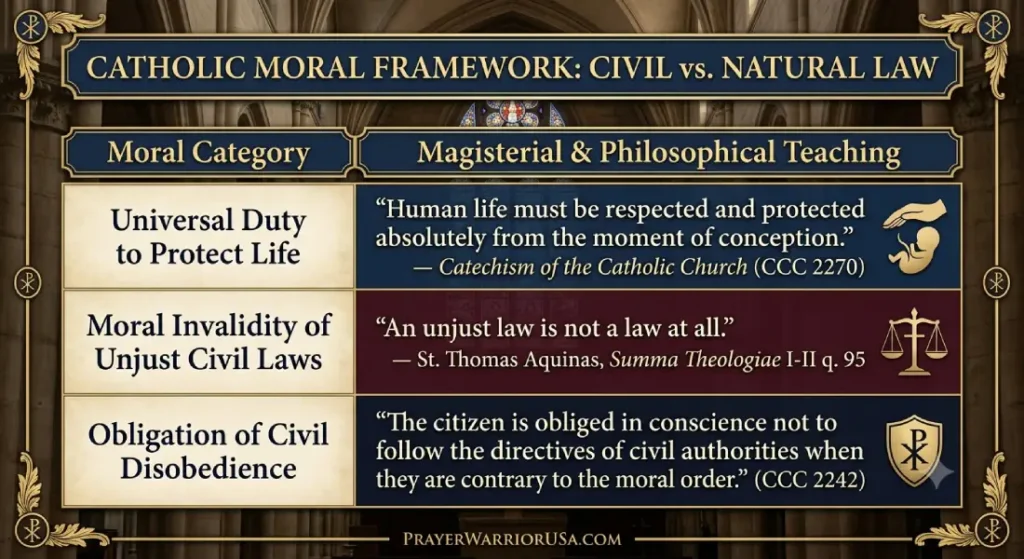
Eva’s congressional testimony highlights a chilling historical parallel. Criminalizing peaceful pro-life intercessors mirrors the religious persecution she escaped in Eastern Europe. Both systems penalize citizens whose formed conscience compels them to defend innocent, defenceless human life against state-sanctioned destruction.
During recent years, FACE Act prosecutions expanded significantly. Federal law enforcement arrested dozens of pro-life advocates—including elderly grandmothers, grandfathers, and clergy. Federal courts handed down severe prison terms for individuals engaged in silent prayer or physical presence at clinic entrances. Eva’s conviction stands as a modern warning: when civil authorities penalize public moral witness, true religious liberty is systematically eroded.
The Natural Law and Catholic Moral Theology on Unjust Laws
The Catholic Church offers a rigorous framework for evaluating state authority and civil statutes. In his landmark encyclical Evangelium Vitae (The Gospel of Life), Pope St. John Paul II explicitly addressed the relationship between civil law and the protection of human life:
“Abortion and euthanasia are thus crimes which no human law can claim to legitimize. There is no obligation in conscience to obey such laws; on the contrary, there is a grave and clear obligation to oppose them by conscientious objection.” (Evangelium Vitae, n. 73)
This principle roots itself in classical Thomistic philosophy. St. Thomas Aquinas observed in the Summa Theologiae (I-II, q. 96, a. 4) that human laws contradictory to divine or natural law carry no moral binding force because “an unjust law is no law at all.” When the state enacts measures that insulate the practice of abortion while criminalizing those who offer peaceful intercession for mothers and unborn children, it abuses its authority.
Furthermore, the Catechism of the Catholic Church explicitly validates nonviolent resistance against unjust state overreach:
“The citizen is obliged in conscience not to follow the directives of civil authorities when they are contrary to the demands of the moral order, to the fundamental rights of persons or the teachings of the Gospel.” (CCC 2242)
Eva Edl’s choice to witness at abortion clinics, despite the threat of imprisonment, reflects this obligation of conscience. Her actions do not constitute lawlessness; rather, they demonstrate fidelity to a higher moral order when civil legislation fails to uphold the primary fundamental right—the right to life itself (CCC 2273).
Selective Enforcement and the Silencing of Moral Witness
The practical application of the FACE Act reveals a deep institutional bias. While federal prosecutors routinely charge peaceful pro-life intercessors with federal crimes, they rarely enforce the statute with equal rigor against individuals who vandalize or attack crisis pregnancy centers and Catholic churches. This asymmetry exposes how state power can be deployed to enforce ideological conformity rather than equal justice under law.
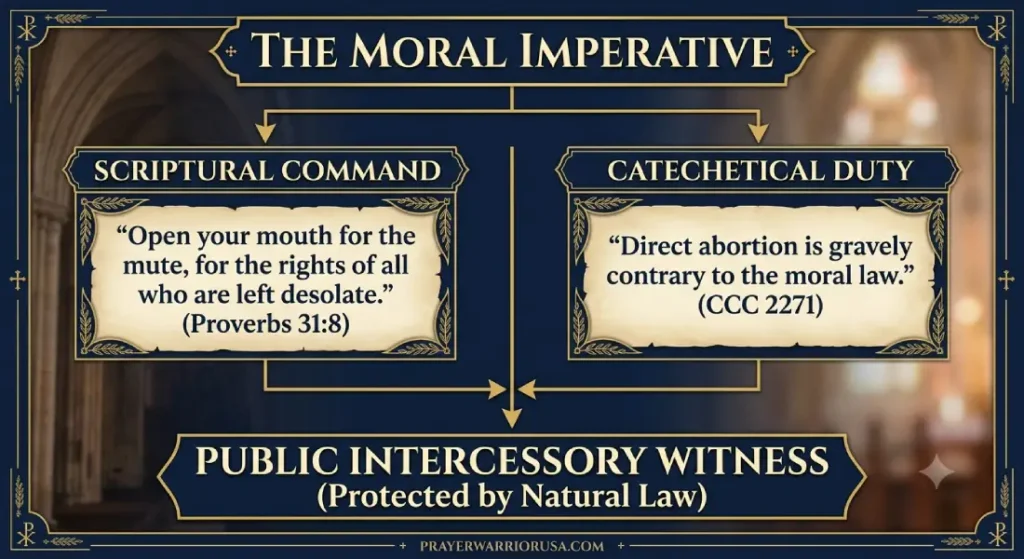
Sacred Scripture mandates public advocacy for the defenseless: “Open your mouth for the mute, for the rights of all who are left desolate” (Proverbs 31:8). Pro-life intercessors embody this scriptural imperative. They stand at the threshold of abortion facilities to offer spiritual, physical, and financial alternatives to women in crisis. In doing so, they fulfill the spiritual work of mercy to instruct, counsel, and pray for the vulnerable.
Pastoral Mandate: Restoring Justice and Protecting Conscience
Congress possesses the legislative authority to repeal or reform the FACE Act immediately. repealing this weaponized law would end federal overreach against peaceful pro-life advocates, restore constitutional guarantees of religious speech, and align federal policy with fundamental natural rights.
The Catholic Church calls the faithful to active, informed civic participation (CCC 2240). Bishops, pastors, and lay leaders must educate congregations regarding the moral imperative to defend human life and protect rights of conscience. Believers are called to pray fervently for justice, engage civil representatives, and support peaceful public intercession outside abortion facilities.
Eva Edl survived the Soviet Gulag. Her warning to the United States Congress serves as a crucial reminder: a nation that criminalizes peaceful moral witness against the destruction of unborn human life imperils its own moral foundation. Lawmakers must act to repeal the FACE Act, protecting both the sanctity of life and the fundamental freedom of conscience.
Frequently Asked Questions
Yes. According to CCC 2242 and Pope St. John Paul II’s Evangelium Vitae (n. 73), Catholics are obliged in conscience not to follow civil directives that contradict natural law or fundamental human rights. Nonviolent resistance to abortion laws is a recognized exercise of conscientious objection.
The Catechism of the Catholic Church states that human life must be respected and protected absolutely from the moment of conception (CCC 2270). Direct abortion is considered a grave moral evil contrary to the Fifth Commandment (CCC 2271).
St. Thomas Aquinas established in the Summa Theologiae (I-II, q. 95–96) that civil laws are valid only insofar as they conform to right reason and natural law. If a civil statute violates natural justice—such as denying the right to life—it loses its moral force as law.
Source: LifeSiteNews
Continue Your Faith Journey

Catholic Prayer for Toxic Family Conflict: A Faithful Guide to Boundaries, Healing, and Charity
Navigating family conflict, estrangement, and narcissistic behavior requires balancing Christian charity with prudent boundaries. Discover how Catholic doctrine, Sacred Scripture, and daily…

The 7 Best Catholic Bibles for Beginners and Scholars: The Ultimate Guide to Faithful Scripture Study
Discover the best Catholic Bibles for beginners and scholars. Compare top translations like the RSV-2CE, NABRE, and Douay-Rheims to deepen your daily…

What Is a Novena? The Biblical Meaning and How to Pray It
Discover the biblical origins of the Catholic nine-day prayer tradition and learn how to pray a novena effectively. Transform your prayer routine…