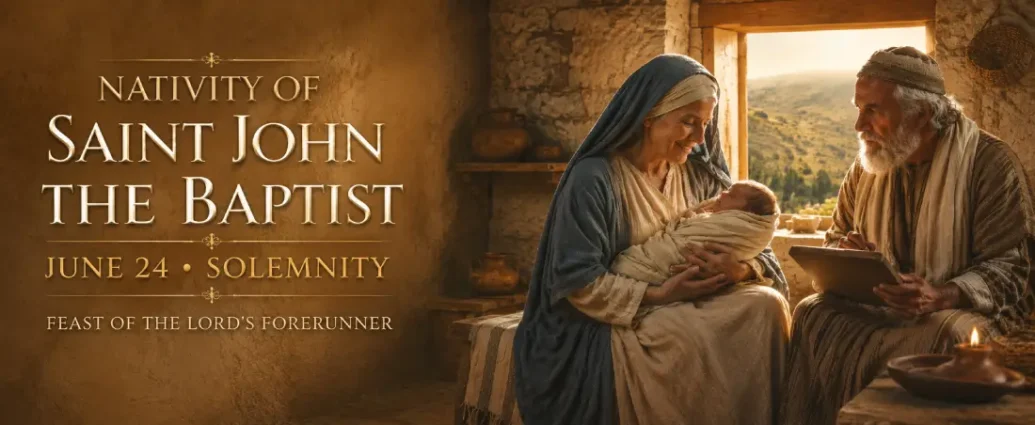
Every year on June 24, Catholics throughout the world celebrate one of the oldest and most significant feasts in the Church’s calendar: the Nativity of Saint John the Baptist. While nearly every saint is commemorated on the day of his or her death—the day of entering eternal life—John the Baptist is one of only three people whose birth the Church celebrates with a solemn feast. The other two are Jesus Christ at Christmas and the Blessed Virgin Mary on September 8.
This distinction alone reveals John’s extraordinary place in salvation history. He was more than a prophet, more than a preacher, and more than a martyr. Chosen by God before his birth, John became the final prophet of the Old Covenant and the immediate herald of the Messiah. His entire life pointed away from himself and toward Jesus Christ.
The celebration of John’s birth is not merely a remembrance of a remarkable child born to elderly parents. It is the celebration of God’s faithful preparation for the coming of His Son. John’s nativity marks the dawn before the sunrise of Christ, the voice that prepared the way for the eternal Word made flesh.
The Biblical Story of John’s Birth
The story of John’s birth is recorded in the first chapter of the Gospel of Luke and stands among the most beautiful narratives in Sacred Scripture.
John’s parents, Zechariah and Elizabeth, were righteous before God. Zechariah served as a priest in the Temple, while Elizabeth was a descendant of Aaron. Despite their faithfulness, they remained childless throughout their lives, and both had grown old.
While Zechariah was offering incense in the Temple, the Archangel Gabriel appeared and announced that Elizabeth would bear a son. The child was to be named John, meaning “The Lord is gracious.” Gabriel declared that the boy would be “great before the Lord,” filled with the Holy Spirit from his mother’s womb, and destined to prepare a people ready for the coming of the Lord.
Unable to believe such astonishing news, Zechariah questioned the angel and was struck mute until the prophecy was fulfilled.
Several months later, after the Annunciation to the Blessed Virgin Mary, Mary visited her cousin Elizabeth. At Mary’s greeting, the unborn John leaped in Elizabeth’s womb, and Elizabeth, filled with the Holy Spirit, proclaimed Mary blessed among women. Catholics have long recognized this moment as John’s first witness to Christ. Even before birth, he acknowledged the presence of the Savior.
When the child was born, family members expected him to receive his father’s name. Elizabeth insisted that he should be called John. Zechariah confirmed the name by writing, “His name is John.” Immediately his speech returned, and he praised God in the beautiful hymn known as the Benedictus, which the Church continues to pray every morning in the Liturgy of the Hours.
Luke concludes the infancy narrative with a brief but profound statement: “The child grew and became strong in spirit, and he was in the wilderness until the day of his public appearance to Israel.”
Why Does the Church Celebrate His Birth?
The Church celebrates very few births because every person is born marked by Original Sin. The birth of John the Baptist is exceptional because of his unique role in God’s plan of salvation.
According to the Gospel of Luke, John was sanctified before birth when he leaped in Elizabeth’s womb during Mary’s visitation. Catholic tradition has long understood this event as the moment when he was cleansed by the grace of Christ, whom he recognized even before seeing Him.
John’s birth also fulfilled centuries of prophecy. The prophet Isaiah spoke of “a voice crying out in the wilderness: Prepare the way of the Lord.” The prophet Malachi foretold that God would send His messenger before the coming of the Lord. Jesus Himself identified John as the fulfillment of these promises.
The Nativity of Saint John the Baptist therefore celebrates not only a miraculous birth but also the beginning of the final stage of God’s preparation for the coming of Christ.
The Historical Setting
John was born during the closing years of the reign of Herod the Great, when Judea existed under Roman authority. The Jewish people longed for the promised Messiah while navigating political oppression, religious tensions, and competing interpretations of the Law.
The Temple in Jerusalem remained the center of Jewish worship, yet many hoped for a new era foretold by the prophets. Into this atmosphere of expectation, God raised up John.
Unlike many religious leaders of his day, John lived apart from cities and positions of influence. His life in the wilderness echoed the great prophets of Israel, especially Elijah, whose courage and simplicity became a model for his own ministry.
John’s Mission as the Forerunner
When John began preaching near the Jordan River, crowds came from Jerusalem and throughout Judea to hear him.
His message was simple but demanding: repent, turn back to God, and prepare for the Kingdom of Heaven.
John baptized those who confessed their sins, not as the sacrament of Christian Baptism that would later be instituted by Christ, but as a sign of repentance and readiness for the coming Messiah.
He challenged every group that approached him. Tax collectors were told to act honestly. Soldiers were instructed not to abuse their authority. Religious leaders were warned against relying solely on their ancestry. Genuine conversion required transformed hearts.
Despite attracting enormous crowds, John consistently refused personal glory. When people wondered whether he might be the Messiah, he answered with humility:
“I am not the Christ.”
Instead, he announced that One far greater was coming, saying that he was not worthy even to loosen the straps of His sandals.
The Baptism of Jesus
The defining moment of John’s ministry occurred when Jesus came to the Jordan to be baptized.
Recognizing Jesus’ holiness, John hesitated, declaring that he himself needed to be baptized by Christ. Jesus nevertheless insisted that the baptism should take place “to fulfill all righteousness.”
As Jesus emerged from the waters, the heavens opened, the Holy Spirit descended in the form of a dove, and the Father’s voice proclaimed, “This is my beloved Son.”
John became the first public witness to this revelation of the Holy Trinity. From that moment onward, his mission steadily diminished as Christ’s public ministry began.
His own words beautifully summarize his vocation:
“He must increase, but I must decrease.”
These words remain one of the greatest expressions of Christian humility ever spoken.
Courage Until the End
John’s fearless commitment to truth eventually brought him into conflict with Herod Antipas.
He publicly condemned Herod’s unlawful marriage to Herodias, refusing to compromise God’s moral law even before powerful rulers.
For this, John was imprisoned in the fortress of Machaerus. During a royal banquet, Herodias’ daughter danced before Herod, who rashly promised to grant her any request. At her mother’s urging, she asked for John’s head.
Although reluctant, Herod fulfilled his oath, and John was beheaded. His disciples buried his body, preserving the memory of a prophet who remained faithful to God until death.
The Jewish historian Josephus independently confirms John’s execution, strengthening the historical reliability of the Gospel accounts.
Why June 24?
The date of June 24 is rooted in the chronology found in the Gospel of Luke.
Luke records that Elizabeth was six months pregnant when the Angel Gabriel announced the conception of Jesus to Mary. Since Christmas is celebrated on December 25, the Church placed John’s birth approximately six months earlier.
The timing also carries beautiful symbolism.
After the summer solstice, daylight gradually decreases in the Northern Hemisphere. Following the winter solstice, daylight begins to increase. Christians have long connected this natural rhythm with John’s words, “He must increase, but I must decrease.”
Whether this symbolism influenced the development of the feast or later enriched its interpretation, it remains one of the most beautiful reflections in the Church’s liturgical tradition.
Symbols of Saint John the Baptist
Christian art portrays John with several recognizable symbols.
His camel-hair garment and leather belt recall the prophet Elijah and his life of ascetic simplicity.
The lamb represents his proclamation of Jesus as “the Lamb of God, who takes away the sin of the world.”
A reed cross symbolizes his mission to prepare the way for Christ.
The Jordan River reminds believers of repentance and the beginning of Jesus’ public ministry.
Many images show John pointing toward Christ rather than toward himself, perfectly expressing the purpose of his entire life.
Relics and Places of Pilgrimage
From the earliest centuries, Christians honored places associated with John the Baptist.
Ein Karem, traditionally identified as his birthplace, has become an important pilgrimage destination.
Numerous churches throughout the world claim relics associated with John, including traditions concerning his head in Damascus, Rome, and Amiens. While the Church preserves these traditions with respect, historians cannot verify the authenticity of every claimed relic.
Regardless of the physical remains, John’s greatest legacy is his witness to Christ.
Lessons for Catholics Today
The Nativity of Saint John the Baptist speaks powerfully to modern Christians.
John teaches that holiness begins with humility. Although admired by thousands, he never sought personal fame.
He reminds us that genuine repentance is more than emotion; it requires concrete changes in the way we live.
His courage encourages believers to defend moral truth even when doing so carries personal cost.
His entire life teaches that authentic discipleship always points others toward Jesus rather than ourselves.
Above all, John demonstrates that God’s plans often begin quietly. A miraculous child born to elderly parents in an obscure Judean village became the prophet chosen to prepare the world for its Savior.
Frequently Asked Questions
Who was Saint John the Baptist?
Saint John the Baptist was the son of Zechariah and Elizabeth, the final prophet of the Old Covenant, and the divinely appointed forerunner who prepared the way for Jesus Christ.
Why is his birth celebrated?
The Church celebrates his birth because of his unique role in salvation history and because he was sanctified before birth through the grace of Christ during the Visitation.
When is the Nativity of Saint John the Baptist celebrated?
The Roman Catholic Church celebrates the Nativity of Saint John the Baptist on June 24 as a Solemnity.
What is John the Baptist known for?
He is known for preaching repentance, baptizing Jesus in the Jordan River, identifying Christ as the Lamb of God, and courageously defending God’s law until his martyrdom.
Was John the Baptist a martyr?
Yes. He was imprisoned and beheaded by order of Herod Antipas after condemning Herod’s unlawful marriage.
A Feast That Points to Christ
The Nativity of Saint John the Baptist is far more than the remembrance of an extraordinary birth. It celebrates the faithfulness of God, who prepared the world for the coming of His Son through a prophet filled with grace from before his birth.
John never sought to build his own reputation. Every sermon, every act of repentance, every baptism, and every sacrifice directed hearts toward Jesus Christ. That is why the Church continues to honor him more than two thousand years later.
Each year, as Catholics celebrate his nativity, they hear once again the call that echoed through the wilderness of Judea: prepare the way of the Lord. John’s voice still invites every generation to repentance, humility, and unwavering faith, reminding us that the greatest life is one that leads others to Christ.