
Catholic Prayer for Anxiety: How to Find Peace Through Divine Providence
Medical and Pastoral Disclaimer:
This article is written for educational and spiritual enrichment purposes and does not constitute medical, psychological, or psychiatric advice. While prayer, the Sacraments, and spiritual direction are vital for the interior life, the Catholic Church recognizes that emotional distress and clinical anxiety can stem from biological and psychological factors requiring professional care. If you or a loved one are experiencing severe, chronic, or debilitating anxiety, panic attacks, or thoughts of self-harm, please consult a qualified physician, licensed mental health professional, or your local emergency health services immediately.
Catholic prayer for anxiety is neither a spiritual sedative nor positive thinking wrapped in pious language. It is something far more profound: the courageous act of interior surrender to Divine Providence.
The Catholic Church does not teach us to treat emotional anxiety as proof of weak faith, nor does She demand that we magically cast out natural human distress. Instead, Holy Mother Church teaches us to pray through anxiety. We are finite creatures living in a fallen world; bringing our raw fear before the throne of God is not a failure of belief, but an act of filial trust.
Quick Guide: The Catholic Remedy for Anxiety
| Action Step | Catholic Anchor | Practical Spiritual Application |
| 1. Ground in the Present | Matthew 6:34 / St. Francis de Sales | Refuse to borrow tomorrow’s trouble; pray: “Jesus, I trust in You.” |
| 2. Seek Sacramental Grace | Council of Trent / CCC 1456 | Receive absolution in Confession to heal guilt and strengthen the will. |
| 3. Meditative Vocal Prayer | Rosarium Virginis Mariae / CCC 2708 | Pray the Holy Rosary to anchor racing thoughts in the mysteries of Christ. |
| 4. Natural Medical Means | St. Thomas Aquinas (ST I-II, q. 109) / CCC 2288 | Prudently consult medical and psychological professionals when needed. |
What the Catechism Teaches on Anxiety and Desiring Control
The Catechism of the Catholic Church addresses the root causes of our interior anxiety in paragraphs 2547 through 2550, placed under the Tenth Commandment: “You shall not covet.”
At first glance, placing anxiety beneath the Tenth Commandment may seem unexpected. However, Catholic moral theology exposes the subtle connection between anxiety and disordered desire—specifically, our desire for absolute control over things we cannot govern. We experience distress when we place our ultimate security in our own plans rather than resting in God’s fatherly care.
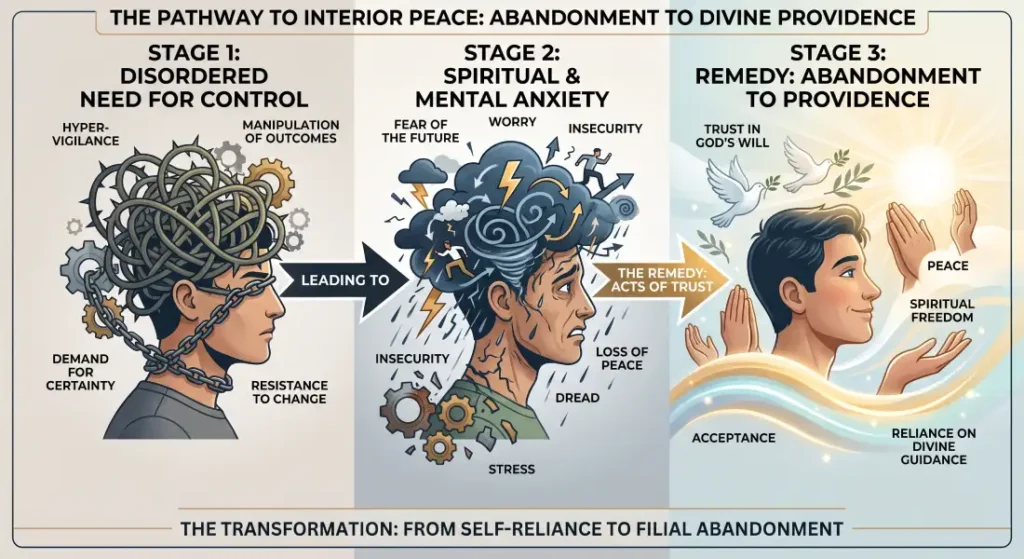
The Catechism provides the corrective:
- Poverty of Heart (CCC 2547): “The Lord enjoins us to choose him above everything and everyone, and not to prefer anything to him.” This radical preference includes relinquishing our compulsive need to control the future.
- Purification of Desire (CCC 2548): The desire for true happiness is natural and good, but it requires “the purification of our hearts and the practice of temperance.” We must practice temperance not merely with physical goods, but with our demands for certainty.
- Trust in Divine Providence (CCC 2550): As Jesus reminded His disciples, we are to rely on God who clothes the lilies and feeds the birds, rather than falling into paralyzing worldly fretfulness.
As spiritual masters such as Jean-Pierre de Caussade have noted, abandonment to Divine Providence is not fatalistic resignation. It is active, confident trust that our Heavenly Father governs all things for the salvation of those who love Him.
Praying Through Anxiety with Sacred Scripture
Sacred Scripture provides the exact framework for transforming anxious distress into theological hope.
St. Paul: The Remedy of Supplication with Thanksgiving
Writing from chains and facing death, St. Paul gave the Church an enduring spiritual prescription:
“Have no anxiety about anything, but in everything by prayer and supplication with thanksgiving let your requests be made known to God. And the peace of God, which passes all understanding, will keep your hearts and your minds in Christ Jesus.” — Philippians 4:6–7 (RSV-CE)
St. Paul does not say “never experience a natural feeling of fear.” He instructs us not to let anxiety govern our interior life.
The remedy contains three essential movements:
- Prayer (Oratio): Elevating the soul directly to God.
- Supplication (Obsecratio): Honestly laying out our specific needs and weaknesses.
- Thanksgiving (Eucharistia): Acknowledging God’s past mercies and praising His eternal goodness even before the storm passes.
Giving thanks in the midst of distress shatters the illusion of abandonment. It shifts our focus from the magnitude of the trial to the magnitude of God’s power.
Christ in the Sermon on the Mount: The Sacrament of the Present Moment
Our Blessed Lord Himself commanded us to guard our hearts against future dread:
“Therefore do not be anxious about tomorrow, for tomorrow will be anxious for itself. Let the day’s own trouble be sufficient for the day.” — Matthew 6:34 (RSV-CE)
Anxiety pulls the soul out of the present moment—either backward into sterile regret or forward into imagined crises. God does not give us grace for imaginary future scenarios; He supplies grace for this exact day, this exact hour, and this exact breath.
4 Practical Catholic Steps When Anxiety Strikes
When your chest tightens, your heart races, and your mind struggles to find peace, implement these four time-tested Catholic remedies:
1. Approach the Sacrament of Reconciliation
Confession is not a substitute for psychological counseling, nor is involuntary anxiety itself a sin. However, severe anxiety frequently exposes unhealed spiritual wounds: excessive self-reliance, fear of judgment, unconfessed guilt, or a lack of trust in God.
In the Sacrament of Penance, the priest acts in persona Christi, speaking the words that shatter spiritual dread: “I absolve you.” This sacramental absolution washes away actual sin, restores peace to the conscience, and infuses sanctifying grace to strengthen our spiritual faculties against fear.
2. Pray the Holy Rosary with Contemplative Focus
When the mind is overstimulated and unable to formulate spontaneous prayers, the Holy Rosary serves as a spiritual anchor. As St. John Paul II taught in Rosarium Virginis Mariae, vocal repetition is designed to facilitate peaceful meditation on the mysteries of Jesus Christ.
Holding the beads grounds the body ; reciting the Angelic Salutation (“Hail Mary, full of grace…”) silences mental chaos and fixes the interior gaze upon the Lord.
3. Make Acts of Abandonment to Divine Providence
Spiritual warfare is won through simple acts of the theological virtues. When intrusive thoughts arise, immediately counter them with short, formal acts of trust:
- The Divine Mercy Aspiration: “Jesus, I trust in You.” (St. Faustina Kowalska)
- The Surrender Aspiration: “O Jesus, I surrender myself to You, take care of everything!” (Servant of God Don Dolindo Ruotolo)
- The Lord’s Prayer: “Fiat voluntas tua — Thy will be done.” (Matthew 6:10)
Repeat these aspirations in the car, before difficult meetings, or when waking with sudden dread.
4. Prudent Use of Medical Care (Grace Builds Upon Nature)
The Catholic Church firmly rejects the error of spiritual fideism—the false belief that all physical and mental suffering must be treated exclusively through spiritual means.
St. Thomas Aquinas laid down the classical principle: Gratia non tollit naturam, sed perficit eam (“Grace does not destroy nature, but perfects it” – ST I, q. 1, a. 8).
If your anxiety is chronic, debilitating, or biologically driven, consult a qualified physician or licensed Catholic mental health counselor. God created the human body and the natural sciences. Seeking medical treatment when needed is an act of prudence, humility, and stewardship of the life God has given you.
Structured Catholic Prayers for Anxiety and Peace of Mind
Use these structured prayer points during your daily holy hour or in moments of acute interior struggle:
An Act of Abandonment to Christ in the Storm
“Lord Jesus Christ, You commanded the wind and the waves to be still, and there was great calm. Calm now the tempest within my mind and heart. Grant me the grace to know that You are in the boat with me, even when the waves seem overwhelming. I surrender my past to Your mercy, my present to Your love, and my future to Your Divine Providence. Amen.”
Prayer to Our Lady, Undoer of Knots
“Holy Mother of God, you stood at the foot of the Cross with unwavering faith, surrendering your sorrow to the Father. Look with maternal compassion upon the knots of fear and confusion that bind my spirit. Take my trembling heart into your immaculate hands and lead me to the peace of your Divine Son. Amen.”
Litany of Trust Aspiration
From the belief that I have to control my life, deliver me, Jesus. > From the fear that I will not have what I need for tomorrow, deliver me, Jesus. > That You are continually guiding all things for my good, Jesus, I trust in You. > That Your peace surpasses all human understanding, Jesus, I trust in You.
Frequently Asked Questions
No. Involuntary emotional or biological anxiety is a natural human reaction and is not a sin. Sin only enters if a person freely consents to despair, excessive worldly attachments, or a deliberate refusal to trust in God’s Divine Providence.
The most effective Catholic prayers for anxiety include the Holy Rosary, the Surrender Novena (“O Jesus, I surrender myself to You, take care of everything!”), the Chaplet of Divine Mercy (“Jesus, I trust in You”), and Scripture meditation on Philippians 4:6–7 and Matthew 6:34.
Yes. Catholic moral theology (CCC 2288) affirms that grace builds upon nature. Utilizing legitimate medical, psychiatric, and therapeutic care for clinical anxiety is a prudent use of natural remedies created and enabled by God.
In CCC 2547–2550, the Catechism links excessive anxiety to our disordered desire to control the future. It teaches that true peace is found in poverty of heart, purifying our desires, and practicing filial abandonment to Divine Providence.
Continue Your Faith Journey

How to Pray the 54 Day Rosary Novena: Complete Guide and Tracker
Discover how to pray the miraculous 54 Day Rosary Novena with this Catholic guide, complete 27-day petition and thanksgiving schedule, and daily…
Why Do Catholics Pray to Mary? Church Teaching, Scripture, and Tradition
Explore why Catholics pray to Mary, the biblical roots of Marian intercession, and the vital theological distinction between the adoration due to…
How the Eucharist Transforms Us: What Pope Leo XIV and Vatican II Teach About Holy Communion
Discover how Pope Leo XIV and Vatican II explain the transforming power of the Holy Eucharist. Learn practical steps to prepare your…