
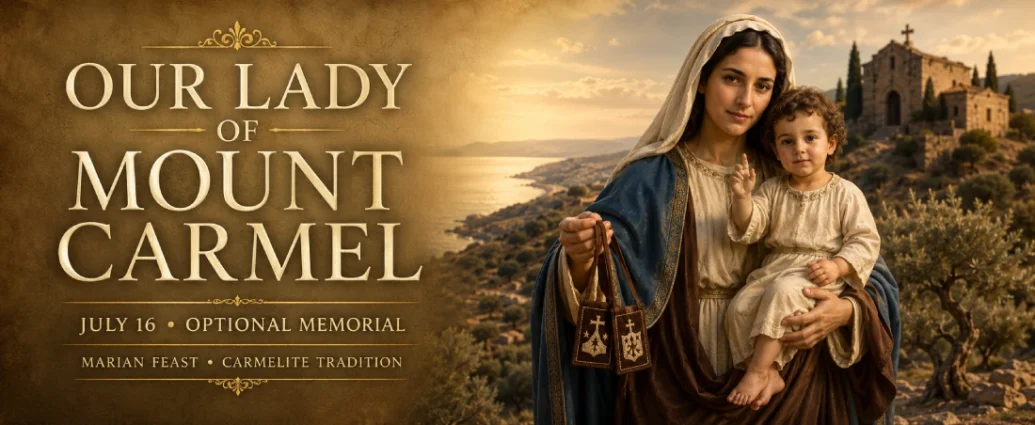
Few Marian titles are as deeply rooted in both Sacred Scripture and the spiritual life of the Church as Our Lady of Mount Carmel. Celebrated each year on July 16, this beloved feast honors the Blessed Virgin Mary’s special relationship with the Carmelite Order and her enduring role as a mother who leads believers to Jesus Christ.
Millions of Catholics around the world know Our Lady of Mount Carmel through the Brown Scapular, one of the Church’s most cherished sacramentals. Others recognize her as the patroness of the Carmelites, the protector of sailors, or the Queen and Beauty of Carmel. Yet her significance reaches far beyond any single devotion. She stands as a model of contemplative prayer, faithful discipleship, and complete trust in God.
To understand why this Marian title has inspired Christians for centuries, we must journey to a mountain that became one of the Bible’s most important places of encounter with the living God.
The Biblical Roots of Mount Carmel
Long before Christians honored the Blessed Virgin as Our Lady of Mount Carmel, Mount Carmel was already sacred in biblical history.
Located along the Mediterranean coast in present-day Israel, Mount Carmel became forever associated with the prophet Elijah. During a time when many Israelites had turned to the worship of Baal, Elijah challenged the false prophets to a dramatic contest on the mountain (1 Kings 18). When God answered Elijah’s prayer by sending fire from heaven upon the sacrifice, the people recognized once again that the Lord alone is God.
Soon afterward, Elijah prayed for rain after years of drought. A small cloud appeared over the sea, signaling God’s mercy and the end of the famine. Throughout Christian tradition—especially within Carmelite spirituality—that cloud came to symbolize hope and was later interpreted as a beautiful image pointing toward Mary, through whom Christ, the Savior of the world, entered history. This interpretation belongs to the Church’s spiritual tradition rather than the literal meaning of the biblical text.
Because of these events, Mount Carmel became a symbol of prayer, fidelity, and God’s victorious presence.
The Birth of the Carmelite Order
During the Crusader period in the late twelfth century, Christian hermits settled on Mount Carmel. Seeking a life of silence, prayer, and contemplation, they looked to the prophet Elijah as their spiritual father.
These hermits built a small chapel dedicated to the Blessed Virgin Mary, placing themselves under her protection. Around 1206–1214, they received a Rule of Life from St. Albert, Patriarch of Jerusalem, establishing the foundation of what became the Order of the Brothers of the Blessed Virgin Mary of Mount Carmel, commonly known as the Carmelite Order.
When political upheaval eventually forced the Carmelites to leave the Holy Land, they carried their devotion to Mary throughout Europe. Rather than fading, the Order flourished, and devotion to the Blessed Virgin under the title Our Lady of Mount Carmel spread across the Catholic world.
Why Is Mary Called Our Lady of Mount Carmel?
Unlike titles that refer to an apparition or a specific event in Mary’s earthly life, Our Lady of Mount Carmel reflects a spiritual relationship.
The title expresses that:
- Mary is the Patroness and Mother of the Carmelite Order.
- She is the perfect model of contemplative prayer.
- She always leads believers to a deeper relationship with Christ.
- She protects those who seek to follow her Son faithfully.
For Carmelites, Mary is not simply honored as an example from history but as a living mother who continues to accompany the Church.
The Brown Scapular: What Is It?
Perhaps the most recognizable aspect of devotion to Our Lady of Mount Carmel is the Brown Scapular.
Originally, a scapular formed part of the Carmelite religious habit. Over time, a smaller version became available for the faithful as a sacramental—a sacred sign instituted by the Church to help believers receive God’s grace through faith and prayer.
The Brown Scapular is not a good-luck charm, magical object, or guarantee of salvation. Catholic teaching is clear that salvation comes through Jesus Christ alone. The scapular is instead a visible reminder of a Christian’s commitment to:
- follow Christ faithfully,
- imitate Mary’s virtues,
- live a life of prayer,
- participate in the sacramental life of the Church,
- and persevere in holiness.
Those enrolled in the Brown Scapular devotion are encouraged to deepen their spiritual lives through regular prayer, reception of the sacraments, and faithful Christian living.
Did the Blessed Virgin Mary Appear to St. Simon Stock?
One of the best-known traditions connected with Our Lady of Mount Carmel concerns St. Simon Stock, an English Carmelite.
According to longstanding Carmelite tradition, the Blessed Virgin Mary appeared to him in 1251 and entrusted him with the Brown Scapular, promising her maternal assistance to those who faithfully lived its spiritual meaning.
What Do Historians Say?
Here it is important to distinguish between history and tradition.
Historically certain:
- St. Simon Stock was an important early Carmelite.
- Devotion to the Brown Scapular became widespread within the Carmelite Order.
Traditional:
- The specific apparition of Mary to St. Simon Stock in 1251 is preserved in Carmelite tradition.
- The historical documentation for the event appears later than the alleged apparition itself, and historians debate its precise historical basis.
The Catholic Church permits and encourages Brown Scapular devotion without requiring Catholics to believe every historical detail of the traditional account.
What Does the Catholic Church Teach About the Brown Scapular?
The Church views the Brown Scapular as a sacramental, not as an automatic guarantee of heaven.
Authentic devotion includes:
- faith in Jesus Christ,
- devotion to the Blessed Virgin Mary,
- prayer,
- repentance,
- participation in the Eucharist,
- and a sincere effort to live according to the Gospel.
The Brown Scapular serves as an outward sign of an inward commitment to Christian discipleship.
The Feast of Our Lady of Mount Carmel
The Feast of Our Lady of Mount Carmel is celebrated every year on July 16.
Originally observed within the Carmelite Order, the feast gradually spread throughout the Church and was eventually included in the General Roman Calendar.
Today Catholics celebrate the day by:
- attending Mass,
- praying the Rosary,
- wearing the Brown Scapular,
- renewing Marian consecration,
- reflecting on Carmelite spirituality,
- and asking Mary’s intercession for deeper union with Christ.
Patronage of Our Lady of Mount Carmel
Our Lady of Mount Carmel is especially honored as the patroness of:
- the Carmelite Order,
- sailors,
- fishermen,
- numerous coastal communities,
- several nations, including Chile and Bolivia,
- and countless churches and dioceses dedicated in her honor.
These patronages developed over centuries through the spread of Carmelite devotion and the trust of the faithful in Mary’s maternal protection.
Symbols and Iconography
Sacred art often depicts Our Lady of Mount Carmel with rich theological symbolism.
She frequently wears the Carmelite habit, showing her closeness to the Order that bears her name.
She commonly holds the Infant Jesus, emphasizing that every Marian devotion ultimately leads to Christ.
The Brown Scapular appears prominently in many images as a reminder of Christian commitment and discipleship.
Artists may also portray Mount Carmel, stars, a crown, or a small cloud, recalling both biblical history and the Carmelite spiritual tradition.
Why Our Lady of Mount Carmel Matters Today
Modern life often leaves little room for silence, contemplation, or sustained prayer. The spirituality of Carmel offers a needed reminder that holiness begins by listening to God.
Our Lady of Mount Carmel teaches Catholics that:
- prayer is not reserved for monks or nuns but is the calling of every Christian;
- devotion to Mary always points toward Jesus Christ;
- outward signs of faith must be matched by inner conversion;
- perseverance in holiness is more important than extraordinary experiences;
- God’s grace transforms ordinary lives through daily fidelity.
Her example continues to inspire saints, priests, religious, families, and lay faithful throughout the world.
Frequently Asked Questions
Who is Our Lady of Mount Carmel?
Our Lady of Mount Carmel is a title given to the Blessed Virgin Mary as Patroness and Mother of the Carmelite Order. The title reflects the Carmelite community’s origins on Mount Carmel in the Holy Land and Mary’s role as a model of prayer and discipleship.
When is the Feast of Our Lady of Mount Carmel?
The Church celebrates the Feast of Our Lady of Mount Carmel every year on July 16.
What is the Brown Scapular?
The Brown Scapular is a Catholic sacramental associated with the Carmelite Order. It is a sign of dedication to Mary and a commitment to live faithfully as a disciple of Christ.
Does wearing the Brown Scapular guarantee salvation?
No. The Catholic Church teaches that the Brown Scapular is not magical and does not automatically save anyone. It is meant to accompany a life of faith, prayer, repentance, and participation in the sacraments.
Who was St. Simon Stock?
St. Simon Stock was a thirteenth-century Carmelite friar traditionally associated with the spread of Brown Scapular devotion. The reported apparition of Mary to him belongs to Carmelite tradition, while the precise historical details remain debated.
What happened on Mount Carmel in the Bible?
Mount Carmel was the site where the prophet Elijah confronted the prophets of Baal and where God answered his prayer with fire from heaven. It later became a place of Christian prayer through the Carmelite hermits.
What is Carmelite spirituality?
Carmelite spirituality emphasizes prayer, contemplation, silence, trust in God, devotion to the Blessed Virgin Mary, and faithful union with Jesus Christ.
Why do Catholics honor Our Lady of Mount Carmel?
Catholics honor Our Lady of Mount Carmel because she is a powerful model of faith, contemplative prayer, and loving discipleship. Her maternal intercession encourages believers to grow closer to her Son and to persevere in holiness.
Conclusion
The story of Our Lady of Mount Carmel is not simply the history of a medieval religious order or a popular Catholic devotion. It is the story of how one biblical mountain became a lasting symbol of prayer, fidelity, and hope, and how the Blessed Virgin Mary came to be honored there as a loving mother who continually points the Church toward Christ.
From Elijah’s courageous witness on Mount Carmel to the quiet lives of the first Carmelite hermits, from centuries of Marian devotion to the widespread use of the Brown Scapular, this tradition has remained centered on one essential truth: authentic devotion to Mary always leads to deeper discipleship under the lordship of Jesus Christ.
For Catholics today, Our Lady of Mount Carmel remains an invitation to embrace silence amid noise, perseverance amid trials, and faithful prayer in every season of life. By following her example of humble obedience and unwavering trust in God, believers discover anew that the path to holiness is found not in extraordinary experiences but in a daily, loving response to God’s grace.