
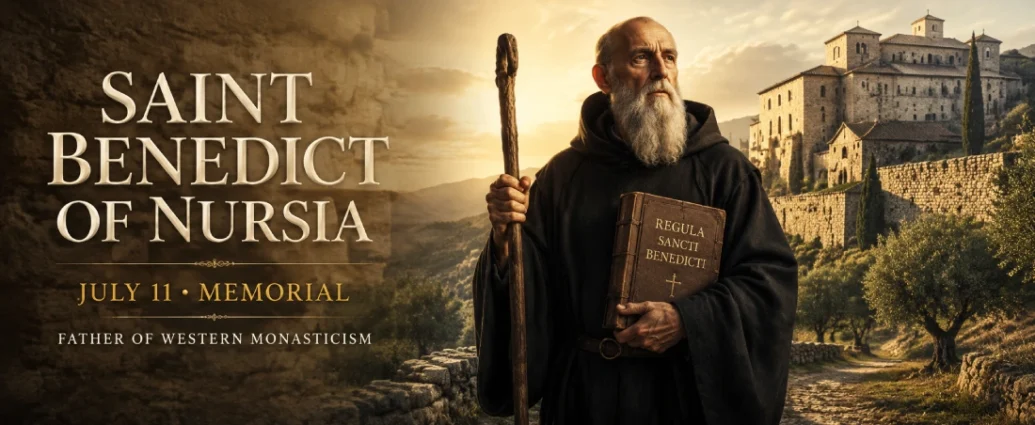
Few saints have shaped the history of the Catholic Church as profoundly as Saint Benedict of Nursia. Living during one of the most turbulent periods in European history, Benedict did not lead armies, govern kingdoms, or preach to vast crowds. Instead, he quietly built communities centered on prayer, work, humility, and love of God—communities that would preserve the Christian faith, learning, and culture for centuries.
Known as the Father of Western Monasticism, Saint Benedict wrote the Rule of Saint Benedict, a spiritual guide that continues to direct Benedictine monasteries around the world. His influence extends far beyond monastic life. The values he taught—balance, obedience, hospitality, stability, and daily conversion—have inspired countless Catholics seeking to live faithfully in every age.
Today, Catholics honor Saint Benedict not only as a great abbot but also as the patron saint of Europe, a protector against spiritual evil through the Church’s use of the Saint Benedict Medal, and a model of holiness whose wisdom remains remarkably relevant.
Historical Background: A Saint for a World in Crisis
Saint Benedict was born around A.D. 480 in Nursia (modern Norcia, Italy), only a few years after the fall of the Western Roman Empire. Europe was entering a period of political instability. Ancient Roman institutions were weakening, cities were declining, and repeated wars brought uncertainty to everyday life.
Although Christianity had become firmly established throughout much of the Roman world, many Christians struggled to live the Gospel amid social upheaval. Across both East and West, men and women were embracing lives of prayer and asceticism, inspired by the earlier Desert Fathers.
Benedict would become the Western Church’s greatest organizer of this monastic movement, offering not extreme asceticism but a balanced and deeply practical path to holiness.
Early Life and Family
Much of what we know about Saint Benedict comes from Pope Gregory the Great’s Dialogues, written about fifty years after Benedict’s death. Historians generally regard Gregory’s work as the principal historical source for Benedict’s life while recognizing that some miraculous accounts belong to the tradition of Christian hagiography.
According to this early tradition, Benedict was born into a respected Roman family. He also had a twin sister, Saint Scholastica, who dedicated her own life to God and is honored as one of the great women of early Western monasticism.
As a young man, Benedict was sent to Rome for his education. There he encountered a society marked by moral decline and political uncertainty. Rather than pursuing a promising worldly career, he chose a radically different path.
Leaving the World Behind
Seeking God above everything else, Benedict withdrew from Rome and eventually settled near Subiaco, where he lived for several years as a hermit in a cave.
These years of solitude became the foundation of his spiritual life.
Far from escaping the world out of fear, Benedict entered the silence to seek Christ more completely. Through prayer, fasting, Scripture, and self-discipline, he developed the spiritual maturity that would later shape thousands of monks and, eventually, Western civilization itself.
His reputation for holiness gradually spread. Visitors sought his counsel, and nearby monks eventually asked him to become their abbot.
The First Monastery—and the Challenges of Reform
Benedict accepted leadership of an existing monastery, but his insistence on discipline and authentic Christian living proved difficult for some monks to accept.
According to long-standing tradition, opposition became so intense that an attempt was even made to poison him. Gregory the Great recounts that Benedict blessed the cup before drinking, causing it to shatter.
Whether understood historically or as a traditional account illustrating God’s protection, the story reflects an important reality: genuine reform is rarely welcomed by everyone.
Benedict eventually left and returned to establishing new communities rather than forcing reluctant monks to change.
Building Communities That Would Change History
Around Subiaco, Benedict founded a network of monasteries where monks lived together under a common rule of prayer, work, study, and mutual charity.
His greatest achievement came around A.D. 529, when he founded the monastery of Monte Cassino on a hill that had once contained a pagan shrine.
Instead of merely destroying the old sanctuary, Benedict transformed the site into a center of Christian worship and monastic life.
Monte Cassino became one of the most influential monasteries in Christian history and remains closely associated with Saint Benedict today.
The Rule of Saint Benedict
Saint Benedict’s greatest lasting contribution was not a miracle or a sermon but a book.
The Rule of Saint Benedict is a practical guide for living a Christ-centered life within a monastic community. Although written primarily for monks, its wisdom has inspired clergy, religious, and lay Catholics for nearly fifteen centuries.
The Rule emphasizes:
- Prayer as the center of daily life.
- Humility as the path to holiness.
- Obedience rooted in love rather than fear.
- Stability within one’s vocation.
- Manual labor performed with dignity.
- Hospitality offered as if welcoming Christ Himself.
- Regular reading of Sacred Scripture.
- Balance instead of extremes.
The familiar Benedictine expression “Ora et Labora” (“Pray and Work”) beautifully summarizes this spirituality, even though the exact phrase does not appear as a formal motto in the Rule itself.
Saint Benedict’s Relationship with Christ
Everything in Benedict’s life revolved around Jesus Christ.
His Rule constantly directs monks to seek Christ through prayer, charity, obedience, and humility. The Divine Office—the daily cycle of psalms and prayer—formed the heartbeat of Benedictine life.
For Benedict, holiness was not achieved through extraordinary experiences but through ordinary faithfulness practiced every day.
His spirituality reminds Catholics that sainthood is often built through countless small acts of love offered consistently to God.
Devotion to the Blessed Virgin Mary
Although Gregory’s biography does not emphasize Marian devotion in the way later saints often would, Benedict lived within the rich Marian faith of the early Western Church.
Benedictine monasteries have long fostered devotion to the Blessed Virgin Mary through the liturgy, Marian feasts, sacred music, and prayer, reflecting the Church’s enduring love for the Mother of God.
Miracles Associated with Saint Benedict
Many miracles are traditionally associated with Saint Benedict through Pope Gregory’s Dialogues. Catholics distinguish these traditional accounts from independently verifiable historical events.
Among the best-known traditions are:
- A broken sieve restored through prayer.
- A poisoned cup shattering after Benedict blessed it.
- A raven carrying away poisoned bread.
- Healings through prayer.
- Prophetic insight into future events.
- Deliverance from demonic oppression.
- The restoration of a dead child to life.
Whether read historically or devotionally, these accounts consistently emphasize God’s power rather than Benedict’s own greatness.
The Saint Benedict Medal
One of the most widely used sacramentals in the Catholic Church is the Saint Benedict Medal.
The medal contains symbols and prayers expressing confidence in Christ’s victory over evil. Catholics do not believe the medal possesses magical powers. Rather, when properly blessed and used with faith, it serves as a sacramental that encourages prayer, conversion, and trust in God’s protection.
Its use reflects Catholic teaching on sacramentals: visible signs that dispose believers to receive God’s grace more fruitfully.
How Did Saint Benedict Die?
According to early tradition, Benedict knew his earthly life was nearing its end.
After receiving Holy Communion, he was supported by his monks while standing in prayer. There, with his hands lifted toward heaven, he peacefully surrendered his soul to God around A.D. 547.
Although the exact details come from traditional accounts, historians generally accept that Benedict died at Monte Cassino around this period.
Burial, Relics, and Veneration
Saint Benedict was buried at Monte Cassino, traditionally beside his sister, Saint Scholastica.
Over the centuries, Monte Cassino became one of Christianity’s greatest centers of pilgrimage, scholarship, and monastic life. The monastery suffered repeated destruction through wars—including during the Second World War—but was rebuilt, symbolizing the enduring strength of Benedict’s legacy.
Devotion to Saint Benedict spread rapidly throughout Europe, aided significantly by Pope Gregory the Great’s biography.
Unlike saints from the earliest centuries of Christianity, Benedict was not canonized through the modern formal process, which did not yet exist. His sanctity was recognized through the Church’s ancient tradition of public veneration, and he has been honored universally for many centuries.
What Is Saint Benedict the Patron Saint Of?
Saint Benedict is the patron saint of:
- Europe.
- Benedictine monks and monasteries.
- Students.
- Agricultural workers.
- Engineers.
- Spelunkers (because of his years in the cave at Subiaco).
- Those seeking protection from poisoning.
In 1964, Pope Saint Paul VI declared him Patron of Europe, recognizing Benedict’s extraordinary role in shaping the continent’s Christian identity.
Symbols of Saint Benedict
Sacred art often depicts Saint Benedict with:
- A black Benedictine habit.
- A crozier, symbolizing his role as abbot.
- The Rule of Saint Benedict.
- A broken cup recalling the traditional poisoning account.
- A raven carrying bread.
- A cross symbolizing Christ’s victory over evil.
- The monastery of Monte Cassino.
These symbols help tell the story of his life and mission while pointing ultimately toward Christ.
Why Is Saint Benedict Important Today?
Saint Benedict lived through uncertainty remarkably similar to many challenges facing modern society.
His answer was not fear or despair.
He taught Christians to build strong families, faithful communities, disciplined prayer lives, and cultures rooted in Christ.
His monasteries became places where faith, education, agriculture, hospitality, art, and learning flourished. They preserved countless classical and Christian texts that might otherwise have been lost.
More importantly, Benedict showed that genuine renewal begins not with political power but with personal holiness.
Lessons Catholics Can Learn from Saint Benedict
Saint Benedict’s life continues to offer practical wisdom for every Catholic.
He teaches us to:
- Put Christ at the center of every day.
- Seek holiness through ordinary faithfulness.
- Balance prayer, work, and rest.
- Practice humility instead of self-promotion.
- Welcome every person with Christian hospitality.
- Remain faithful during times of cultural uncertainty.
- Build communities grounded in charity and truth.
His Rule reminds us that sanctity is rarely dramatic. More often, it is the quiet result of daily fidelity to God.
Frequently Asked Questions
Who was Saint Benedict of Nursia?
Saint Benedict of Nursia was a sixth-century Italian monk, abbot, and founder of Western monasticism. He wrote the Rule of Saint Benedict, which continues to guide Benedictine communities around the world.
What is Saint Benedict known for?
He is best known for founding the monastery at Monte Cassino, writing the Rule of Saint Benedict, and establishing a balanced approach to Christian monastic life centered on prayer, work, humility, and community.
Why is Saint Benedict called the Father of Western Monasticism?
His Rule became the foundation for most Western monastic communities and profoundly influenced the spiritual, educational, and cultural development of Europe.
What is Saint Benedict the patron saint of?
He is the patron saint of Europe, Benedictine monks, students, agricultural workers, engineers, spelunkers, and those seeking protection from poisoning.
When is Saint Benedict’s feast day?
The General Roman Calendar celebrates Saint Benedict on July 11. His traditional date of death, March 21, is still observed in some Benedictine communities.
What miracles are associated with Saint Benedict?
Traditional accounts include the restoration of a broken sieve, the shattering of a poisoned cup, a raven carrying away poisoned bread, healings, prophetic insight, exorcisms, and other miraculous events described by Pope Gregory the Great.
What is the Rule of Saint Benedict?
The Rule is a practical spiritual guide for monastic life emphasizing prayer, humility, obedience, work, hospitality, and continual conversion to Christ.
What is the Saint Benedict Medal?
The Saint Benedict Medal is a Catholic sacramental that expresses faith in Christ’s victory over evil. When blessed and used with devotion, it encourages prayer, trust in God, and a deeper commitment to Christian life.
Where are Saint Benedict’s relics?
Saint Benedict is traditionally buried at Monte Cassino in Italy alongside his sister, Saint Scholastica. Some relics are also venerated elsewhere according to longstanding ecclesiastical tradition.
Why does Saint Benedict still matter today?
His wisdom speaks directly to modern life. In an age of distraction and instability, Benedict reminds us that prayer, discipline, humility, community, and love of Christ remain the surest path to lasting peace.
Conclusion
More than fifteen hundred years after his death, Saint Benedict of Nursia continues to shape the life of the Catholic Church. His monasteries transformed Europe, his Rule formed generations of saints, and his vision of Christian living remains as relevant as ever.
Benedict never sought fame. He simply sought God.
By choosing prayer over ambition, humility over power, and faithful daily service over worldly success, he became one of the most influential saints in Christian history.
His life reminds every Catholic that holiness is not reserved for extraordinary people. It is found in ordinary believers who faithfully seek Christ each day—through prayer, work, charity, and steadfast hope.