
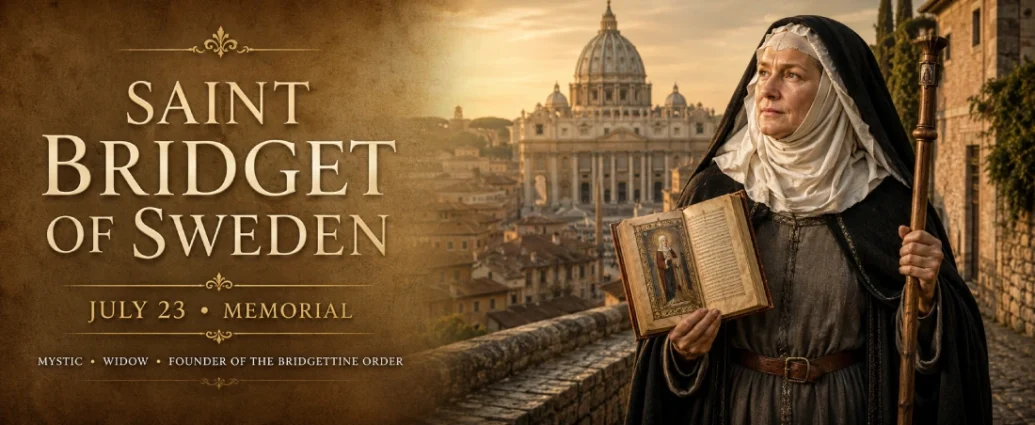
Every age of the Church has produced men and women whose lives called others back to Christ. Among the most remarkable is Saint Bridget of Sweden (c. 1303–1373)—a wife, mother of eight children, widow, mystic, religious founder, and one of the greatest female voices for renewal in medieval Christianity. Honored as the patron saint of Sweden, a co-patroness of Europe, and the founder of the Bridgettine Order, she demonstrated that holiness can flourish in every stage of life.
Saint Bridget is best known for her deep devotion to the Passion of Christ, her reported mystical revelations, and her fearless appeals to kings, bishops, and popes to pursue justice, repentance, and fidelity to the Gospel. More than six centuries after her death, Catholics continue to honor her because her life united prayer with courageous action and unwavering trust in God.
A Noble Childhood in Medieval Sweden
Bridget, known in Swedish as Birgitta Birgersdotter, was born around 1303 at Finsta in Uppland, Sweden, into a respected noble family. Her father, Birger Persson, served as a provincial governor and judge, while her mother, Ingeborg Bengtsdotter, was known for her Christian faith.
She grew up during a turbulent period in European history. The Church was experiencing the Avignon Papacy, when the popes resided in France instead of Rome. Political conflicts, social unrest, and later the devastation of the Black Death challenged both society and the Church. These events shaped Bridget’s lifelong concern for moral reform and faithful Christian living.
Medieval tradition records that Bridget experienced extraordinary spiritual experiences from an early age. While these accounts form part of her traditional biography, historians distinguish them from the historically documented events of her adult life.
Marriage, Family, and a Holy Household
Unlike many saints remembered primarily for monastic life, Bridget first lived the vocation of marriage. Around the age of thirteen, she married Ulf Gudmarsson, a Swedish nobleman.
Their marriage produced eight children, including Saint Catherine of Sweden, who would later continue her mother’s spiritual work.
Bridget’s life reminds Catholics that holiness is not reserved for monasteries or convents. She fulfilled her responsibilities as wife, mother, estate manager, and member of the royal court while maintaining a deep life of prayer. Her family became an example of Christian charity, hospitality, and devotion.
Around 1341, Bridget and Ulf made a pilgrimage to Santiago de Compostela in Spain. The journey strengthened their faith and marked a turning point in Bridget’s spiritual life.
Widowhood and a New Mission
After Ulf’s death around 1344, Bridget entered a new chapter of her life. Rather than remarry, she dedicated herself completely to prayer, charity, and service to the Church.
It was during this period that she reported receiving numerous mystical revelations centered on Christ’s Passion, the Blessed Virgin Mary, the Eucharist, and the need for repentance. These revelations were recorded by her confessors and later compiled as the Revelations of Saint Bridget.
The Catholic Church recognizes these writings as private revelations, not part of the deposit of faith. Catholics are free to benefit from them spiritually, but they are not required to believe them as they do Sacred Scripture or Sacred Tradition.
Bridget’s writings consistently called Christians to conversion, humility, obedience, and love for Christ.
Founder of the Bridgettine Order
One of Saint Bridget’s greatest historical achievements was founding the Order of the Most Holy Savior, commonly known as the Bridgettine Order.
The order was unique in medieval Europe because it envisioned communities of women and men living in neighboring monasteries under the leadership of an abbess. Bridget believed religious life should combine contemplation, charity, education, and fidelity to Christ.
She sought papal approval for the order and spent many years working toward its establishment. Today, Bridgettine communities continue her mission throughout the world.
A Voice for Reform
Saint Bridget never separated prayer from action.
Living during a period of political instability and ecclesiastical challenges, she courageously addressed kings, nobles, bishops, and even the pope. She urged them to repent, govern justly, and remain faithful to Christ.
Perhaps her most significant historical role was encouraging the pope to return from Avignon to Rome, believing that the Church’s unity required the successor of Saint Peter to reside in the Eternal City.
Although historians recognize that many political and ecclesiastical factors influenced the eventual return of the papacy, Bridget’s persistent appeals made her one of the most respected voices for reform during the fourteenth century.
Pilgrimage to Rome and the Holy Land
In 1349, Bridget moved permanently to Rome. There she devoted herself to prayer, charitable works, and promoting reform within the Church.
Later in life she fulfilled another lifelong desire by making a pilgrimage to the Holy Land. Visiting the places associated with the life, death, and Resurrection of Jesus Christ deepened her meditation on the Passion, a theme that permeates her spiritual writings.
These pilgrimages reflected her conviction that faith is not merely intellectual but lived through sacrifice, prayer, and encounter with God’s saving work.
How Did Saint Bridget Die?
Saint Bridget died peacefully in Rome on July 23, 1373, shortly after returning from the Holy Land.
Her body was later transferred to Vadstena Abbey in Sweden, which became the spiritual heart of the Bridgettine Order and remains an important pilgrimage destination.
Her relics continue to be honored there, although some relics are also preserved in Rome and other churches associated with her order.
Canonization and Patronage
Because of her widely recognized holiness and influence, Bridget was canonized in 1391 by Pope Boniface IX, only eighteen years after her death.
In 1999, Pope Saint John Paul II declared Saint Bridget a Co-Patroness of Europe, together with Saint Catherine of Siena and Saint Teresa Benedicta of the Cross (Edith Stein). The title recognizes her profound contribution to the spiritual identity of Europe and her enduring witness to Christian unity.
Today she is especially honored as the patron saint of:
- Sweden
- Europe (Co-Patroness)
- Widows
- Pilgrims
- Those experiencing difficulties in marriage
Her feast day is celebrated on July 23 in the General Roman Calendar.
What Miracles Are Associated with Saint Bridget?
Unlike many saints known primarily for dramatic miracles during their lifetime, Saint Bridget is remembered chiefly for her extraordinary spiritual influence.
The principal miraculous claims associated with her involve her reported visions of Christ and the Blessed Virgin Mary. Historically, these experiences cannot be verified as historical events, and the Church wisely distinguishes them from public Revelation.
During her canonization process, however, documented healings attributed to her intercession were investigated according to the Church’s established procedures, contributing to her recognition as a saint.
Spiritual Legacy
Saint Bridget’s spirituality centered on Jesus Christ, especially His Passion. She encouraged believers to contemplate Christ’s suffering with gratitude and to respond through repentance, charity, and faithful discipleship.
Her devotion to the Blessed Virgin Mary also shaped her writings, presenting Mary as the perfect disciple who always leads believers to her Son.
Bridget’s life demonstrates that sanctity can be lived in marriage, parenthood, widowhood, public service, and religious life. She never abandoned her responsibilities; instead, she allowed each stage of life to become a path toward holiness.
What Can Catholics Learn from Saint Bridget Today?
Saint Bridget remains remarkably relevant.
She teaches that authentic reform begins with personal conversion before it transforms society. She reminds families that marriage and parenthood are genuine vocations to holiness. She demonstrates that prayer should produce courage, compassion, and a willingness to speak the truth with charity.
Her witness also reminds Christians to remain faithful to the Church while praying and working for its continual renewal according to the Gospel.
Frequently Asked Questions
Who was Saint Bridget of Sweden?
Saint Bridget of Sweden was a fourteenth-century Catholic mystic, wife, mother, widow, religious founder, and Co-Patroness of Europe, best known for her spiritual writings and commitment to Church renewal.
What is Saint Bridget the patron saint of?
She is the patron saint of Sweden, widows, pilgrims, those experiencing difficult marriages, and a Co-Patroness of Europe.
When is Saint Bridget’s feast day?
Her feast day is celebrated on July 23.
What are the Revelations of Saint Bridget?
They are collections of private mystical experiences recorded by her confessors. The Church permits devotion to them but does not require belief in them.
What is the Bridgettine Order?
The Bridgettine Order, officially the Order of the Most Holy Savior, was founded by Saint Bridget and continues her mission of prayer, contemplation, and service.
Where are Saint Bridget’s relics?
Her principal relics are preserved at Vadstena Abbey in Sweden, with additional relics in Rome and other Bridgettine churches.
Why is Saint Bridget important?
She united family life, deep prayer, courageous leadership, and Church reform, leaving a lasting influence on Catholic spirituality and European Christianity.
Why was Saint Bridget canonized?
The Church recognized her heroic holiness, enduring witness, spiritual writings, and the miracles investigated during her canonization process.
Conclusion
Saint Bridget of Sweden stands among the Church’s most remarkable saints because her holiness embraced every season of life. She was a devoted wife, loving mother, faithful widow, courageous reformer, gifted mystic, and founder of a religious order that continues to serve the Church today.
Her life reminds us that sanctity is not reserved for a privileged few. It is found in daily faithfulness, prayer rooted in Christ, love for the Blessed Virgin Mary, service to others, and the courage to seek renewal in ourselves and in the world around us. More than 650 years after her death, Saint Bridget continues to inspire Catholics to live the Gospel with conviction, humility, and hope.