
The Assault on Motherhood: A Catholic Defense of Womanhood, Creation, and Natural Law
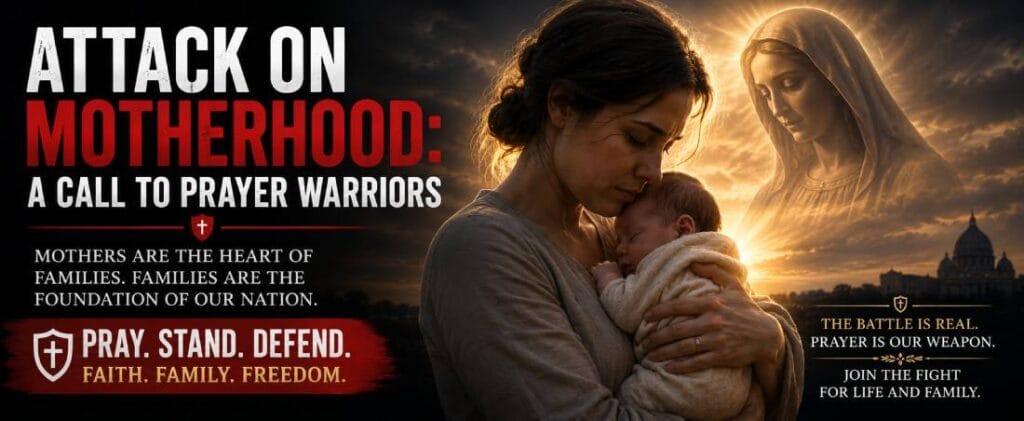
The contemporary push to replace terms like “woman” and “mother” with sterile phrases such as “birthing person,” “pregnant individual,” or “gestational parent” is not a benign linguistic evolution. It is a direct assault on natural law, biological reality, and the divine order established by God. Healthcare networks, legislative bodies, and academic institutions increasingly adopt terminology that strips femininity of its unique, God-given identity.
For the Catholic faithful, this shift represents a theological crisis. Human language carries moral weight; when society systematically erases the word “mother,” it attempts to erase the spiritual and physical reality of womanhood itself. The Church calls all believers to respond not with resignation, but with clarity, sacramental conviction, and authentic Christian charity.
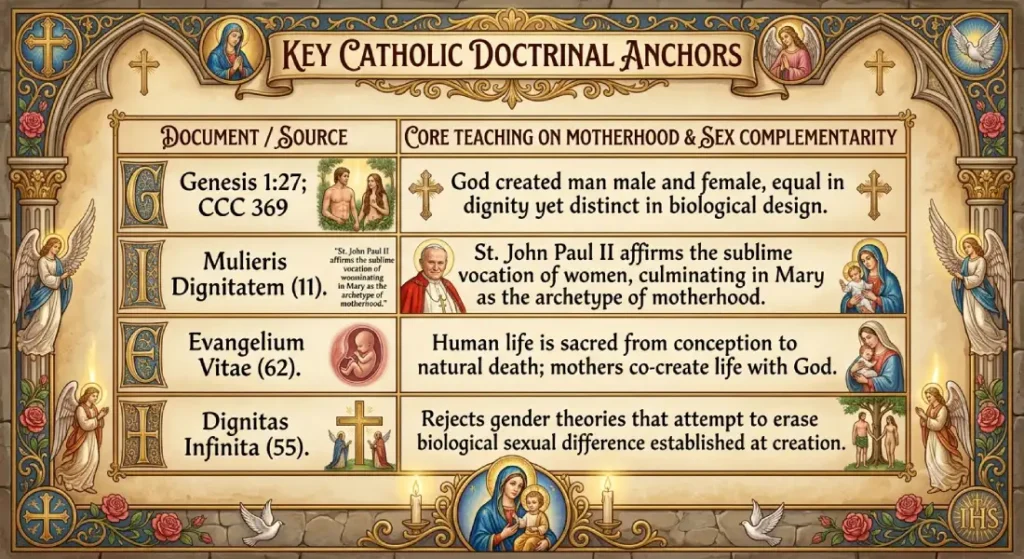
God’s Intentional Design: Sex Complementarity and Natural Law
Biological sex is neither a social construct nor an accident of nature. As the Catechism of the Catholic Church states, “Man and woman have been created, which is to say, willed by God: on the one hand, in perfect equality as human persons; on the other, in their respective beings as man and woman” (CCC 369). The capacity to conceive, carry, and nourish new human life belongs exclusively to the female sex.
In his landmark Apostolic Letter Mulieris Dignitatem (On the Dignity and Vocation of Women), Pope St. John Paul II emphasized that motherhood is linked to the personal structure of the woman’s organism:
“Motherhood involves a particular communion with the mystery of life, as it develops in the mother’s womb… This unique contact with the new human being being formed within her creates an attitude towards human beings—not only towards her own child, but every human being—which profoundly marks the woman’s personality.” (Mulieris Dignitatem, 18)
When secular institutions mandate gender-neutral terminology in maternity care, they deny the soul-body unity of the human person. St. Thomas Aquinas teaches in the Summa Theologiae that the soul is the substantial form of the body (ST I, q. 76, a. 1). Physical biology is an essential aspect of human personhood created in the image of God (cf. Genesis 1:27). Attempting to sever maternal function from feminine identity dishonors the wisdom of the Creator.
The Spiritual Dimension of Co-Creation
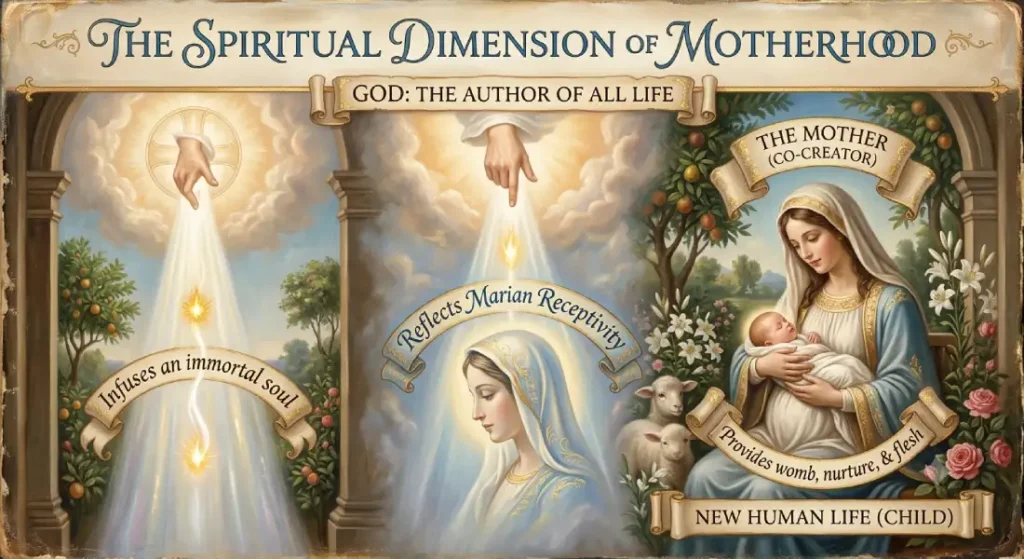
Motherhood is far more than a biological mechanism; it is a sacred participation in God’s creative power. Sacred Scripture frequently highlights the sacred partnership between a mother and the Almighty. The Psalmist proclaims: “For you created my inmost being; you knit me together in my mother’s womb” (Psalm 139:13).
Catholic moral theology recognizes mothers as co-creators with God. While the parents contribute the biological material, God directly infuses an immortal soul at the moment of conception (CCC 366). Modern phrases like “birthing person” reduce this sublime spiritual mystery to mere functional mechanics, degrading the mother from a sacred co-creator to an anonymous biological unit.
Furthermore, the Catholic Church sees the ultimate elevation of womanhood and motherhood in the Blessed Virgin Mary. Through her Fiat—her full consent to the Divine Will—Mary became the Theotokos, the Mother of God. In Mary, motherhood becomes the gateway through which Redemption entered the world. Every earthly mother reflects, in a finite way, this Marian dignity, offering her body, energy, and love so that new life may flourish.
The Link Between Linguistic Erasure and the Culture of Death
The systematic erasure of “woman” from maternal care cannot be separated from the broader legal and cultural attacks on human life. In his encyclical Evangelium Vitae (The Gospel of Life), St. John Paul II warned against the corruption of language used to disguise moral evils:
“We need now more than ever to have the courage to look the truth in the eye and to call things by their proper name, without yielding to convenient compromises or to the temptation of self-deception… Especially in the case of abortion there is a widespread use of ambiguous terminology, such as ‘interruption of pregnancy’, which tends to hide its true nature and to attenuate its seriousness in public opinion.” (Evangelium Vitae, 58)
The same ideological framework that redefines pregnancy as a gender-neutral condition also promotes abortion as essential healthcare. Both positions rest on the false premise that the human body can be manipulated or discarded according to individual autonomy or political utility. By rejecting the objective truth of human biology, society undermines the foundational moral truth that every human life possesses intrinsic dignity from conception to natural death (CCC 2270).
In its 2024 declaration Dignitas Infinita, the Dicastery for the Doctrine of the Faith explicitly affirmed that theories attempting to erase sexual difference violate human dignity: “Any sex-change intervention, as a rule, risks threatening the unique dignity the person has received from the moment of conception” (Dignitas Infinita, 60). Defending the word “mother” is therefore a direct defense of human dignity and natural law.
A Catholic Action Plan: Spiritual Combat and Pastoral Courage
Faced with severe cultural confusion, Catholic lay faithful and clergy must respond with courage, spiritual discipline, and genuine pastoral charity. As St. Paul exhorts, “Our struggle is not with flesh and blood, but with the principalities, with the powers, with the world rulers of this present darkness” (Ephesians 6:12).
To defend the sanctity of motherhood, Catholics must deploy both spiritual and practical remedies:
1. Ground Action in the Sacraments and the Rosary
Spiritual confusion requires spiritual weapons. Catholics should offer regular intentions during Mass, participate in Eucharistic Adoration, and pray the Holy Rosary for the protection of mothers, unborn children, and family life. Invoking the intercession of the Blessed Virgin Mary and St. Joseph provides powerful supernatural protection against cultural falsehoods.
2. Refuse Linguistic Compromise
Catholics must maintain complete clarity in public discourse, professional settings, and civic institutions. Always use clear, truthful vocabulary—referring to “women,” “mothers,” “expectant mothers,” and “fathers.” Truth spoken in charity has immense power to dispel ideological darkness.
3. Support Crisis Pregnancy Ministries
Defending motherhood requires tangible support for women in difficult circumstances. Catholic parishes and individuals must generously assist crisis pregnancy centers, maternity homes, and parochial programs like Gabriel Project or the USCCB’s Walking with Mothers in Need initiative. Providing financial, emotional, and spiritual care proves that the Church honors and protects every mother.
4. Form the Next Generation in Theology of the Body
Parents and catechists must proactively teach young people God’s vision for human sexuality, biological sex, and marriage. Utilizing St. John Paul II’s Theology of the Body, families can equip children to understand that their bodies are sacred gifts designed for holy purpose, shielding them from secular gender ideologies.
Frequently Asked Questions
The Catholic Church teaches that God created human beings as male and female (Genesis 1:27; CCC 369). Biological sex is an integral component of personal identity. Motherhood involves the unique biological, physical, and psychological capacity to conceive, carry, and nourish new life—a capacity that belongs exclusively to the female sex according to divine design and natural law.
While using a term out of ignorance or institutional mandate may not always constitute a grave personal sin, deliberately using language that denies biological reality and divine creation undermines truth. Catholics are called to “speak the truth in love” (Ephesians 4:15) and resist ideological language that erases the dignity of womanhood and motherhood.
Protecting the unborn child requires honoring the unique role of the mother who carries that child. The Church teaches that human life begins at conception and must be protected at every stage (CCC 2270). Denying the reality of motherhood undermines the moral framework that protects both mother and child from abortion and exploitation.
Conclusion
The vocation of motherhood is established by God, consecrated by the Incarnation, and reflected in the Blessed Virgin Mary. While secular culture attempts to erase sexual differences through sterile language, the Catholic Church stands firm as a guardian of truth, natural law, and human dignity. By remaining grounded in the Sacraments, speaking with uncompromising clarity, and providing loving support to expectant mothers, the faithful will preserve and restore the sacred calling of motherhood for generations to come.
Source: LifeSiteNews
Continue Your Faith Journey
Dobbs Decision Anniversary: Why the Battle for Life Has Moved from the Courts to the Heart
On the Dobbs decision anniversary, the pro-life mission shifts from courtrooms to human hearts. Discover how Catholic teaching and Evangelium Vitae call…
Venerable Jérôme Lejeune, Pope Leo XIV, and the Inviolable Dignity of Human Life
Explore how Venerable Jérôme Lejeune's scientific witness and Catholic teaching defend the sacred dignity of human life against modern programmed death. Learn…
What the Catholic Church Teaches About Surrogacy: Dignity, Marriage, and the Gift of Life
Explore what the Catholic Church teaches about surrogacy, human dignity, and the sacred marital covenant. Learn why the Magisterium protects children as…