
Dehumanization in the Public Square: A Catholic Theological Analysis of Rep. Shri Thanedar’s Abortion Remarks
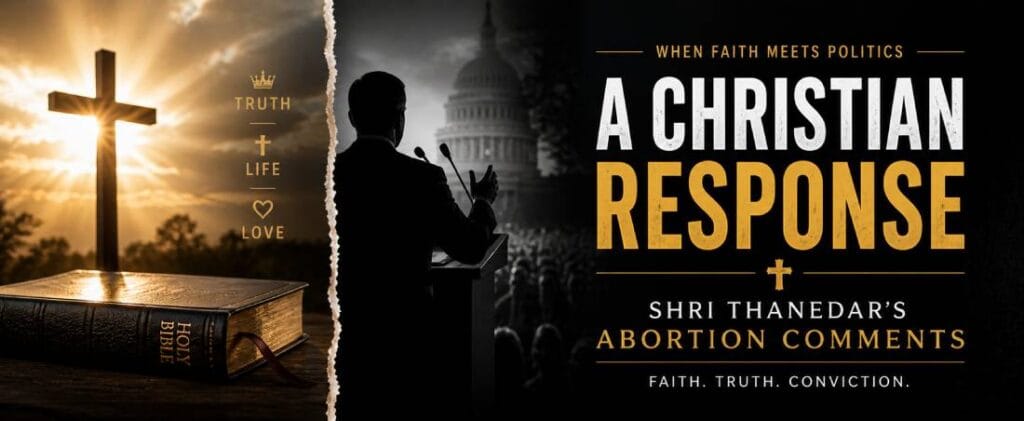
In a tense Capitol Hill exchange following House Judiciary Committee proceedings, Representative Brandon Gill (R-TX) pressed pro-abortion witnesses to address the anatomical reality of abortion procedures—specifically suction curettage, dilation and evacuation, and chemical abortions. In response, Representative Shri Thanedar (D-MI) published a statement on social media declaring: “My favorite kind of abortion is the kind that’s safe, legal, accessible, and none of your damn business to regulate.” He further claimed that descriptions of unborn life amounted to “fearmongering by describing what goes on to a half-ounce fetus with no consciousness, self-awareness, or feeling of pain.”
These remarks provoked widespread outrage among pro-life advocates, Christians, and moral theologians. However, for faithful Catholics, Thanedar’s statement is not merely a political dispute. It serves as a stark manifestation of a secularized culture that denies natural law, rejects the objective dignity of the human person, and scoffs at divine authority. To respond effectively, Catholics must move beyond emotional grief and ground their understanding in Sacred Scripture, Sacred Tradition, the Catechism of the Catholic Church, and the wisdom of the Doctors of the Church.
1. Dogmatic Foundation: The Inviolability of Unborn Human Life
The Catholic Church has unchangeably affirmed the moral evil of every procured abortion since its apostolic origins. This teaching is not a disciplinary rule subject to political compromise; it is an unalterable principle of natural moral law and divine revelation.
“Human life must be respected and protected absolutely from the moment of conception. From the first moment of his existence, a human being must be recognized as having the rights of a person—among which is the inviolable right of every innocent being to life.”
— Catechism of the Catholic Church, CCC 2270
This doctrine is rooted in the early Apostolic witness. The Didache (c. A.D. 70–100), one of the oldest surviving non-canonical Christian documents, explicitly commands: “You shall not procure an abortion, nor destroy a newborn child” (Didache 2, 2). This consistent stance was reiterated by Pope St. John Paul II in his landmark encyclical Evangelium Vitae (1995):
“By the authority which Christ conferred upon Peter and his Successors, in communion with the Bishops… I declare that direct abortion, that is, intended as an end or as a means, always constitutes a grave moral disorder, since it is the deliberate killing of an innocent human being.”
— Evangelium Vitae, n. 57
When public officials trivialize abortion as a personal preference or a matter beyond public regulation, they directly contradict the foundational duty of civil authority. As the Congregation for the Doctrine of the Faith noted in its 1974 Declaration on Procured Abortion, human law cannot authorize what is contrary to natural law: “A positive law which contradicts the natural law is not validly obligating in conscience.”
2. Refuting Utilitarianism: Personhood, Consciousness, and Natural Law
Representative Thanedar’s dismissal of the unborn child rests on a classic utilitarian error: defining human worth by functional capacity. By claiming that a child lacks “consciousness, self-awareness, or feeling of pain,” his argument asserts that personhood is earned through developmental milestones rather than inherited through human nature.
From a Thomistic and Catholic philosophical perspective, this claim fails to distinguish between the essence of a human person and the expression of biological faculties.
Thomistic Hylomorphism and Natural Right
St. Thomas Aquinas teaches that human beings are a composite of body and rational soul (Summa Theologiae, I, q. 75, a. 4). The human soul is the substantial form of the body. From the moment of conception, the zygote is not a potential human being, but a human being with potential.
- Inherent Dignity vs. Functional Ability: A human person does not lose their intrinsic value during sleep, anesthesia, or coma, despite temporary absences of active consciousness. Reduced neurological activity does not strip an individual of their human nature.
- Natural Law Realism: Justice requires giving each person their due (Summa Theologiae, II-II, q. 58, a. 1). Because the unborn child is a distinct, living individual of the species Homo sapiens, depriving that child of life is an act of supreme injustice.
- Biblical Witness: Sacred Scripture repeatedly testifies to God’s direct creation and intimate knowledge of the child in the womb: “For you created my inmost being; you knit me together in my mother’s womb… your eyes saw my unformed body” (Psalm 139:13, 16).
3. Comparative Matrix: Secular Rhetoric vs. Catholic Dogma
To equip catechists, parish leaders, and faithful citizens, the following matrix contrasts common secular abortion arguments with authentic Catholic doctrine:
| Secular / Political Claim | Catholic Magisterial Teaching | Primary Dogmatic Source |
| “Abortion is safe, legal, and accessible healthcare.” | Direct abortion is never healthcare; it is the intentional termination of an innocent human life, which is intrinsically evil. | CCC 2271; Evangelium Vitae, n. 57 |
| “An unborn fetus lacks consciousness and is not yet a person.” | Human dignity begins at conception. Human personhood depends on nature, not developmental capacity or feeling. | CCC 2270; St. Thomas Aquinas, ST I, q. 75 |
| “Abortion is none of the government’s business to regulate.” | The political community is morally obligated to defend the fundamental rights of every innocent person, especially the weak. | CCC 2273; Pacem in Terris, n. 60 |
| “Pro-life arguments are based on emotional fearmongering.” | Describing the physical reality of abortion exposes a grave moral truth that natural reason alone can discern. | CDF Declaration on Procured Abortion (1974) |
4. Spiritual Combat and the Moral Duty of the Church Militant
The Catholic Church views the battle against abortion through both a moral and spiritual lens. St. Paul writes: “For our struggle is not against flesh and blood, but against the rulers, against the authorities, against the powers of this dark world” (Ephesians 6:12).
However, Catholic theology balances this spiritual reality with strict personal accountability. While systemic errors and cultural darkness influence public discourse, elected officials possess free will and intellect (Summa Theologiae, I-II, q. 6, a. 1). Publicly defending or promoting intrinsic evil carries grave personal moral consequences (CCC 1868).
Pope St. John Paul II warned that when a society tolerates the destruction of preborn life, it succumbs to a structure of sin:
“We are facing an enormous and dramatic clash between good and evil, death and life, the ‘culture of death’ and the ‘culture of life’… We are all involved and we all share in it, with the unconditional responsibility of choosing to be unconditionally in favour of life.”
— Evangelium Vitae, n. 28
5. A Catholic Action Plan: Prayer, Penance, and Civic Engagement
Faithful Catholics cannot remain passive observers when civil leaders mock the sanctity of human life. Grounded in Sacred Scripture and Church teaching, our response must encompass four core pillars:
- Sacramental Intercession and Eucharistic Adoration:
- Offer Holy Hours of Adoration for the conversion of public officials who promote abortion (1 Timothy 2:1–2).
- Perform acts of penance and Friday fasting for the restoration of a culture of life within our nation.
- Uncompromising Moral Witness in the Public Square:
- Contact federal and state representatives to demand legislative protection for unborn children from conception (CCC 2244).
- Educate fellow parishioners on the Catholic Church’s teaching regarding political responsibility and the protection of innocent life (Gaudium et Spes, n. 43).
- Direct Support for Mothers and Families:
- Actively support local Catholic crisis pregnancy centers, maternity homes, and adoption agencies that provide direct material assistance to mothers in need.
- Promote post-abortion healing programs, such as Project Rachel, extending the healing mercy of Jesus Christ to those suffering from past abortions.
- Spiritual Works of Mercy:
- Fulfill the command of Proverbs 24:11: “Rescue those being led away to death; hold back those staggering toward slaughter.” Speak the truth with unwavering clarity and Christlike charity.
Frequently Asked Questions (PAA)
The Catholic Church teaches that human life begins at the moment of conception (fertilization). From this first moment, the child possesses the inviolable right to life, as affirmed in paragraph 2270 of the Catechism of the Catholic Church.
No. Catholic doctrine explicitly prohibits formal or immediate material cooperation in the intrinsic evil of abortion (CCC 2272). Supporting or voting for legislation designed to promote or expand direct abortion violates Catholic moral teaching.
Catholics are called to pray for the conversion and salvation of public leaders (1 Timothy 2:1–2) while firmly opposing their public actions. Faithful citizens must respectfully hold elected officials accountable through civic advocacy, voting, and public witness to natural law and the Gospel of Life.
Source: LifeSiteNews
Continue Your Faith Journey
Venerable Jérôme Lejeune, Pope Leo XIV, and the Inviolable Dignity of Human Life
Explore how Venerable Jérôme Lejeune's scientific witness and Catholic teaching defend the sacred dignity of human life against modern programmed death. Learn…
Dobbs Decision Anniversary: Why the Battle for Life Has Moved from the Courts to the Heart
On the Dobbs decision anniversary, the pro-life mission shifts from courtrooms to human hearts. Discover how Catholic teaching and Evangelium Vitae call…
Catholic Prayer for Toxic Family Conflict: A Faithful Guide to Boundaries, Healing, and Charity
Navigating family conflict, estrangement, and narcissistic behavior requires balancing Christian charity with prudent boundaries. Discover how Catholic doctrine, Sacred Scripture, and daily…