
Supreme Court Abortion Pill Ruling: A Catholic Call to Prayer, Truth, and Mercy
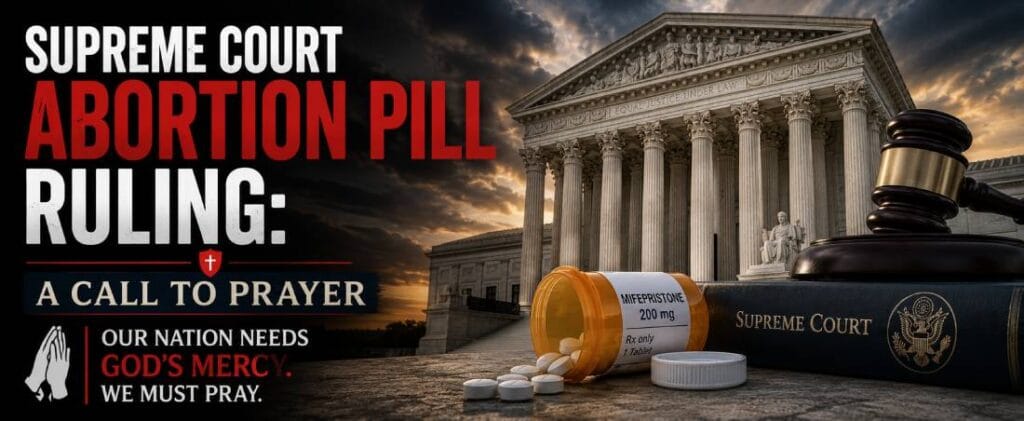
Justice Samuel Alito issued a temporary order blocking a lower court decision that had restricted access to chemical abortion pills by mail. While this procedural stay maintained the status quo through May 11, it offered no definitive legal ruling on the merits of the case. For Catholic faithful dedicated to defending the sanctity of human life, this critical moment demands urgent intercession, clear moral teaching, and compassionate pastoral action.
The physical, moral, and spiritual stakes of this legal battle remain profound. Chemical abortion—specifically the two-drug regimen utilizing mifepristone—now accounts for the majority of preborn life terminations in the United States. The expansion of mail-order access removes even basic medical oversight, exposing women to grave physical risks and isolation while directly terminating innocent preborn lives. As members of the Mystical Body of Christ, we are called to confront this crisis with the truth of the Gospel and the power of prayer.
What the Supreme Court Order Means
Justice Alito’s administrative order served as a temporary procedural hold while the full Supreme Court evaluated whether to take up the case. The lower court rulings had sought to reinstate critical safety restrictions on mifepristone, citing severe medical complications and the lack of in-person physician screening.
Chemical abortion involves blocking progesterone—the natural hormone necessary to sustain a pregnancy—and subsequently causing uterine contractions to expel the preborn child. Women undergoing this process at home frequently experience severe physical complications, profound grief, and spiritual distress without immediate medical or emotional support.
While Justice Alito has historically defended the constitutional right to life, an administrative stay is purely procedural. It bought time for judicial review but offered no guarantee regarding the ultimate outcome. Consequently, the temporary nature of such rulings underscores that authentic victory for human life will not be achieved solely through civil courts, but through the transformation of hearts and culture.
Grounding the Defense of Life in Catholic Doctrine
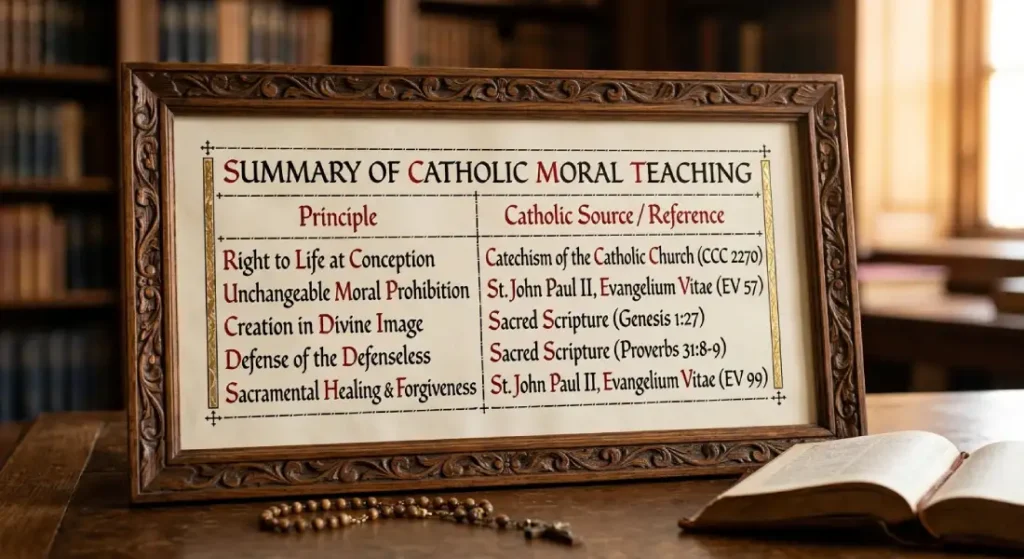
Human life must be respected and protected absolutely from the moment of conception. From the first moment of existence, a human being must be recognized as having the rights of a person—among which is the inviolable right of every innocent being to life.
The Catholic Church’s prohibition of direct abortion is unchangeable and rooted in natural law, Sacred Scripture, and constant Sacred Tradition:
- The Inviolability of Life (Imago Dei): God alone is the Lord of life from its beginning until its end; no one can under any circumstance claim for himself the right directly to destroy an innocent human being. Every child created bears the divine image and likeness (Gen 1:27).
- Constant Magisterial Teaching: Since the first century, the Church has affirmed the moral evil of every procured abortion. As the Catechism of the Catholic Church states: “Direct abortion, that is to say, abortion willed either as an end or a means, is gravely contrary to the moral law” (CCC 2271).
- The Duty to Defend the Vulnerable: Sacred Scripture commands the faithful to speak out for those who cannot speak for themselves (Prov 31:8-9). The unborn represent the most defenseless members of the human family.
Spiritual Combat, Prayer, and Pastoral Healing
Our response to the culture of death is fundamentally a matter of spiritual combat. In his encyclical Evangelium Vitae (The Gospel of Life), Pope St. John Paul II reminded us that “a great prayer for life, which will encompass the whole world, is urgently needed”.
Prayer is not a passive sentiment, but a powerful spiritual weapon. St. James writes that “the prayer of a righteous person has great power as it is working” (Jas 5:16). We must intercede continuously for Supreme Court justices, legislators, and healthcare professionals, asking God to grant them the wisdom and courage to defend human life and dignity.
Simultaneously, authentic Catholic pastoral care requires that our witness be marked by profound Christ-like charity and mercy. St. Thomas Aquinas teaches that charity is the principle of all good works (Summa Theologiae, II-II, q. 23). Women facing unexpected or difficult pregnancies need real material, emotional, and spiritual accompaniment.
Furthermore, for those who have experienced the tragedy of abortion, the Church offers the boundless mercy of God. As Pope St. John Paul II compassionately wrote to women who have had an abortion:
“The Church is aware of the many factors which may have influenced your decision, and she does not doubt that in many cases it was a painful and even shattering decision… Do not give in to discouragement and do not lose hope. Try rather to understand what happened and face it with honesty. If you have not already done so, give yourselves over with humility and trust to repentance. The Father of mercies is ready to give you his forgiveness and his peace in the Sacrament of Reconciliation.” (Evangelium Vitae, 99)
Ministries such as Project Rachel provide confidential healing, bringing the peace and forgiveness of Christ to men and women suffering from post-abortion trauma.
Action Beyond the Courts: Living Faith in Action
Faith without works is dead (Jas 2:26). As Catholic citizens, our spiritual duties must translate into concrete action to build a culture of life:
- Eucharistic Adoration and Intercession: Offer Holy Hours, Rosaries, and personal sacrifices specifically for the protection of preborn children, the end of chemical abortion, and the conversion of hearts.
- Support Local Pregnancy Care Centers: Actively assist crisis pregnancy centers and Catholic charities that provide practical support, housing, medical care, and adoption resources to mothers in need.
- Civic Witness and Advocacy: Contact elected representatives at federal and state levels to advocate for laws that restrict dangerous abortion drugs and safeguard the inviolable right to life.
- Parish Education and Truth-Telling: Educate young people and fellow parishioners on the medical realities of chemical abortion and the beauty of Church teaching regarding the dignity of human life.
By uniting our prayers, moral clarity, and charitable action, we serve as faithful witnesses to the Gospel of Life, trusting that God’s truth and mercy will ultimately prevail.
Frequently Asked Questions
The Catholic Church teaches that human life begins at the moment of conception and must be protected absolutely. Direct abortion—willed either as an end or a means—is a grave moral evil contrary to the Fifth Commandment (“You shall not kill”). This teaching is unchangeable and has been consistently upheld from the early Church Fathers to the modern Magisterium (CCC 2270–2271).
Morally, both chemical and surgical abortions result in the direct termination of an innocent preborn human life and are gravely sinful. Chemically, abortion involves medications like mifepristone and misoprostol to starve the fetus of nutrients and force contractions. Because chemical abortions are frequently distributed via mail without in-person medical evaluation, they also carry heightened physical health risks for the mother.
Yes. While abortion is a grave sin, there is no sin beyond the reach of God’s infinite mercy. Anyone who has undergone, performed, or cooperated in an abortion can receive complete absolution, spiritual healing, and restoration through sincere repentance and the Sacrament of Reconciliation (Confession). Organizations like Project Rachel offer compassionate pastoral support for post-abortion recovery.
Source: LifeSiteNews
Continue Your Faith Journey
Dobbs Decision Anniversary: Why the Battle for Life Has Moved from the Courts to the Heart
On the Dobbs decision anniversary, the pro-life mission shifts from courtrooms to human hearts. Discover how Catholic teaching and Evangelium Vitae call…
Catholic Church Teaching on IVF: Doctrine, Dignity, and Moral Alternatives
Explore the Catholic Church's official teaching on IVF, rooted in the dignity of human life and marital union. Learn about licit alternatives…
Venerable Jérôme Lejeune, Pope Leo XIV, and the Inviolable Dignity of Human Life
Explore how Venerable Jérôme Lejeune's scientific witness and Catholic teaching defend the sacred dignity of human life against modern programmed death. Learn…