
Parents’ Role in Faith Formation: Transforming Your Home into a Domestic Church
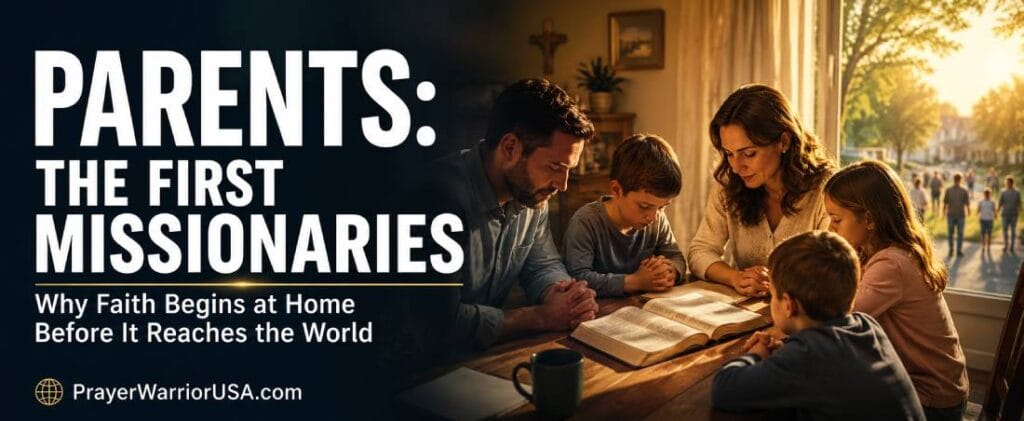
Recent research from the Institute for Family Studies and Communio reinforces a foundational Catholic truth: parents play the decisive role in their children’s spiritual future. While parish religious education and youth ministry programs provide crucial support, the primary responsibility for faith formation cannot be outsourced to institution or classroom alone. The Catechism of the Catholic Church teaches that “parents have the first responsibility for the education of their children,” particularly in handing down the Christian faith (CCC 2221). The home is not merely a residence; it is the Ecclesia domestica—the Domestic Church—where grace meets daily life and discipleship is forged in ordinary moments (CCC 1656).
This reality stems from the divine design for the family. In the Second Vatican Council’s Dogmatic Constitution on the Church, Lumen Gentium, the Council Fathers declared: “The family is, so to speak, the domestic church. In it parents should, by their word and example, be the first preachers of the faith to their children” (Lumen Gentium 11). Faith is not an isolated subject to be studied for an hour on Sunday morning. Rather, it is an integrated way of living, breathing, and loving that saturates the rhythm of everyday existence.
The Sacramental Foundation of Family Discipleship
Parental authority and capability to form children in the Faith derive directly from the sacramental grace of Holy Matrimony (CCC 1638). When parents receive the Sacrament of Matrimony, Christ consecrates them for the duty of Christian education, bestowing the specific graces needed to build up the Domestic Church. As St. John Paul II emphasized in his Apostolic Exhortation Familiaris Consortio, the ministry of evangelization in the home is “rooted in the Sacrament of Marriage and receives a new force from the sacramental grace” (Familiaris Consortio 39).
This domestic ministry does not operate in isolation from the broader Church. Rather, it flows directly from and leads back to the Holy Sacrifice of the Mass, which is the “source and summit of the Christian life” (CCC 1324). The Eucharist nourishes the family, granting parents and children the virtue and charity required to live out their baptismal call.
In the Old Testament, God articulated this continuous daily rhythm of faith transmission to the Israelites:
“Hear, O Israel: The Lord our God is one Lord; and you shall love the Lord your God with all your heart, and with all your soul, and with all your might. And these words which I command you this day shall be upon your heart; you shall teach them diligently to your children, and shall talk of them when you sit in your house, and when you walk by the way, and when you lie down, and when you rise.” (Deuteronomy 6:4–7, RSV-CE)
God designed discipleship to happen within these organic daily margins—making breakfast, driving to sports practice, tending to household chores, and sitting together at the dinner table. These ordinary interactions serve as the primary altar upon which family spiritual life is built.
The Parish and the Domestic Church: A Sacred Partnership
Understanding the distinction between parish catechesis and domestic formation prevents confusion about where spiritual growth primarily occurs. Parish programs, including Confraternity of Christian Doctrine (CCD) classes, youth ministries, and Catholic schools, are vital instruments designed to support parents, not replace them.
| Dimension | The Parish Community | The Domestic Church (Your Home) |
| Primary Role | Sacramental ministerium, public worship, and formal doctrinal instruction. | Daily living of sacramental grace, moral witness, and habitual prayer (CCC 2221). |
| Key Moments | Holy Mass, Sacramental preparation (First Confession, Eucharist, Confirmation). | Mealtime prayers, bedtime blessings, modeling forgiveness, daily Scripture reading. |
| Core Objective | Ecclesial communion, communal liturgy, and formal theological instruction. | Incarnational faith, habituation of virtue, and practical Christian living. |
| Scriptural Anchor | “Go therefore and make disciples of all nations, baptizing them…” (Matthew 28:19). | “You shall teach them diligently to your children…” (Deuteronomy 6:7). |
Raising Children in Christian Discipline
St. Paul instructs fathers specifically regarding the moral and spiritual upbringing of youth: “Fathers, do not provoke your children to anger, but bring them up in the discipline and instruction of the Lord” (Ephesians 6:4, RSV-CE). The Greek term used here for discipline (paideia) signifies a holistic formation of character, mind, and soul.
Children learn far more from observed behavior than from spoken directives. They observe how parents respond to trials, financial pressure, and personal conflict. When stress arises, do parents turn immediately to prayer, or do they seek refuge in worldly distractions? When wrong occurs within the household, do family members practice mutual forgiveness and reconciliation, or do they harbor resentment?
Teaching children the Catholic faith does not require an advanced degree in sacred theology. It requires personal integrity, consistency, and authentic witness. When parents humble themselves, seek forgiveness after a mistake, and participate regularly in the Sacrament of Reconciliation, children receive a vivid lesson in authentic Christian repentance.
Cultivating Family Prayer and Scripture Reading
A vibrant family prayer life serves as the bedrock of the Domestic Church. Prayer must not be treated as an optional add-on to a crowded schedule, but as the underlying structure of family life. Parents can establish lasting spiritual habits by incorporating manageable daily anchors:
- Mealtime Gratitude: Pause before meals to offer genuine thanks to God, modeling true gratitude for His providence.
- Bedtime Prayer & Blessings: Bedtime presents an irreplaceable window when children’s defenses drop and deeper existential questions arise. Tracing the Sign of the Cross on a child’s forehead and praying a brief blessing instills peace and spiritual security.
- Proclamation of Sacred Scripture: Open the Holy Bible regularly in the home. Reading even a few verses from the Gospels introduces children to the living Word of God, establishing Scripture as a guiding authority rather than a decorative book.
- The Holy Rosary: Praying a decade or a full Rosary as a family connects the household to the mysteries of Christ’s life, death, and Resurrection through the intercession of the Blessed Virgin Mary.
Fides Quaerens Intellectum: Addressing Doubts and Questions
As children mature, they naturally encounter intellectual difficulties and spiritual questions. Parents must not fear these inquiries or view them as signs of spiritual failure. The Catholic intellectual tradition has long maintained the essential harmony of faith and reason (fides et ratio).
St. Anselm famously defined Christian theology as fides quaerens intellectum—faith seeking understanding. Authentic faith welcomes honest inquiry. In the Summa Theologiae, St. Thomas Aquinas notes that questioning and intellectual investigation in search of truth do not undermine faith; rather, they allow the believer to assent more deeply to divine truth through grace (ST II-II, q. 2, a. 10).
When a child asks difficult questions about suffering, morality, or Church teachings, respond with patience and intellectual honesty. If you do not know the answer, use it as an opportunity to search the Catechism, study Church documents, or consult a knowledgeable priest together. Showing your children that truth stands up to scrutiny builds a resilient, lifelong faith.
Practical Steps to Reclaim the Domestic Mission Field
Reclaiming the home as a mission field requires deliberate choices to resist cultural noise and digital overload.
- Eliminate Digital Distractions During Key Moments: Establish screen-free zones, particularly during family meals and bedtime. Eye contact and attentive listening demonstrate to children that their souls matter more than notifications.
- Prioritize Sunday Mass Above Extracurricular Activities: Ensure that sports practices, social gatherings, and academic demands never supplant the Sunday Eucharistic obligation (CCC 2181).
- Enthrone the Sacred Heart of Jesus: Formally dedicate your home to the Sacred Heart of Jesus and the Immaculate Heart of Mary, placing a visible image of Christ in a prominent central location.
- Frequent the Sacrament of Reconciliation: Make regular Confession a shared family practice, demonstrating that every Christian continually relies on divine mercy.
Pastoral Prayers for Catholic Parents
Catholic parents may offer these focused prayers daily to seek God’s grace in fulfilling their sacred vocation:
For Courage in Vocation: Lord Jesus Christ, grant me the fortitude to prioritize my children’s spiritual salvation over worldly achievements. Help me recognize that leading my family in virtue matters more than secular success.
For Authentic Witness: Heavenly Father, purify my intentions and grant me genuine holiness. May my children see in me an authentic love for Your Church, free from hypocrisy. When I fall, grant me the humility to repent and model reliance on Your mercy.
For Wisdom and Discernment: Holy Spirit, grant me heavenly wisdom to answer my children’s questions with patience, truth, and love. Guide our home in all goodness, and guard my children’s minds against the deceptions of the world. Amen.
Frequently Asked Questions
According to the Catechism of the Catholic Church (CCC 2221), parents are the primary and principal educators of their children in faith and virtue. Through the Sacrament of Matrimony, parents build the Domestic Church (Ecclesia domestica), forming children in daily prayer, moral truth, and sacramental living.
Start with brief, consistent spiritual anchors: offer grace before meals, pray a short bedtime blessing over your children, read a few Gospel verses daily, and pray a decade of the Rosary together. Consistency in small daily practices builds a strong habit of prayer.
The Second Vatican Council (Lumen Gentium 11) calls the family the “Domestic Church” (Ecclesia domestica) because it is the initial community where grace is lived out daily. In the home, children first encounter God’s love, learn prayer, practice virtue, and participate in Christ’s mission.
Parents should welcome honest questions with patience and intellectual clarity. Catholic theology affirms that faith seeks understanding (fides quaerens intellectum, CCC 158). Addressing doubts using Sacred Scripture, the Catechism, and sound reason helps children build an authentic, durable faith anchored in truth.
Continue Your Faith Journey

Can a Catholic Marriage Be Annulled? Understanding the Process, Canon Law, and Truth
Facing civil divorce or seeking healing in the Church? Discover how the Catholic marriage annulment process works under Canon Law, including true…
Catholic Prayer for Toxic Family Conflict: A Faithful Guide to Boundaries, Healing, and Charity
Navigating family conflict, estrangement, and narcissistic behavior requires balancing Christian charity with prudent boundaries. Discover how Catholic doctrine, Sacred Scripture, and daily…
Catholic Prayer for Husband Addicted to Porn: A Spiritual Warfare & Relational Healing Guide
Discover how Catholic spiritual warfare, Eucharistic grace, and deprecatory deliverance prayers can help free a husband from pornography addiction. Learn to combine…