
Biblical Intercessory Prayer: Scripture, Tradition, and the Power of Standing in the Breach
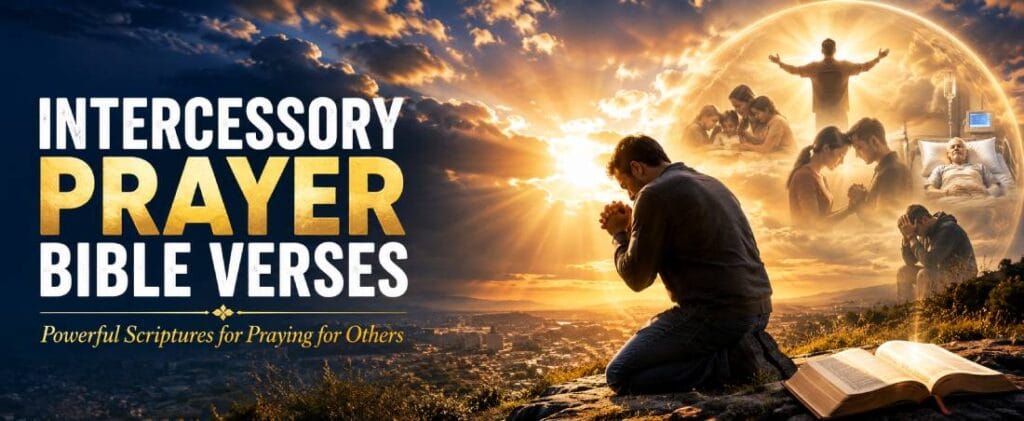
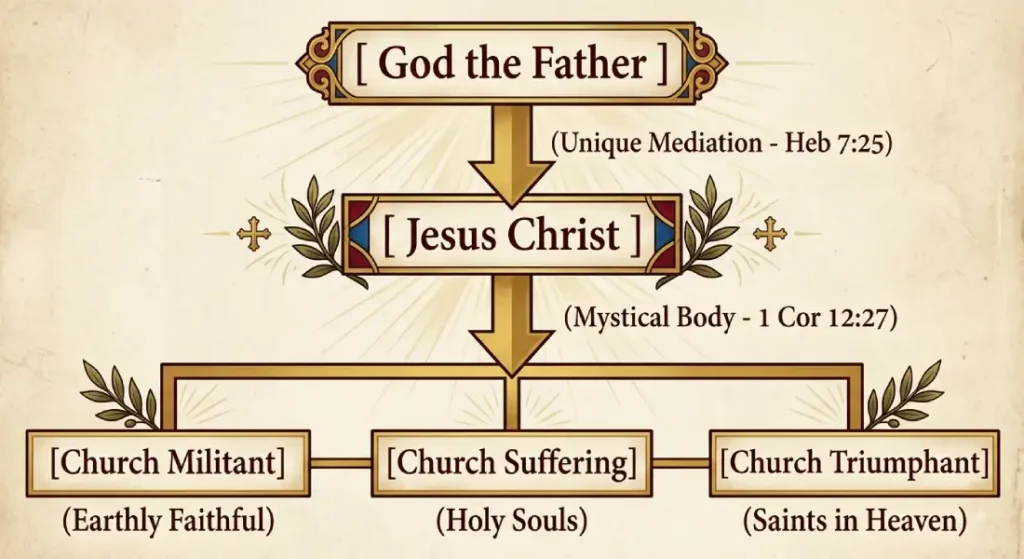
Intercessory prayer is more than a spiritual habit—it is an active participation in the prayer of Jesus Christ, our sole High Priest, who continually intercedes for us before the Father (Hebrews 7:25; CCC 2593). When we intercede for others—whether a struggling neighbor, a civic authority, an unborn child, or a soul in Purgatory—we act as members of Christ’s Mystical Body (1 Corinthians 12:27).
Because the Church is bound together in charity, our prayers are never isolated acts. Through the Communion of Saints, our intercession draws upon and unites with the prayers of the Blessed Virgin Mary, the holy angels, and the saints in Heaven, extending grace across the Church Militant on earth, the Church Suffering in Purgatory, and the Church Triumphant in Glory (CCC 954–959).
Quick Reference: Biblical Pillars of Intercession
| Topic & Search Intent | Anchor Scripture | Core Theological Focus |
| Christ’s Eternal Intercession | Hebrews 7:25 | Jesus as sole High Priest and model of all prayer (CCC 2593). |
| For Civic Leaders & Nations | 1 Timothy 2:1–2 | Securing public peace, justice, and common good (CCC 1900). |
| For the Unborn & Destitute | Proverbs 24:11 | Moral duty to protect vulnerable human life (CCC 2270). |
| For the Sick & Suffering | James 5:14–16 | Sacramental grace in Anointing of the Sick (CCC 1514). |
| For Enemies & Persecutors | Luke 23:34 | Perfecting charity through Christlike forgiveness (CCC 2844). |
Old Testament Foundations: Standing in the Breach
Right from the dawn of salvation history, Sacred Scripture reveals that God seeks righteous souls to stand between His justice and a world in need of mercy. Patriarchs and prophets prefigured the definitive mediation of Christ by pleading for those who could not or would not pray for themselves.
Patriarchal Pleading for Mercy
“So Abraham prayed to God, and God healed Abimelech, and also healed his wife and female slaves so that they bore children.”
— Genesis 20:17
Abraham’s intercession demonstrates that God answers prayers offered even for those who have wronged us. St. Thomas Aquinas teaches that praying for others flows directly from fraternal charity (Summa Theologiae, II-II, q. 83, a. 7). When we lift up others, our heart aligns with God’s mercy.
“And the Lord said, ‘If I find at Sodom fifty righteous in the city, I will spare the whole place for their sake.’”
— Genesis 18:26
Abraham’s bold negotiation for Sodom reveals that intercession can be persistent and specific. God invites faithful souls into authentic dialogue regarding the salvation of communities and nations.
Moses and the Prophetic Call
“And Moses made a plea before the Lord his God and said, ‘O Lord, why does your wrath burn hot against your people…?’”
— Exodus 32:11
Moses stood in the gap for a rebellious Israel. The Catechism notes that Moses’ intercession is a striking shadow of Christ’s definitive mediation; he does not defend his own interest, but God’s glory and the people’s salvation (CCC 2577).
“And I sought for a man among them who should build up the wall and stand in the breach before me for the land, that I should not destroy it, but I found none.”
— Ezekiel 22:30
God continuously calls intercessors to repair spiritual breaches caused by sin. Standing in the breach requires perseverance, self-denial, and steady reliance on the Holy Spirit.
The Psalms: Liturgical Intercession and Pervasive Mercy
The Book of Psalms forms the heart of the Church’s official prayer, the Liturgy of the Hours. In the Psalms, intercession spans generations, geographic locations, and every human condition.
- Intercession for Future Generations: “Let this be recorded for a generation to come, so that a people yet to be created may praise the Lord.” (Psalm 102:18). Praying for unborn descendants participates in God’s overarching plan of redemption.
- Intercession for Cities and Peace: “Pray for the peace of Jerusalem! May they be secure who love you!” (Psalm 122:6). Catholics are called to intercede for geographic regions, parishes, and civil societies.
- Solidarity with the Crushed: “The Lord is near to the brokenhearted and saves the crushed in spirit.” (Psalm 34:18). Our intercession aligns us with God’s natural proximity to the afflicted.
- Corporate Intercession: “Save us, O Lord our God, and gather us from among the nations, that we may give thanks to your holy name…” (Psalm 106:47). We bring the intentions of the entire Mystical Body before God’s altar.
New Testament Doctrine: Christ, the Apostles, and the Church
In the New Testament, intercession reaches its perfection in the Person of Jesus Christ and is handed on to His Church.
The Supreme Intercessor
“Therefore he is able to save to the uttermost those who draw near to God through him, since he always lives to make intercession for them.”
— Hebrews 7:25
Jesus is not a passive figure in salvation history; He is actively offering His heavenly High Priestly sacrifice. When we pray for others, we are united to His ongoing, perfect offering to the Father (CCC 2634).
“Likewise the Spirit helps us in our weakness. For we do not know what to pray for as we ought, but the Spirit himself intercedes for us with groanings too deep for words.”
— Romans 8:26
The Holy Spirit inspires every authentic act of intercession. Even when words fail, the Spirit directs our intentions toward the Father’s perfect will.
Apostolic Precedent
“First of all, then, I urge that supplications, prayers, intercessions, and thanksgivings be made for all people…”
— 1 Timothy 2:1
St. Paul places intercession at the priority of Christian worship. It is not a secondary option; it is an obligation born of the theological virtue of charity (CCC 1822).
“I appeal to you, brothers, by our Lord Jesus Christ and by the love of the Spirit, to strive together with me in your prayers to God on my behalf.”
— Romans 15:30
Even the Great Apostle needed intercessory support. Spiritual warfare and apostolic fruitfulness depend directly on the quiet intercession of the faithful.
Intercession for Authorities, Civil Order, and Leaders
Catholic moral theology emphasizes our civic duty to pray for those who exercise public governance.
“First of all, then, I urge that supplications… be made for all people, for kings and all who are in high positions, that we may lead a peaceful and quiet life, godly and dignified in every way.”
— 1 Timothy 2:1–2
Intercession for political leaders is required regardless of political party or personal agreement. We pray that civil laws align with natural law and the divine order, fostering the common good (CCC 1900).
“The king’s heart is a stream of water in the hand of the Lord; he turns it wherever he will.”
— Proverbs 21:1
God holds absolute sovereignty over earthly powers. Our intercession petitions God to grant world leaders wisdom, justice, and respect for religious freedom.
Protecting the Vulnerable, Unborn, and Silent
Intercession is a primary spiritual weapon for defending human dignity at every stage of life, from natural conception to natural death.
“Rescue those who are being taken away to death; hold back those who are stumbling to the slaughter.”
— Proverbs 24:11
This verse imposes a clear duty to stand up for those facing death, including unborn children. Prayer before the Lord of Life forms the spiritual foundation for all pro-life apostolates (CCC 2270).
“Open your mouth for the mute, for the rights of all who are destitute. Open your mouth, judge righteously, defend the rights of the poor and needy.”
— Proverbs 31:8–9
When we intercede for those who lack a voice—the disabled, the destitute, the elderly, and the unborn—we perform an essential spiritual work of mercy.
Sacramental Intercession and Prayer for the Sick
Sacred Scripture connects intercession directly to physical healing, spiritual reconciliation, and the sacramental economy.
“Is anyone among you sick? Let him call for the priests of the church, and let them pray over him, anointing him with oil in the name of the Lord.”
— James 5:14
Here, Sacred Scripture attests to the Sacrament of the Anointing of the Sick. The intercession for the suffering is not merely informal; Christ established a sacramental rite administered by ordained priests (presbyteroí) to confer healing, the forgiveness of sins, and union with His Passion (CCC 1514–1515).
“Confess your sins to one another and pray for one another, that you may be healed. The prayer of a righteous person has great power as it is working.”
— James 5:16
Ecclesial intercession brings emotional, physical, and spiritual restoration. Sanctifying grace increases the efficacy of our prayers, making our intercession powerful through Christ.
Interceding for Enemies: The Ultimate Test of Charity
The highest standard of Christian intercession is set by Our Divine Master upon the Cross.
“Father, forgive them, for they know not what they do.”
— Luke 23:34
“But I say to you, Love your enemies and pray for those who persecute you.”
— Matthew 5:44
Interceding for persecutors breaks the cycle of hatred. The Catechism teaches that prayer for our enemies transforms the human heart, conforming it to Christ’s divine mercy (CCC 2844).
Standing in the Gap Today
Scripture makes it clear: intercessory prayer is an essential aspect of the Christian life. Through baptism, we share in Christ’s priestly office, granting us access to the Father in prayer (CCC 1268).
Take time today to intercede intentionally for someone in need:
- Name a concrete intention: A family member, a civil leader, or an unborn child.
- Anchor your prayer in Scripture: Pray using Psalms or the Lord’s Prayer.
- Unite it to the Mass: Offer your intentions during the Eucharistic Sacrifice, the highest form of intercession on earth (CCC 1368).
When we stand in the breach for others, we enter holy ground and participate directly in Christ’s work of salvation.
Continue Your Faith Journey
How to Conduct a Catholic Night Prayer Examination of Conscience: A Step-by-Step Spiritual Guide
Learn how to conduct a daily Catholic night prayer examination of conscience using the timeless five-step method of the saints. Cultivate true…
Catholic Prayer for Toxic Family Conflict: A Faithful Guide to Boundaries, Healing, and Charity
Navigating family conflict, estrangement, and narcissistic behavior requires balancing Christian charity with prudent boundaries. Discover how Catholic doctrine, Sacred Scripture, and daily…
Catholic Prayer for Adult Child Who Left the Faith: Doctrinal & Intercessory Action Plan
Discover how Catholic parents can overcome grief and guilt when an adult child leaves the Church. Anchored in Scripture, Church teaching, and…