
Over This, Your White Grave: St. John Paul II’s Poem on Grief, Hope, and Eternal Life
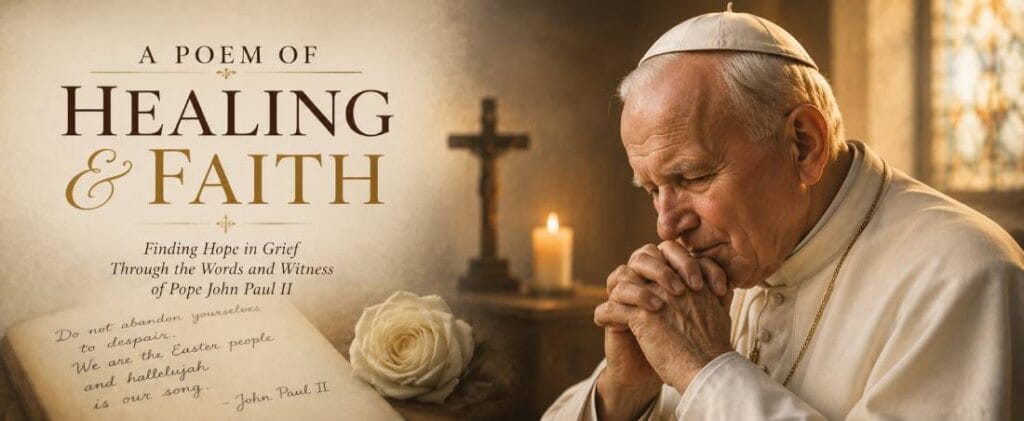
When nine-year-old Karol Wojtyła stood by his mother’s bedside in Wadowice, Poland, in April 1929, he confronted a sorrow that would permanently shape his soul. Emilia Wojtyła died from heart and kidney failure at the age of forty-five, leaving behind her husband and young son. Ten years later, as a nineteen-year-old university student in Cracow, the future Pope John Paul II channeled that enduring ache into a poignant Polish poem: Over This, Your White Grave (Nad Twoją białą mogiłą).
In Catholic spiritual tradition, grief is neither denied nor allowed to decay into despair. As St. John Paul II demonstrated throughout his life and papal ministry, human heartbreak becomes redemptive when brought before the Cross of Christ.
The Historical Context: A Youth Forged in Sorrow
Karol Wojtyła was no stranger to bereavement. The loss of his mother in 1929 was followed three years later by the sudden death of his older brother, Edmund, a physician who contracted scarlet fever while treating patients. By February 1941, when his father Karol Sr. passed away during the Nazi occupation of Poland, twenty-year-old Karol was left entirely alone in his immediate family.
Rather than sinking into bitterness or fatalism, Wojtyła anchored his heart in Catholic piety. His father had established a rigorous household routine centered on personal prayer, Sacred Scripture, and daily Mass. Out of this domestic sanctuary emerged a poet-mystic who understood that suffering could be offered up to God.
In the spring of 1939, while studying Polish philology at Jagiellonian University, Wojtyła composed Over This, Your White Grave. The poem reflects a young man gazing across ten years of absence, reconciling filial devotion with the mystery of divine providence.
The Full Text: “Over This, Your White Grave” (Spring 1939)
Over this, your white grave,
the flowers of life in white—
so many years without you—
how many have passed out of sight?
Over this, your white grave,
covered for years, there is a stir
in the air, something uplifting
and, like death, beyond comprehension.
Over this, your white grave,
oh, Mother, can such loving cease?
For all his filial adoration,
a prayer: Give her eternal peace.
Stanza-by-Stanza Theological Analysis
- “The flowers of life in white…” The image of white flowers placed over a white grave symbolizes both baptismal purity and resurrection hope. In Catholic liturgy, white is the liturgical color of Easter, virginity, and Christian funerals, proclaiming the victory of the Risen Christ over death.
- “Something uplifting and, like death, beyond comprehension…” Wojtyła touches upon what St. Thomas Aquinas describes as the transcendent realm of divine grace (Summa Theologiae I, q. 1, a. 2). Death appears as an incomprehensible wall to human reason alone, yet divine grace introduces an uplifting spiritual reality that points beyond physical decay.
- “Oh, Mother, can such loving cease?” This rhetorical question addresses the persistence of personal identity and love after death. Catholic dogmatic theology affirms that charity (caritas) never ends (1 Corinthians 13:8). The spiritual bond between mother and child is not annihilated by death; it is transformed within the Communion of Saints (CCC 958).
- “A prayer: Give her eternal peace.” The poem concludes not with vague sentimentality, but with liturgical prayer: Requiem aeternam dona ei, Domine (“Eternal rest grant unto her, O Lord”). Wojtyła instinctively fulfills the ancient Catholic duty of offering prayers for the departed soul.
The Catholic Theology of Grief: Faith Transforming Sorrow
A common misconception among modern believers is that strong faith eliminates sadness. Sacred Scripture and Sacred Tradition reveal the opposite. Jesus Himself wept at the tomb of His friend Lazarus (John 11:35), validating the reality of human tears.
St. John Paul II’s life demonstrated that authentic pastoral strength flows from a profound integration of lived human experience with objective Catholic doctrine (Fides et Ratio, 16). Grief is not a spiritual failing; it is a natural manifestation of love under the conditions of a fallen world.
Grief and the Dogma of Purgatory
When facing the death of loved ones, Catholic doctrine provides both profound comfort and active spiritual responsibility. Unlike theological systems that assume immediate entry into heaven without purification, Catholic teaching recognizes the necessity of post-mortem purification for those who die in God’s grace but still require cleansing from temporal punishment (CCC 1030).
- The Duty of Suffrages: Catholics are called to offer prayers, penances, almsgiving, and above all, the Holy Sacrifice of the Mass for the holy souls in Purgatory (CCC 1032). As written in 2 Maccabees 12:46: “It is therefore a holy and wholesome thought to pray for the dead, that they may be loosed from sins.”
- Resurrection Hope: By remaining in the state of sanctifying grace and offering faithful suffrages for our deceased family members, we maintain an active spiritual communion with them while awaiting eternal reunion in God’s heavenly Kingdom.
| Perspective Principle | Secular Worldview | Authentic Catholic Teaching |
| Nature of Physical Death | Terminal end of human existence | Doorway to eternal life and purification (CCC 1020) |
| Role of Human Sorrow | Psychological obstacle to overcome | Human emotion elevated by redemptive grace |
| Duty to the Deceased | Nostalgic memory & legacy retention | Offering Holy Mass, prayers, and suffrages (CCC 1032) |
| Ultimate Hope | Vague emotional reassurance | Resurrection of the body & Communion of Saints |
Marian Devotion: Finding a Spiritual Mother in Loss
Following Emilia Wojtyła’s death, Karol’s father took his young son on a pilgrimage to the Marian Shrine of Kalwaria Zebrzydowska. Pointing to the icon of Our Lady, his father told him that Mary would now be his Mother.
This pivotal moment forged Wojtyła’s lifelong Marian devotion, summarized in his papal motto: Totus Tuus (“Totally Yours”). In times of profound loss, Catholics look to the Blessed Virgin Mary, who stood steadfast at the foot of the Cross (Stabat Mater).
The Church recognizes Mary as the Mother of the Church and Mother of all believers (CCC 969 / Lumen Gentium, 61–62). When earthly mothers pass away, Our Lady remains an ever-present spiritual Mother who intercedes for grieving hearts and draws them closer to her divine Son.
4 Practical Steps for Navigating Loss Through Catholic Faith
- Offer Holy Mass Intentions for the Deceased: The primary prayer the Church offers for a departed soul is the Holy Sacrifice of the Mass. Contact your local parish to request Mass intentions for the repose of your loved one’s soul.
- Practice Spiritual Writing and Prayer Poetry: Following the example of Karol Wojtyła, use journals or written prayers to express your pain directly to God. Bringing raw human emotion into structured prayer becomes a channel for divine grace.
- Recite the Holy Rosary for the Departed: Contemplating the Sorrowful Mysteries of the Rosary allows us to unite our personal sorrow with Christ’s Passion and Mary’s compassion, finding peace in their presence.
- Remain Anchored in Sacramental Grace: During seasons of grief, frequent the Sacraments of Reconciliation and the Holy Eucharist. Confession restores sanctifying grace, while Holy Communion unites us directly with Christ, who is the Resurrection and the Life (John 11:25).
Frequently Asked Questions
Pope John Paul II (Karol Wojtyła) wrote Over This, Your White Grave (Nad Twoją białą mogiłą) in Cracow in the spring of 1939. Composed ten years after his mother Emilia died, the poem reflects his enduring filial love and offers a prayer for her eternal rest.
Catholic theology views grief as a natural manifestation of human love. Scripture records that Jesus wept at Lazarus’s tomb (John 11:35). St. Paul encourages believers not to grieve “as others do who have no hope” (1 Thessalonians 4:13), meaning Christians mourn with an anchor of resurrection hope.
Catholics pray for the deceased because Catholic dogma teaches the reality of Purgatory—a state of final purification for those who die in God’s grace but still require cleansing from temporal punishment (CCC 1030–1032). Offering prayers and Mass intentions assists souls on their journey to heavenly glory.
Losing his mother, brother, and father by age twenty gave Karol Wojtyła firsthand experience with human suffering. This personal history informed his apostolic letter Salvifici Doloris (On the Christian Meaning of Human Suffering) and inspired his compassionate outreach to the sick, elderly, and grieving throughout his pontificate.
Source: NCRegister
Continue Your Faith Journey

Catholic Prayer for Toxic Family Conflict: A Faithful Guide to Boundaries, Healing, and Charity
Navigating family conflict, estrangement, and narcissistic behavior requires balancing Christian charity with prudent boundaries. Discover how Catholic doctrine, Sacred Scripture, and daily…
How to Pray the 54 Day Rosary Novena: Complete Guide and Tracker
Discover how to pray the miraculous 54 Day Rosary Novena with this Catholic guide, complete 27-day petition and thanksgiving schedule, and daily…
How to Conduct a Catholic Night Prayer Examination of Conscience: A Step-by-Step Spiritual Guide
Learn how to conduct a daily Catholic night prayer examination of conscience using the timeless five-step method of the saints. Cultivate true…