
How to Dispose of Broken Blessed Religious Items: A Catholic Guide to Rosaries, Bibles, and Scapulars
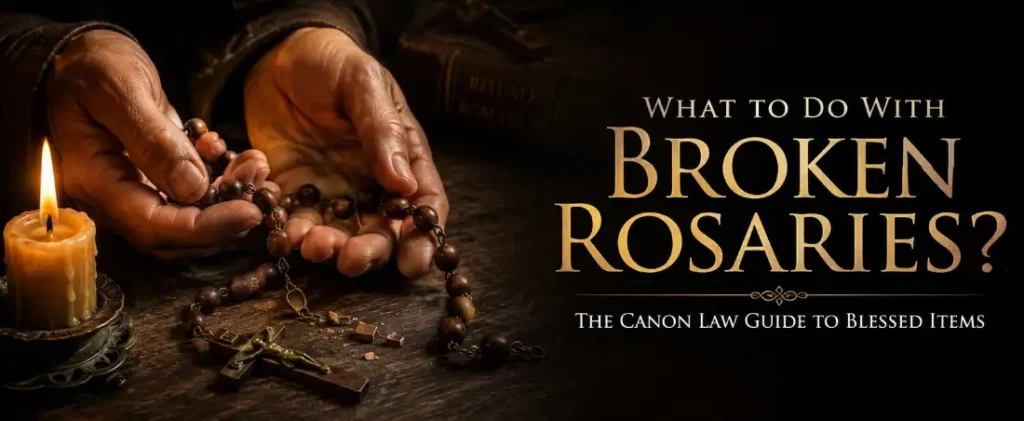
To properly dispose of broken blessed religious items (sacramentals) like Rosaries, Bibles, and Scapulars, Catholics must burn them and bury the ashes, or bury the item intact directly in clean soil. Under Catholic Canon Law (Can. 1171), objects dedicated to divine worship by a blessing must be treated with reverence and never discarded into household trash.
Treating broken sacramentals with care is an authentic expression of the virtue of religion. Below is the complete theological, historical, and practical guide for handling broken holy objects in full fidelity to the Magisterium of the Catholic Church.
1. Biblical & Magisterial Foundation
What Makes an Object Sacred?
To understand why broken holy items require special handling, we must examine what occurs during a sacerdotal blessing. The Church distinguishes between the Seven Sacraments—instituted by Christ to confer sanctifying grace—and Sacramentals.
According to the Catechism of the Catholic Church:
“Holy Mother Church has, moreover, instituted sacramentals. These are sacred signs which bear a resemblance to the sacraments. They signify effects, particularly of a spiritual nature, which are obtained through the intercession of the Church.” (CCC 1667)
Sacramentals include Rosaries, crucifixes, blessed salt, holy water, scapulars, and medals. While sacramentals do not confer grace automatically (ex opere operato), they prepare the faithful to receive grace and cooperate with it (CCC 1670).
When a priest or deacon blesses an object, it is consecrated—set apart (res sacra)—for divine worship and spiritual sanctification (CCC 1671, 1677). From that moment forward, the object no longer serves a purely secular function.
Canon Law Mandate: Canon 1171
The Church’s legal norm regarding blessed items is explicitly stated in the Code of Canon Law:
Canon 1171: “Sacred objects, which are designated for divine worship by dedication or blessing, are to be treated reverently and are not to be employed for profane or inappropriate use even if they are owned by private persons.”
Discarding a blessed item into ordinary garbage exposes it to profane waste. Even when privately owned, a blessed item carries an obligation of pious stewardship.
| Status | Definition | Canon Law Mandate | Proper Action |
| Blessed Item | Consecrated by clergy (res sacra) | Canon 1171 applies | Repair, Burn, or Bury |
| Unblessed Item | Mass-produced, not blessed | Canon 1171 does not apply | Recycle, Donate, or Trash |
Scriptural Foundation for Reverence
Sacred Scripture consistently emphasizes that objects set apart for God require reverent handling. In the Old Testament, God commanded Moses regarding sanctuary items:
“You shall consecrate them, that they may be most holy; whatever touches them will become holy.” (Exodus 30:29, RSV-2CE)
Reverence for holy items reflects an interior commitment to God. External piety must mirror authentic obedience to the Father, as Our Lord Jesus Christ taught:
“Not every one who says to me, ‘Lord, Lord,’ shall enter the kingdom of heaven, but he who does the will of my Father who is in heaven.” (Matthew 7:21, RSV-2CE)
2. Historical & Patristic Context
The reverent disposal of sacred materials has been practiced since ancient times.
Old Testament Precedent
When Judas Maccabeus purified the Temple after its defilement, his men faced a dilemma regarding the desecrated stones of the altar:
“They cleansed the sanctuary and removed the defiled stones to an unclean place… So they tore down the altar, and stored the stones in a convenient place on the temple hill, until there should come a prophet to tell what to do with them.” (1 Maccabees 4:43, 45, RSV-2CE)
The Israelites refused to throw away altar stones carelessly, storing them respectfully until proper divine instruction was received.
Patristic Witness
The early Church Fathers urged strict care for holy things. St. Cyril of Jerusalem (c. 313–386 AD), writing on the extreme care required for the Holy Eucharist, asked that if someone were given gold dust, they would hold it vigilantly lest any particle be lost (Mystagogical Catechesis V, 21).
By extension, Catholic tradition applies this same care to sacramentals. If objects set apart by the Church’s blessing are handled carelessly, we show indifference toward God.
St. Jerome (c. 347–420 AD) similarly emphasized that inanimate objects dedicated to divine service demand honor:
“Sacred chalices, holy veils, and other accessories associated with the Lord’s Passion… are to be venerated with the same reverence as the Body and Blood of the Lord.” (Epistula 52 ad Nepotianum, 10)
The Tradition of the Sacrarium
Catholic churches feature a specialized sacristy sink called a sacrarium (or piscina). Its drainage pipe does not connect to municipal sewer lines; it drains directly into clean earth.
Priests pour holy water and the first rinsings of altar linens down the sacrarium. Returning sacred elements directly to the untouched earth (creatio Dei) establishes the precedent for domestic disposal: reverent burning or burial.
3. Practical Disposal Protocol: Step-by-Step
When a blessed item breaks or wears out, follow this simple protocol to resolve the matter with peace of soul.
Step 1: Attempt Repair
Before disposing of any religious item, determine if it can be restored:
- Rosaries: Re-attach loose links using small jewelry pliers, or replace broken cord.
- Bibles: Use archival bookbinding tape to secure detached pages or loose leather covers.
- Scapulars: If the wool squares remain intact, sew a new cord onto the existing fabric.
Note: Minor repairs do not remove a blessing from an object. A new blessing is only necessary if the item is so completely destroyed that it loses its original identity.
Step 2: Choose the Proper Disposal Method
Method A: Reverent Burning (Pious Incineration)
Burning is the preferred method for organic, combustible sacramentals.
- Applicable Items: 100% Wool Brown Scapulars, wooden or cord Rosaries, damaged Catholic Bibles, blessed palms, and blessed candles.
- Process: Burn the item completely in a clean fire pit or metal container—separate from household waste. Gather all remaining ashes and bury them in clean soil in a private yard or garden.
Method B: Reverent Burial
Burial is required for non-combustible holy items.
- Applicable Items: Metal Rosaries, saint medals, metal crucifixes, and broken plaster or resin statues.
- Process: Place broken items into a clean cloth bag or biodegradable box. Dig a hole 6 to 12 inches deep in private soil (such as a flower bed), place the container inside, and cover it completely.
✝️ Prayer Before Disposing of a Sacramental
“Lord Heavenly Father, Creator of all things, I thank You for the spiritual fruits I have received through the pious use of this holy item. As I return its material elements to the earth, renew my heart in true devotion, that I may serve You faithfully in all things. Through Christ our Lord. Amen.”
Step 3: Parish Assistance & Sacristan Contact
If you lack private land for burial or cannot burn items safely, your local parish can assist. Many parishes collect worn sacramentals annually before Ash Wednesday to burn for ashes.
Parish Sacristan Contact Script:
“Hello, I have several broken blessed items (a worn wooden rosary and old palms) that need proper disposal. Does the parish have a sacrarium or a collection bin for sacred items prior to Lent?”
Handling Mass-Mailed Unblessed Items
Catholic households often receive unsolicited mailings containing paper holy cards or plastic rosaries. These commercial items are unblessed unless explicitly stated otherwise.
Canon 1171 does not apply to unblessed items. You may freely give them away, recycle paper cards, or donate them. Out of respect for sacred imagery, many Catholics prefer to burn or bury unblessed holy cards rather than trash them.
📥 Free Printable Download
Get the 1-Page Catholic Sacramental Disposal Matrix (PDF)
Keep this simple reference guide in your home prayer space or parish bulletin. Includes quick-check decision trees for scapulars, Bibles, medals, and holy water.
4. Durable Devotional Tools to Prevent Frequent Breakage
Investing in well-crafted prayer tools reduces frequent damage and prevents holy items from ending up in disrepair.
- Rugged Paracord Rosary: Traditional chain rosaries snap under daily carry. Paracord rosaries—made from 550 military-grade cord and heavy-duty beads—are virtually unbreakable and built for daily pocket carry.
- The Ignatius Bible (RSV-2CE): Featuring a durable sewn binding and leather cover, the Revised Standard Version, Second Catholic Edition offers liturgical accuracy and long-lasting structural integrity for daily lectio divina.
- 100% Virgin Wool Premium Brown Scapular: Cheap synthetic scapulars fray within weeks. Selecting a scapular made from 100% woven virgin wool with reinforced stitching ensures long-lasting wear in fulfillment of Our Lady of Mount Carmel’s promise.
Frequently Asked Questions
A sacramental loses its blessing only when its physical substance is so damaged that it no longer retains its original form or function (e.g., a crushed crucifix). Minor disrepair, like a detached chain link, does not destroy the blessing, though broken pieces must still be disposed of reverently
No. Accidental disposal lacks the deliberate consent required for sin. However, intentionally throwing a known blessed object into ordinary garbage is a sin of impiety against God. If done deliberately in the past, bring it to the Sacrament of Reconciliation for peace of soul.
Yes. Lay Catholics are fully authorized to burn or bury their own home sacramentals in clean private soil. You do not need a priest to perform this disposal, as exercising pious care over household holy items is part of your baptismal stewardship in the domestic church.
Blessed holy water must be poured directly into outdoor soil or a houseplant, never down a standard sink drain. Leftover Holy Oils (Sacred Chrism or Oil of the Sick) are governed by Canon 847 §2 and must be returned to your parish for proper disposal by clergy.
Continue Your Faith Journey
Catholic Prayer for Toxic Family Conflict: A Faithful Guide to Boundaries, Healing, and Charity
Navigating family conflict, estrangement, and narcissistic behavior requires balancing Christian charity with prudent boundaries. Discover how Catholic doctrine, Sacred Scripture, and daily…
Are Intrusive Thoughts Mortal Sins in Catholic Teaching? Peace for the Anxious Soul
Struggling with sudden, uninvited blasphemous or impure thoughts? Discover what Catholic moral theology, the Catechism, and the saints teach about deliberate consent,…
Does Watching Live Stream Mass Fulfill Your Sunday Obligation? A Catholic Theological Guide
Discover whether watching Mass online satisfies your weekly Catholic duty. Learn what the Catechism of the Catholic Church, Canon Law, and Sacred…