
Saint Gianna Beretta Molla: Heroic Motherhood, Bioethics, and the Vocation of Daily Love
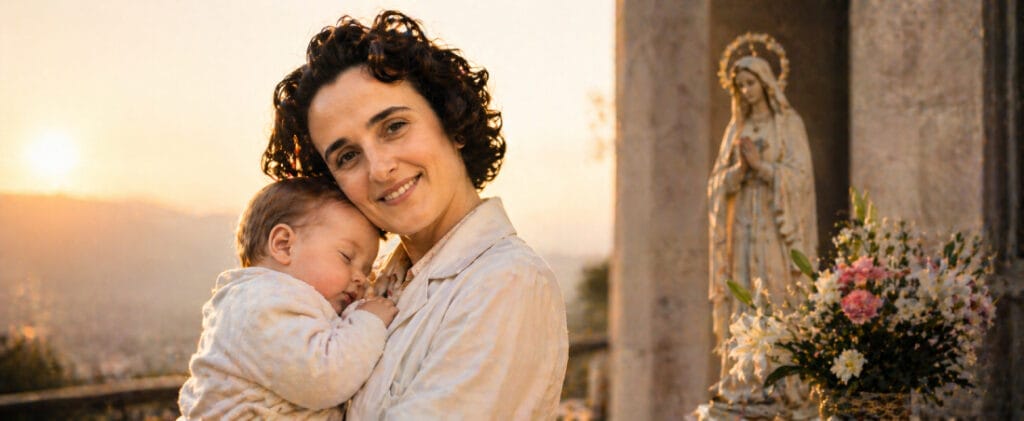
Saint Gianna Beretta Molla (1922–1962) stands as a landmark 20th-century witness to the sacred dignity of human life, the holiness of ordinary marital life, and the medical-moral integrity of Catholic bioethics. A working pediatrician, devoted wife, and mother, she was canonized by Pope John Paul II on May 16, 2004, in the presence of her husband, Pietro Molla, and their children—marking a historic first in Church history.
Key Facts & Quick Reference
| Feature | Details |
| Birth & Death | October 4, 1922 – April 28, 1962 (Aged 39) |
| Feast Day | April 28 |
| Beatification & Canonization | Beatified April 24, 1994; Canonized May 16, 2004 by Pope John Paul II |
| Patronage | Mothers, Physicians, Unborn Children, Families |
| Primary State in Life | Laywoman, Pediatrician, Wife, and Mother |
| Core Moral Witness | Protection of unborn life (Donum Vitae; CCC 2270–2273) |
Early Life and Vocation as Medicine
Born in Magenta, Italy, Gianna was raised in a devout Catholic family that cultivated active prayer and service through the St. Vincent de Paul Society and Catholic Action. Choosing medicine as her field of apostolic mission, she completed her surgical and pediatric degrees at the University of Pavia.
She viewed her medical career not as a career path toward prestige, but as a direct exercise of Christian charity (caritas). As a practicing pediatrician, Gianna offered specialized care to mothers, infants, the elderly, and the poor, seeing in each patient the suffering face of Christ.
“Whoever touches the body of a patient touches the Body of Christ.” — St. Gianna Beretta Molla
In 1955, Gianna married Pietro Molla, an engineer. Together they sought to build a family rooted in the Sacraments, welcoming three children: Pierluigi, Maria Zita (Mariolina), and Laura. Gianna demonstrated that holiness is attainable within the rhythms of lay life—balancing professional responsibilities, maternal devotion, and leisure activities such as mountaineering and painting.
The Medical Crisis: Catholic Bioethics in Practice
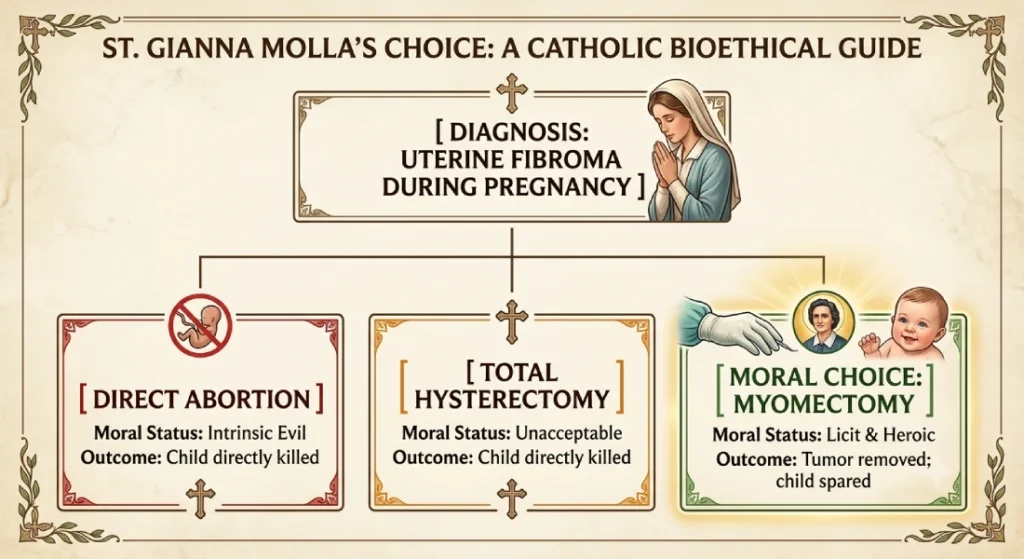
In September 1961, during the second month of her fourth pregnancy, doctors discovered a large uterine fibroma (a benign tumor). The situation presented a serious bioethical decision with three potential surgical interventions:
- A Complete Hysterectomy: Surgical removal of the uterus, which would directly cause the death of the unborn child.
- Abortion with Tumor Removal: Directly terminating the child’s life prior to removing the tumor.
- Selective Myomectomy: Surgical removal of only the fibroma, attempting to preserve the child’s pregnancy while accepting higher medical risks for the mother.
Catholic moral theology strictly forbids direct abortion or any action that directly intends the termination of an innocent human life (Catechism of the Catholic Church, 2270–2271; Sacred Congregation for the Doctrine of the Faith, Declaratio de abortu procurato). Direct abortion is an intrinsic evil that can never be justified, even for noble therapeutic ends.
Aware of these moral truths both as a faithful Catholic and as an experienced physician, St. Gianna explicitly rejected interventions that would directly harm her child. She chose a surgical myomectomy. Prior to the procedure, she explicitly instructed her medical team:
“If you must decide between me and the child, do not hesitate: choose the child—I insist on it. Save the baby.”
Heroic Sacrifice and Passing
The myomectomy successfully removed the tumor and allowed the pregnancy to continue. Gianna spent the remaining seven months of her pregnancy fulfilling her daily duties as a physician and mother while offering her physical suffering to God.
On April 21, 1962 (Holy Saturday), Gianna Emanuela Molla was delivered safely via Caesarean section. However, severe postoperative complications quickly developed. Gianna was diagnosed with septic peritonitis.
Despite excruciating pain, her focus remained fixed on Christ. Repeating the prayer “Jesus, I love you,” St. Gianna died on April 28, 1962, at the age of 39. Her life realized the truth of Sacred Scripture: “Greater love has no one than this: to lay down one’s life for one’s friends” (John 15:13).
Magisterial Meaning and Pastoral Legacy
In canonizing St. Gianna in 2004, Pope John Paul II highlighted her life as a confirmation of the “Gospel of Life” (Evangelium Vitae):
“Gianna Beretta Molla was a simple, but more than ever, significant messenger of divine love… Following the example of Christ, who ‘having loved his own who were in the world, loved them to the end’ (Jn 13:1), this holy mother of a family remained heroic in her fidelity to the commitment made on her wedding day. The extreme sacrifice that sealed her life testimony to the fact that only those who have the courage to give themselves completely to God and to their brothers and sisters find fulfillment.”
Her daughter, Dr. Gianna Emanuela Molla, grew up to become a physician herself, dedicating her life to sharing her mother’s spiritual legacy of sacrificial love and defense of human life.
Frequently Asked Questions (PAA)
Was St. Gianna’s choice required by Catholic Church teaching?
No. Church teaching requires that one must never directly choose to end the life of an unborn child (CCC 2270–2271). However, a mother is not morally bound under pain of sin to make an extraordinary sacrifice of her own life when licit medical treatments are available. St. Gianna’s choice to undergo a high-risk myomectomy rather than treatments that would indirectly risk the child was an act of heroic virtue (heroica virtus) and charity, exceeding the baseline moral obligation.
Did St. Gianna refuse all medical treatment?
No. St. Gianna did not refuse treatment; she underwent surgery to remove the fibroma while insisting that the surgeon take all steps to preserve her baby’s life. She utilized medical interventions consistent with Catholic bioethical principles.
What is the patron saint stance on the Principle of Double Effect?
Under the bioethical Principle of Double Effect (cf. St. Thomas Aquinas, Summa Theologiae II-II, q. 64, a. 7), a medical procedure necessary to preserve the life of a mother (such as treating uterine cancer) that indirectly results in the tragic loss of an unborn child can be morally permissible, provided the death of the child is neither directly intended nor the means to the cure. St. Gianna chose an option that aimed specifically at saving her child’s life while accepting risk to her own, exemplifying heroic charity.
Prayer to Saint Gianna Beretta Molla
God, our Father, You have given to Your Church Saint Gianna Beretta Molla, a woman who practiced love as a doctor, wife, mother, and witness to the Gospel of Life. Through her intercession, grant us the grace to respect the sacred dignity of every human person from conception to natural death, and to live our daily vocations with complete faith and generous self-gift. Through Christ our Lord. Amen.
Source: Catholic Exchange
Continue Your Faith Journey
What the Catholic Church Teaches About Surrogacy: Dignity, Marriage, and the Gift of Life
Explore what the Catholic Church teaches about surrogacy, human dignity, and the sacred marital covenant. Learn why the Magisterium protects children as…