
How to Process Anger at God and Restore Broken Faith: A Catholic Guide

Feeling deep anger or disappointment toward God after severe hardship, unanswered prayer, or tragic loss is a heavy burden. Many faithful Christians experience a profound disconnect between what they know about God’s goodness and what they feel in the middle of suffering.
While Catholic theology teaches that God is absolute Goodness and incapable of doing wrong, the emotional experience of feeling abandoned or betrayed is real. Navigating this tension requires honest prayer, theological clarity, and the healing grace of the Sacraments.
Understanding the Tension: Can a Catholic “Forgive” God?
The phrase “forgiving God” sounds problematic on its surface. Is it possible—or even theologically correct—for a creature to forgive the Creator?
To answer this, we must distinguish between objective reality and our subjective emotional experience:
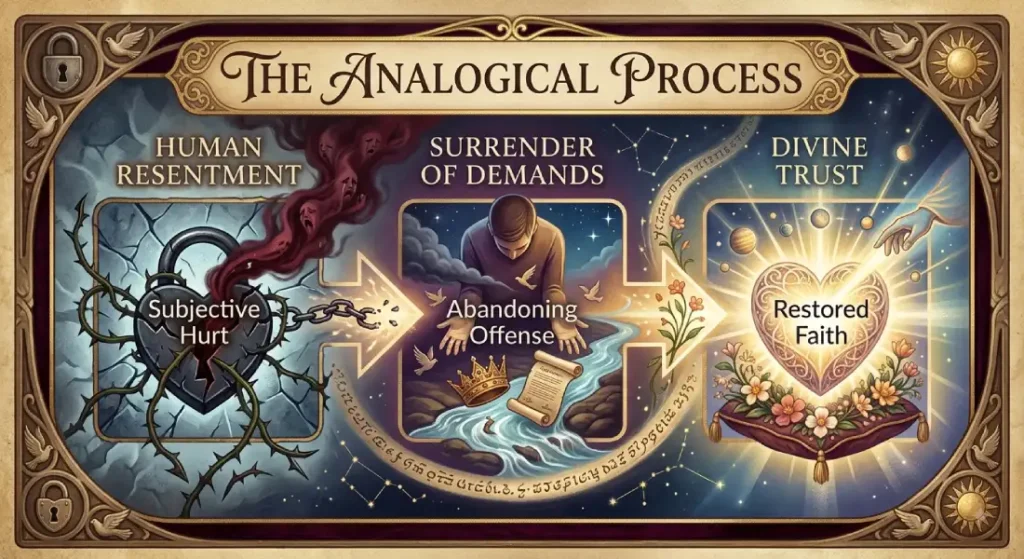
- Objective Theological Reality: God is infinite Goodness, Truth, and Justice ($ST$ I, q. 6, a. 1; CCC 385). He cannot commit an offense, fail in His promises, or owe a debt to His creation. Strictly speaking, God never needs our forgiveness.
- Subjective Human Experience: In our finite understanding, God’s permission of suffering can feel like an offense or a breach of trust.
When Catholic writers speak analogically about “forgiving God,” they do not mean pardoning a divine fault. Rather, it refers to relinquishing our human resentment, repenting of our false accusations against divine providence, and surrendering our demand that God justify Himself to us (CCC 306–314).
What Scripture Teaches About Honest Lamentation
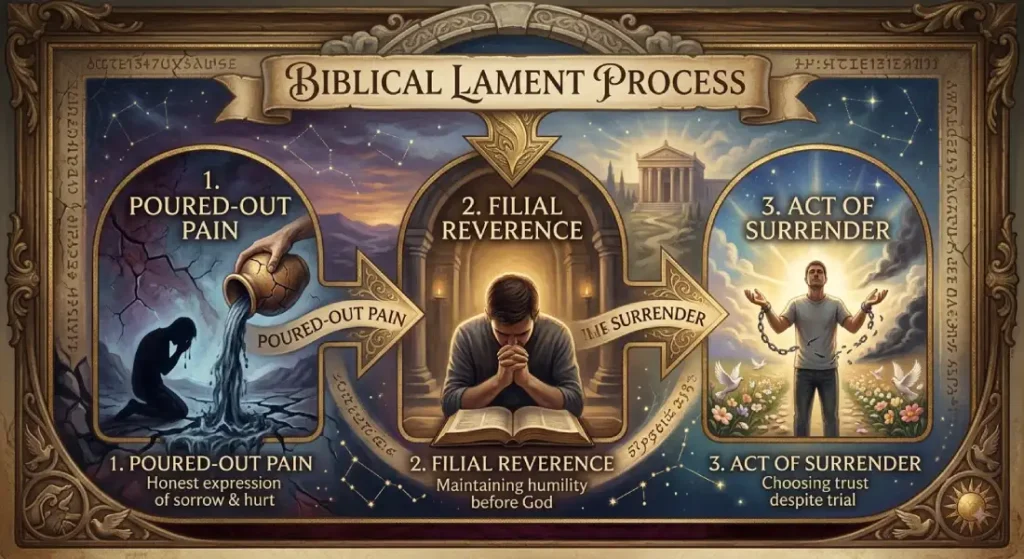
Scripture does not demand that we hide our sorrow or pretend that suffering does not hurt. Sacred Scripture preserves raw expressions of human grief, providing a holy framework for lamentation.
The Model of the Psalms
King David and the psalmists frequently brought their unvarnished distress directly to God:
“My God, my God, why have you forsaken me? Why are you so far from saving me, so far from my cries of anguish?”
— Psalm 22:1 (NABRE)
“How long, O LORD? Will you forget me forever? How long will you hide your face from me?”
— Psalm 13:1 (NABRE)
Notice that the Psalmist brings his pain to God rather than walking away from Him. True biblical lament is an act of faith, not rebellion. It uses raw honesty while maintaining filial reverence (CCC 2584).
The Trial and Repentance of Job
The Book of Job explores the mystery of innocent suffering. Job lost his children, wealth, and health. While Job’s friends wrongly insisted that his suffering was a punishment for secret sin, Job insisted on his integrity while wrestling with God’s silence.
Job did not sin merely by feeling anguish or asking why. However, in his distress, Job crossed into error when he demanded that the Almighty enter the courtroom to justify His providence.
When God finally responded out of the storm, He did not offer an explanation for Job’s suffering. Instead, He revealed His infinite majesty:
“Where were you when I laid the foundation of the earth? Tell me, if you have understanding.”
— Job 38:4 (NABRE)
Job realized that finite human intelligence cannot fathom the infinite wisdom of divine governance. His response provides the ultimate model for moving from anger to trust:
“I had heard of you by the hearing of the ear, but now my eye sees you; therefore I despise myself, and repent in dust and ashes.”
— Job 42:5–6 (RSV-CE)
Comparing Human Experience with Theological Truth
To move from emotional pain to spiritual peace, it helps to contrast what our feelings tell us during trials with what Catholic doctrine reveals.
| Human Emotional Experience | Theological Reality (Magisterium) | Scriptural / Catechetical Anchor |
| “God has abandoned me in my misery.” | God permits trials but never forsakes His children; He remains closest in suffering. | Psalm 22:1; CCC 307 |
| “God owes me an explanation for this pain.” | Divine providence guides all things toward the ultimate good, operating beyond human comprehension. | Job 38:4; CCC 314 |
| “I have a right to hold a grudge against God.” | God is absolute Goodness (Summum Bonum); human anger must yield to trust and repentance. | $ST$ I, q. 6, a. 1; CCC 385 |
| “My faith is broken beyond repair.” | Tested faith purifies the soul, stripping away superficial comfort to build deeper hope. | Habakkuk 3:17–18; CCC 1817–1818 |
Practical Catholic Steps to Heal Broken Faith
Recovering from deep spiritual wounds requires both spiritual practices and divine grace. Here are four actionable steps grounded in Catholic tradition:
1. Pray with the Psalms of Lament
Do not conceal your pain from God. Pray the Psalms out loud, making David’s inspired words your own. Let scripture give voice to your sorrow while anchoring your posture in Catholic humility (CCC 2559).
2. Frequent the Sacrament of Reconciliation
Unaddressed emotional anger can gradually harden into spiritual bitterness, resentment, or quiet unbelief.
The Sacrament of Reconciliation provides essential healing grace (CCC 1422):
- Confess any willful resentment, loss of trust, or accusations harbored against God.
- Receive sacramental absolution, which washes away spiritual wounds and restores interior peace.
- Ask the priest for practical spiritual direction on handling spiritual dryness.
3. Seek Strength in the Holy Eucharist
When life feels unbearable, bring your wounds to the Eucharistic sacrifice. In the Mass, Christ’s Passion is made present again on the altar.
By receiving the Holy Eucharist, you unite your earthly suffering directly with the Lord’s sacrifice on Calvary (CCC 1324).
4. Cultivate the Virtue of Hope
Christian hope is not a simple feeling; it is a theological virtue infused into the soul by the Holy Spirit (CCC 1817). Hope enables us to desire eternal happiness while trusting in Christ’s promises rather than our immediate circumstances.
“Faith after suffering looks different than faith before it. It is less naive, but far more resilient.”

A Prayer for Healing and Surrender
Lord God, Creator of Heaven and Earth, I bring You the heavy burdens of my heart. You know the exact pain, disappointment, and sorrow I carry.
Help me to surrender my demand for human answers and release all bitterness toward Your divine plan. Grant me the grace to trust Your goodness even when I cannot see Your hand.
Through the Sacraments of Your Holy Church, heal my wounded spirit, purify my faith, and strengthen the virtue of hope within my soul. I ask this through Jesus Christ, Our Lord. Amen.
Frequently Asked Questions
Feeling emotional distress, grief, or sorrow is not inherently sinful. Sin occurs when unaddressed anger turns into deliberate resentment, malice, or a refusal to submit to God’s authority. Bringing emotional pain to God in humble prayer follows the biblical model of holy lamentation (CCC 2584).
Because God is infinite Goodness and perfection ($ST$ I, q. 6, a. 1; CCC 385), He cannot commit wrong or owe a debt. “Forgiving God” is an analogical phrase. It means surrendering human resentment, repenting for misjudging divine providence, and releasing our demand for explanations (CCC 306–314).
Begin by praying with the Psalms of Lament (e.g., Psalm 13, Psalm 22). Seek grace through the Sacrament of Reconciliation to remove any lingering bitterness (CCC 1422), receive the Holy Eucharist regularly (CCC 1324), and speak with a faithful Catholic priest or spiritual director.
God permits physical and moral evil not because He desires it, but because He respects human free will and possesses the infinite power to bring a greater good out of every trial (CCC 311–312). The ultimate answer to suffering is revealed in the Cross of Jesus Christ.
Continue Your Faith Journey

Can a Catholic Marriage Be Annulled? Understanding the Process, Canon Law, and Truth
Facing civil divorce or seeking healing in the Church? Discover how the Catholic marriage annulment process works under Canon Law, including true…

Catholic Prayer for Husband Addicted to Porn: A Spiritual Warfare & Relational Healing Guide
Discover how Catholic spiritual warfare, Eucharistic grace, and deprecatory deliverance prayers can help free a husband from pornography addiction. Learn to combine…
Does Watching Live Stream Mass Fulfill Your Sunday Obligation? A Catholic Theological Guide
Discover whether watching Mass online satisfies your weekly Catholic duty. Learn what the Catechism of the Catholic Church, Canon Law, and Sacred…