
What Is Natural Family Planning? Catholic Teaching, Theology, and Practice

NFP & Contraception Disclaimer: Fertility tracking and Natural Family Planning methods require proper instruction, personalized medical evaluation, and individual training to be practiced effectively. This article is educational and does not replace professional medical advice or certified NFP instruction. Prayer Warrior USA makes no representations regarding the efficacy or success of fertility tracking methods for any individual.
Certified NFP Providers & Instruction Organizations
Catholic teaching on Natural Family Planning (NFP) centers on honoring both essential dimensions of marital intimacy—unitive love and procreative openness—while providing a morally sound method to space or achieve pregnancy through the observation of natural biological markers.
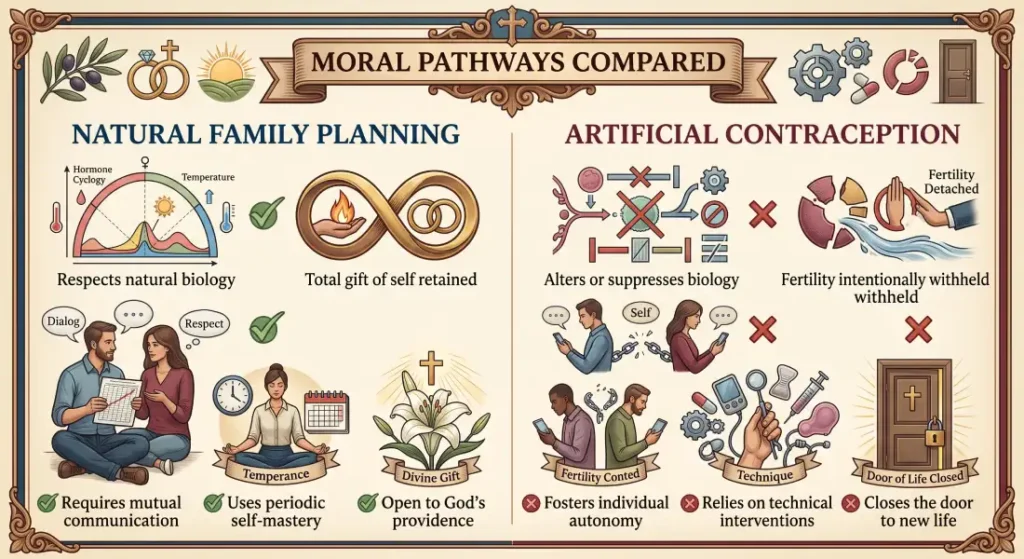
Unlike artificial contraception, which deliberately suppresses or damages human fertility, NFP works in harmony with God’s design for human physiology. It enables married couples to practice responsible parenthood through mutual communication, periodic continence, and shared discenment.
The Core Meaning of Catholic Natural Family Planning
Natural Family Planning is not merely a “Catholic alternative” to artificial birth control. Rather, it represents a distinct approach to the conjugal act, marriage, and the theology of the human body.
The Church teaches that the marital act possesses an intrinsic nature established by God:
- The Unitive Meaning: The mutual, total self-giving of husband and wife that fosters marital bonding and deepens intimacy.
- The Procreative Meaning: An intrinsic openness to the transmission of human life and the generation of children.
“So God created man in his own image, in the image of God he created him; male and female he created them. And God blessed them, and God said to them, ‘Be fruitful and multiply, and fill the earth and subdue it'” (Genesis 1:27–28, RSV-CE). From the beginning, human sexuality was given a specific teleological purpose. St. Thomas Aquinas affirmed that every human action must align with the natural end (telos) intended by the Creator (Summa Contra Gentiles, III, c. 122). When couples engage in the marital act, they participate in a sacred sign of God’s life-giving covenant.
The Inseparable Connection: What Humanae Vitae Actually Teaches
In his 1968 landmark encyclical Humanae Vitae (“Of Human Life”), Pope Paul VI addressed modern questions regarding marriage, family, and artificial birth control. Standing firm against cultural pressures, the encyclical articulated the foundational moral principle of marital intimacy:
“The Church, nevertheless, in urging men to the observance of the precepts of the natural law, which it interprets by its constant doctrine, teaches as often as possible that each and every marital act must of necessity retain its intrinsic relationship to the procreative dimension of human life.” (Humanae Vitae, no. 11)
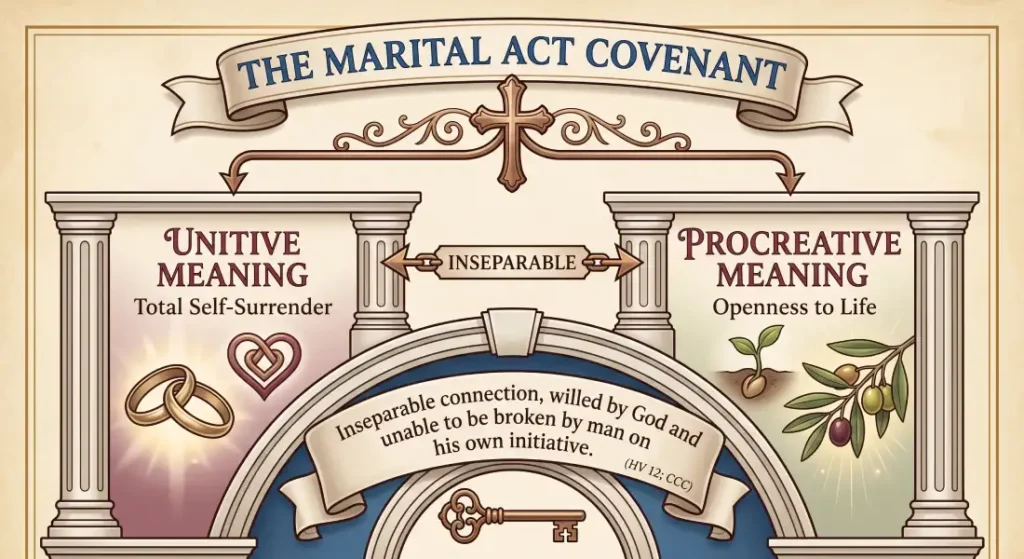
When spouses use artificial contraception (barriers, hormonal suppression, surgical sterilization), they introduce an intentional division between these two inseparable meanings. They give their spouse their affection, but deliberately withhold their fertility. Pope St. John Paul II noted in Familiaris Consortio (no. 32) that this dynamic alters the marital act from an authentic total self-gift into a conditional exchange.
Conversely, practicing periodic continence during fertile phases does not violate the marital act. The couple does not frustrate biology or manipulate the act’s nature; instead, they respect the natural rhythm of fertility created by God.
The Catechism of the Catholic Church on Spousal Love and NFP
The Catechism of the Catholic Church summarizes the Magisterial teaching on marital chastity, periodic continence, and responsible parenthood across paragraphs 2366–2370:
- The Inseparable Bond (CCC 2366, 2369): Conjugal love cannot artificially separate the unitive and procreative aspects without contradicting the objective moral order.
- Responsible Parenthood (CCC 2368): For just reasons, spouses may space births, provided their heart is not motivated by selfishness, but by authentic generosity.
- Moral Integrity of Periodic Continence (CCC 2370): Periodic continence and modern fertility awareness methods respect the bodies of the spouses, foster mutual tenderness, and cultivate interior self-mastery.
Discerning “Serious Reasons” (Iustae Causae) in Marriage
The Church does not teach that married couples must have as many children as biologically possible. Rather, she calls couples to exercise Christian prudence and generosity (Gaudium et Spes, no. 50).
Under Humanae Vitae (no. 10, 16), couples who have “serious motives” (seriis causis) or “just reasons” (iustae causae) may morally postpone pregnancy. Such reasons are evaluated before God in prayer and include:
- Physical and Mental Health: Medical conditions, post-partum recovery, or psychological strain on either spouse.
- Economic Realities: Significant financial difficulties or severe instability affecting the family’s basic needs.
- Family Welfare: The specific developmental and emotional needs of existing children or eldercare obligations.
These reasons must arise from authentic moral discernment rather than comfort-seeking, societal pressure, or a subtle contraceptive mindset. St. Thomas Aquinas taught that the virtue of prudence directs practical reasoning toward what is good (ST II-II, q. 47, a. 2). Spouses must regularly revisit their discernment, asking whether God is calling them to welcome another child.
Modern Evidence-Based NFP Methods
Modern Natural Family Planning is rooted in peer-reviewed reproductive science, distinct from the outdated calendar-based “Rhythm Method” of the early 20th century.
Modern fertility awareness systems track precise, real-time biological biomarkers:
| Method | Primary Biomarkers Observed | Clinical Effectiveness (Correct Use) | Ideal Circumstances |
| Sympto-Thermal Method (STM) | Basal Body Temperature (BBT) & Cervical Fluid | 99.4% (Human Reproduction, 2007) | Couples wanting a double-check cross-referencing system. |
| Marquette Model | Urinary Hormone Levels (LH & Estrogen Metabolites) | 98.4–99.0% (Journal of Obstetric, Gynecologic, & Neonatal Nursing) | Postpartum, breastfeeding, perimenopause, or irregular cycles. |
| Creighton Model (FertilityCare) | Standardized Cervical Mucus Biomarkers | 98.8–99.5% (Journal of Reproductive Medicine) | Identifying underlying gynecological issues via NaProTECHNOLOGY. |
| Billings Ovulation Method | Sensation and Visual Characteristics of Cervical Mucus | 98.5–99.0% (World Health Organization Studies) | Universal applicability without the need for special monitoring devices. |
Pastoral Practicalities: Living the Vocation of Marriage
Transitioning to Natural Family Planning requires intentionality, patience, and mutual charity:
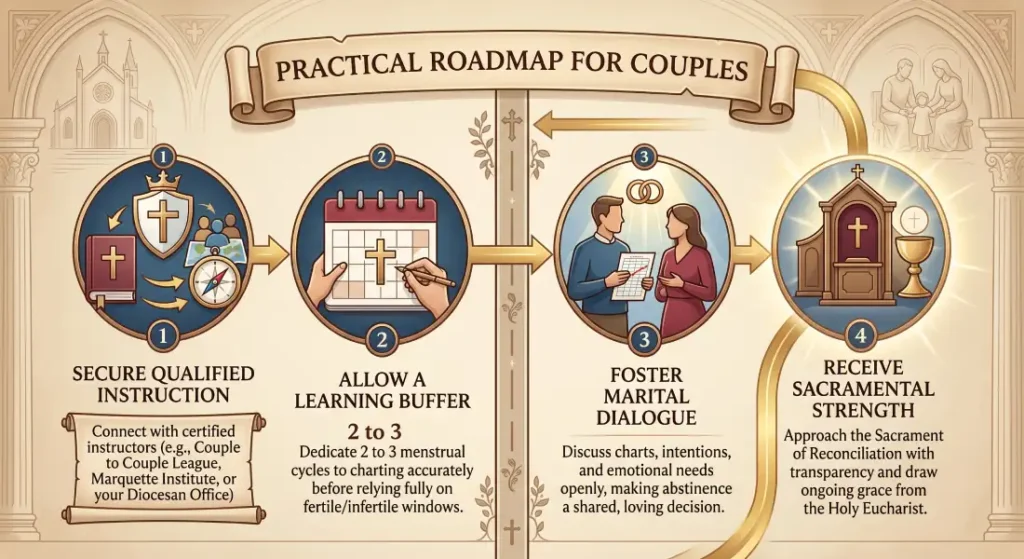
When practiced with a spirit of prayer and sacrifice, NFP strengthens spousal communication, deepens respect, and grounds the marital covenant in self-giving love.
Prayers for Spousal Discernment and Family Life
- For Openness to God’s Will: Lord God, Creator of all life, give us the grace to view our fertility not as a burden to manipulate, but as a sacred trust reflecting Your creative love. Align our hearts with Your Holy Will.
- For Strength and Mutual Chastity: Jesus Christ, Bridegroom of the Church, grant us patience, self-discipline, and charity during times of periodic abstinence. May our sacrifices draw us closer to You and to one another.
- For Pastoral Peace and Healing: Holy Spirit, heal every division in our marriage caused by past contraception or misunderstandings. Grant us clear discernment, unwavering trust in Your Providence, and deep peace in our home.
- Through Marian Intercession: Holy Mary, Mother of the Holy Family, wrap our marriage in your mantle of protection and pray that our domestic church may witness joyfully to the beauty of human life. Amen.
Frequently Asked Questions
No. While the historical rhythm method relied on rigid calendar calculations, modern Natural Family Planning (NFP) monitors real-time biological markers such as basal body temperature, cervical fluid patterns, and urinary hormone levels. Peer-reviewed studies demonstrate that modern NFP methods are over 98% effective with correct use.
According to Humanae Vitae (no. 10, 16) and Gaudium et Spes (no. 50), “serious” or “just” reasons (iustae causae) encompass significant physical, mental, economic, or family conditions evaluated through prayer and Christian prudence. Spouses must discern with generosity, avoiding selfishness or a contraceptive mindset.
Artificial contraception actively blocks, destroys, or suppresses fertility, divorcing the unitive and procreative meanings of the marital act. NFP respects the natural, God-given rhythms of fertility through periodic continence, preserving the act’s total self-giving integrity without frustrating its natural purpose.
Yes. Because NFP methods track precise biomarkers of ovulation—such as estrogen surges, luteinizing hormone (LH) peaks, and fertile cervical mucus—couples can accurately identify their peak fertile window to maximize the likelihood of conceiving.
Certified NFP Providers & Instruction Organizations
- Couple to Couple League (CCL)
- Focus: Sympto-Thermal Method instruction (in-person, live online, and self-paced courses).
- Website:
ccli.org - Contact / Support:
info@ccli.org| 1-800-745-8252
- Marquette University Institute for Natural Family Planning
- Focus: Marquette Model (hormone monitoring using clear-plan devices and urine test strips).
- Website: marquette.edu/nursing/institute-natural-family-planning/classes.php
- Contact / Support:
muinstnfp@marquette.edu| 414-288-3854
- Natural Family Planning International (NFPI)
- Focus: Cross-checking cervical mucus and basal body temperature methods.
- Website:
nfpandmore.org - Contact / Support:
nfp@nfpandmore.org
Official Catholic Magisterial & Diocesan Resources
- United States Conference of Catholic Bishops (USCCB) – NFP Program
- Focus: Official Church teachings, diocesan directory, and ministry support.
- Website:
usccb.org/topics/natural-family-planning - Contact:
nfp@usccb.org| 202-541-3240
- Local Diocesan Offices: Reach out directly to your local Catholic diocese’s Office of Marriage and Family Life to find certified instructors and support groups in your parish area.
Continue Your Faith Journey
Catholic Prayer for Husband Addicted to Porn: A Spiritual Warfare & Relational Healing Guide
Discover how Catholic spiritual warfare, Eucharistic grace, and deprecatory deliverance prayers can help free a husband from pornography addiction. Learn to combine…

Why Do Catholics Make the Sign of the Cross? Meaning, History, and Spiritual Power
Discover why Catholics make the sign of the cross. Explore its biblical origins, bodily symbolism, patristic history, and spiritual power as an…

Living Sacred Heart Devotion in the Family: Life After Enthronement
Discover practical ways to live out your Sacred Heart family consecration after the home enthronement. Build daily rhythms of prayer, mutual forgiveness,…