
Why Do Catholics Make the Sign of the Cross? Meaning, History, and Spiritual Power
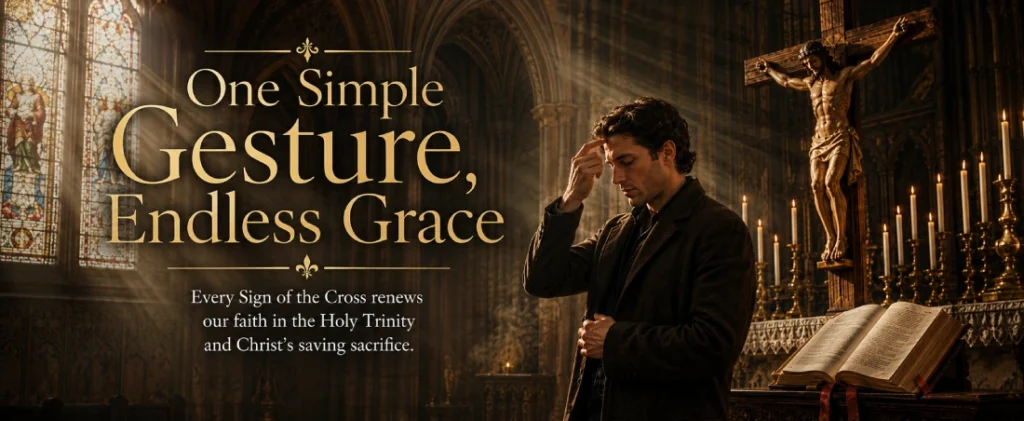
Catholics make the Sign of the Cross to profess the Holy Trinity, embody the mystery of the Incarnation and Redemptive Passion of Jesus Christ, and consecrate their entire being—mind, body, and soul—to God. As an ancient sacramental of the Church, this gesture invokes divine protection, sanctifies daily actions, and renews baptismal promises.
1. The Trinitarian Formula: Pure Dogma in Motion
The spoken words of the Sign of the Cross contain the core of Catholic dogma. When we say, “In the name”—singular, rather than plural—we proclaim the divine unity of the Godhead. When we immediately name the Father, the Son, and the Holy Spirit, we profess the Triune mystery: three distinct Divine Persons sharing one divine nature (CCC 253–258).
In a single breath, the believer confesses the foundational mystery of Christian revelation. We do not merely speak this truth; we embody it through physical action:
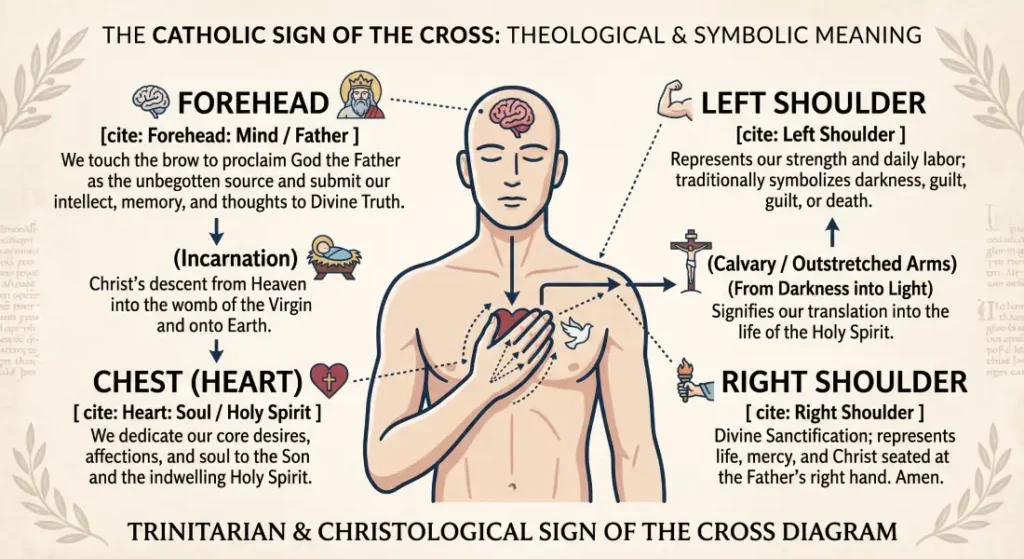
- The Vertical Descent (Forehead to Heart): Traces the descent of the Son from the Father into the world—the mystery of the Incarnation (“the Word became flesh and dwelt among us,” John 1:14).
- The Horizontal Span (Left to Right Shoulder): Traces the outstretched arms of Christ on Calvary, signifying how His sacrifice embraces all humanity and reconciles heaven and earth (Ephesians 2:16).
2. Bodily Symbolism: Praying with the Whole Person
Catholic worship is inherently sacramental and incarnational. Because God took on human flesh, physical matter and bodily posture matter in prayer. When teaching children or converts, understanding each physical movement turns a routine habit into an intentional act of consecration.
| Physical Movement | Theological Meaning | Personal Consecration |
| Forehead | The Father / The Descent of the Incarnation | Sanctifying thoughts, intellect, and memory to God’s truth |
| Heart / Breast | The Son / Christ’s Love and Indwelling Spirit | Surrendering emotions, affections, and desires to Christ |
| Shoulders | The Holy Spirit / Outstretched Arms of the Cross | Consecrating our strength, daily labor, and bodily actions |
As St. Thomas Aquinas explains in the Summa Theologiae (II-II, q. 84, a. 2), bodily signs are necessary in human worship because our interior devotion is naturally stirred by visible and exterior actions.
3. Biblical Roots: Marked by God for Salvation
While modern believers use the full Trinitarian formula, the physical act of signing the body with God’s seal is deeply rooted in Sacred Scripture.
The Old Testament Seal of Protection (Ezekiel 9:4)
In the Old Testament, the prophet Ezekiel is shown a vision where God’s faithful are set apart from destruction:
“And the Lord said to him, ‘Go through the city, through Jerusalem, and put a mark upon the foreheads of the men who sigh and groan over all the abominations that are committed in it.'” (Ezekiel 9:4, RSV-CE)
In the original Hebrew, this “mark” was the letter Tau ($\text{ת}$), which in ancient paleo-Hebrew script was drawn in the exact shape of a cross ($+$ or $\times$). The early Church Fathers recognized this as a prophetic prefiguration of Christians being marked with the Cross of Christ at Baptism.
The Saving Power of Calvary (1 Corinthians 1:18)
In the New Testament, the Cross is not an ornament of defeat, but the instrument of divine power:
“For the word of the cross is folly to those who are perishing, but to us who are being saved it is the power of God.” (1 Corinthians 1:18, RSV-CE)
When a Catholic signs their body, they directly invoke the power of Christ’s Paschal mystery over whatever task they are undertaking—whether sitting down for a meal, starting a workday, or stepping into temptation.
4. What the Catechism Teaches (CCC 2157)
The Catechism of the Catholic Church places the Sign of the Cross under its explanation of the Second Commandment (“You shall not take the name of the Lord your God in vain”):
“The Christian begins his day, his prayers, and his activities with the Sign of the Cross: ‘in the name of the Father and of the Son and of the Holy Spirit. Amen.’ The baptized person dedicates the day to the glory of God and calls on the Savior’s grace which lets him act in the Spirit as a child of the Father.” (CCC 2157)
Under CCC 2157, the gesture fulfills three primary spiritual realities:
- Reverence for the Holy Name: It guards against taking God’s name in vain by invoking it with deliberate faith and adoration.
- Consecration of Daily Action: It sanctifies ordinary human work, ordering mundane tasks toward eternal life.
- Renewal of Baptismal Dignity: It reminds the soul that through baptism, it has been indelibly marked as a child of God.
5. Ancient Witness: The Testimony of the Early Church Fathers
The Sign of the Cross was not a medieval addition; it was the daily, constant practice of the earliest Christian martyrs and apologists.
Tertullian (c. 160–225 AD)
Writing in De Corona Militis (The Crown), Tertullian illustrates how ubiquitous the gesture was among the earliest Christians:
“At every forward step and movement, at every going in and out, when we put on our clothes and shoes, when we bathe, when we sit at table, when we light the lamps, on couch, on seat, in all the ordinary actions of daily life, we trace upon the forehead the sign.”
St. Cyril of Jerusalem (c. 313–386 AD)
In his Catechetical Lectures (13.36), St. Cyril explicitly instructed new converts never to hide this gesture out of fear or embarrassment:
“Let us then not be ashamed to confess the Crucified. Be the cross our seal, made with boldness by our fingers on our brow and in everything; over the bread we eat and the cups we drink, in our comings and goings, before our sleep, when we lie down and when we awake.”
6. A Sacred Shield: The Theology of Sacramentals
According to Catholic doctrine, the Sign of the Cross is a sacramental (CCC 1667–1670). Unlike the seven Sacraments, which confer grace ex opere operato (by the very fact of the action being performed), sacramentals prepare the soul to receive grace and cooperate with it through the prayer and intercession of the Church (ex opere operantis Ecclesiae).
As an authentic sacramental, making the Sign of the Cross:
- Repels Demonic Attacks: St. Athanasius recorded that demons flee from the invocation of the Cross of Jesus Christ.
- Remits Venial Sins: When made with genuine contrition, love for God, and holy water, it disposes the soul to the forgiveness of daily venial faults.
- Sanctifies Physical Environments: Blessing homes, meals, and workspaces dedicates material reality to the sovereignty of God.
Listen to our full audio breakdown on the history and spiritual warfare dimensions of the Sign of the Cross on Spotify.
7. How to Live This Devotion Daily
It is easy to let the Sign of the Cross become a rushed, mechanical habit. Renewing devotion to this practice requires deliberate, intentional action:
- Slow Down: Pause for one second before beginning the gesture to bring your mind fully into God’s presence.
- Reclaim Public Witness: Boldly cross yourself before meals at restaurants or in public squares without shame. It serves as a silent, powerful witness to the Gospel.
- Mark Life’s Transitions: Follow Tertullian’s advice by signing yourself when leaving home, when hearing emergency sirens, before reading Scripture, and before turning off your light to sleep.
- Bless Your Children: Trace the cross on the foreheads of your children before they leave for school or go to bed, exercising your baptismal priesthood within the domestic Church.
Daily Consecration to the Holy Trinity
- Most Holy Trinity, one God, help me to understand more deeply the mystery of Your divine life that I profess each time I cross myself; Father who created me, Son who redeemed me, and Holy Spirit who sanctifies me, draw my whole being into communion with You.
- Lord Jesus Christ, teach me to make the Sign of the Cross with intention and reverence, never rushing through this sacred prayer but allowing each motion to consecrate my mind, heart, and strength to You.
- Holy Spirit, grant me the courage to make the Sign of the Cross publicly and without shame, that this witness may plant seeds of faith in hearts seeking salvation.
- Blessed Mother Mary, who stood faithfully at the foot of Calvary, pray for me that I may embrace my daily cross with unyielding trust and love. Amen.
Frequently Asked Questions
Western Catholics sign from left to right, symbolizing Christ moving from death to life and darkness to light. Eastern Catholics cross from right to left, symbolizing Christ seated at the right hand of the Father. Both are ancient, authentic apostolic traditions representing Catholic theological truth.
Yes. The Sign of the Cross is an invocation of the Holy Trinity and a complete short prayer in itself (CCC 2157). It expresses adoration, confesses faith in the Incarnation and Crucifixion, and dedicates our actions to God.
This three-fold tracing of the cross—known as the minor Sign of the Cross—is an interior prayer asking God to cleanse the mind to understand the Gospel, the lips to proclaim it, and the heart to love and live it faithfully.
Yes. Under CCC 1667–1670, the Sign of the Cross is a sacramental instituted by the Church. It does not confer grace directly like a Sacrament, but it prepares the faithful to receive divine grace and disposes the soul to cooperate with God.
Continue Your Faith Journey
Catholic Prayer for Toxic Family Conflict: A Faithful Guide to Boundaries, Healing, and Charity
Navigating family conflict, estrangement, and narcissistic behavior requires balancing Christian charity with prudent boundaries. Discover how Catholic doctrine, Sacred Scripture, and daily…
Catholic Prayer for Husband Addicted to Porn: A Spiritual Warfare & Relational Healing Guide
Discover how Catholic spiritual warfare, Eucharistic grace, and deprecatory deliverance prayers can help free a husband from pornography addiction. Learn to combine…
What Is Natural Family Planning? Catholic Teaching, Theology, and Practice
Explore Catholic teaching on Natural Family Planning (NFP). Learn how Humanae Vitae, the Catechism, and modern fertility awareness methods protect the unitive…