
What the Consecration to the Sacred Heart Means for America’s Future
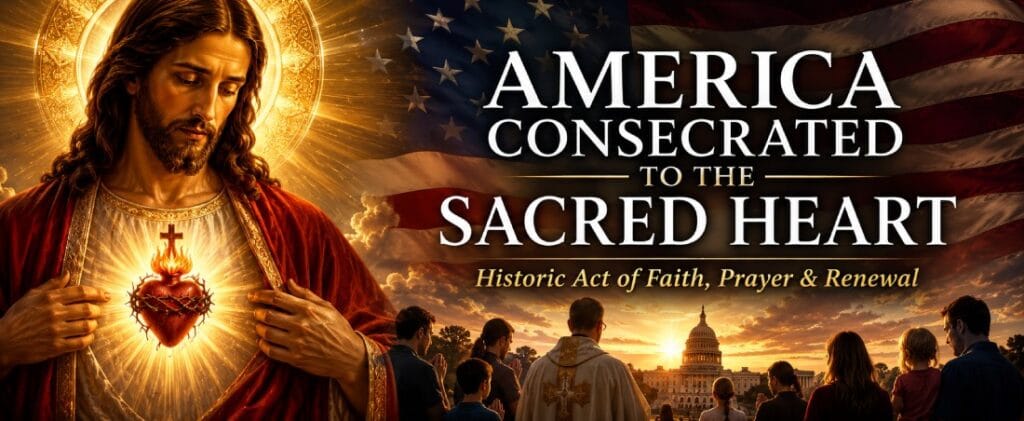
The United States Conference of Catholic Bishops (USCCB) marked a historic milestone by solemnly consecrating the nation to the Most Sacred Heart of Jesus as America approaches its 250th anniversary. This public act goes far beyond ceremonial symbolism. It represents a profound spiritual declaration: an acknowledgment that our culture, civic institutions, and communities stand in urgent need of divine mercy, moral renewal, and the healing love of Jesus Christ.
For Catholics and all Christians observing this national dedication, understanding its theological depth reveals why this moment matters for the future of our country.
Understanding Consecration: An Act of the Virtue of Religion
In authentic Catholic theology, to consecrate something is to set it apart for God’s exclusive possession and divine purposes. St. Thomas Aquinas teaches that consecration is an act belonging to the virtue of religion (religio), through which believers offer due honor and worship to God (Summa Theologiae, II-II, Q. 81, A. 5).
When the bishops consecrate our nation, they perform a formal surrender of our society to the merciful reign of Jesus Christ. As the Catechism of the Catholic Church explains, duty toward God requires individuals and societies to offer authentic worship, recognizing Christ as the ultimate sovereign over human affairs (CCC 2105).
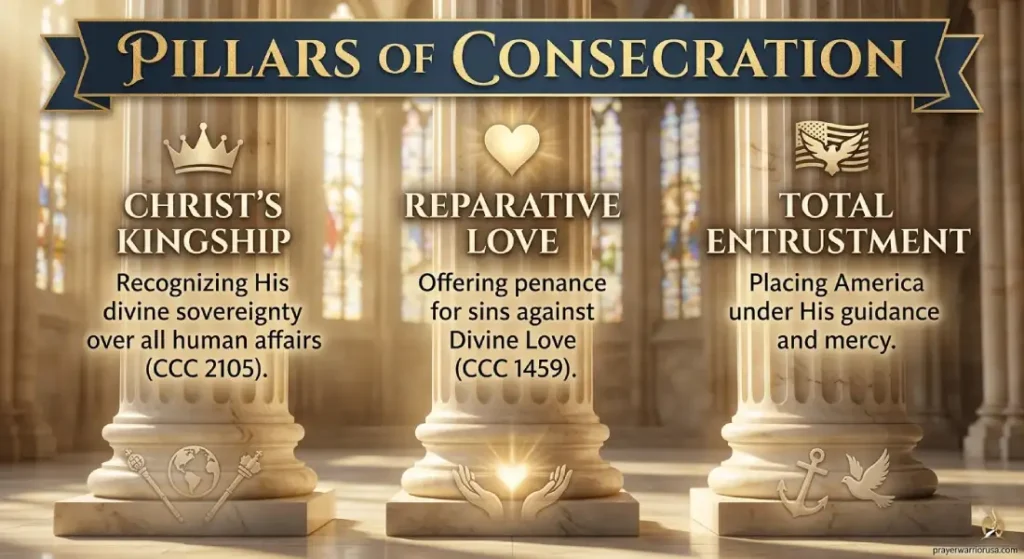
This solemn act rests on three theological pillars:
- Acknowledgment of Christ’s Kingship: Recognizing that true peace and order flow only from submission to the divine natural law.
- Reparative Love (Reparatio): Offering acts of love, penance, and restitution to amend for national sins and indifference toward God’s grace.
- Total Entrustment: Placing the protection, guidance, and future of the country into the hands of the Incarnate Saviour.
The Sacred Heart and the Social Kingship of Christ
Devotion to the Sacred Heart of Jesus is not a private or sentimental practice; it touches the core of Christian life and society. Pope Leo XIII, in his monumental encyclical Annum Sacrum (1899), emphasized that Christ’s sovereign authority extends not only over baptized Catholics, but over all humanity.
“His empire includes not only Catholic nations, not only baptized persons… but also all those who are outside the Christian faith; so that truly the whole of mankind is subject to the power of Jesus Christ.”
— Pope Leo XIII, Annum Sacrum, §8
Later, Pope Pius XI established in Quas Primas (1925) that when rulers and nations acknowledge the public authority of Christ, society receives baseline stability, justice, and liberty. Consecrating America to the Sacred Heart affirms that political solutions alone cannot fix moral decay. True restoration requires turning back to the Source of justice and charity.
As Pope Francis highlighted in his encyclical Dilexit Nos (2024), the Pierced Heart of Christ remains the living sanctuary where divine mercy meets human suffering. By turning to His Heart, we encounter the infinite love that transforms broken human wills and restores unity to divided peoples.
Scriptural Mandate: Praying and Atoning for Our Country
The act of national consecration grounds itself directly in Sacred Scripture. God calls His people to intercede actively for the civic communities in which they live.
The Call to Civil Intercession
Writing to Saint Timothy, Saint Paul commands regular prayer for civic authorities:
“First of all, then, I urge that supplications, prayers, intercessions, and thanksgivings be made for all people, for kings and all who are in high positions, that we may lead a peaceful and quiet life, godly and dignified in every way.”
— 1 Timothy 2:1–2 (ESV)
Catholic social teaching affirms that praying for civil leaders and political well-being is a fundamental duty of citizenship (CCC 1900, 2240). We do not pray for leaders only when we agree with them; we pray that God grants them moral wisdom, integrity, and respect for human dignity.
The Roadmap for Healing
In the Old Testament, the Lord provides a clear formula for spiritual recovery:
“If my people who are called by my name humble themselves, and pray and seek my face and turn from their wicked ways, then I will hear from heaven and will forgive their sin and heal their land.”
— 2 Chronicles 7:14 (ESV)
This promise underscores the necessity of reparative prayer. Healing requires national humility, sincere repentance, and a commitment to turn away from systemic sin.
Sacramental Reality vs. Universal Christian Application
While consecration to the Sacred Heart is a distinctively Catholic act rooted in sacred tradition and the sacraments, its message offers a powerful invitation to all Christians. The following framework illustrates how this devotion bridges formal Catholic doctrine with broader ecumenical action:
| Theological Dimension | Catholic Sacramental Reality | Ecumenical Christian Application |
| Primary Act | Formal liturgical consecration & Holy Sacrifice of the Mass | Intercessory prayer, fasting, and civic moral witness |
| Core Devotion | Reparation for sin, Adoration of the Blessed Sacrament, Eucharistic devotion | Seeking Christ’s love, guidance, and national healing |
| Scriptural Foundation | 1 Timothy 2:1–2; John 19:34; Sacred Heart revelations grounded in Scripture | 2 Chronicles 7:14; 1 Timothy 2:1–2 |
| Moral Mandate | Defence of life from conception to natural death (CCC 2270–2279) | Active defense of the vulnerable, unborn, and elderly |
How to Live Out the Consecration Daily
National consecration is not a one-time event; it demands a lived response. To manifest Christ’s reign in our culture, believers are called to cultivate intentional spiritual habits:
1. Consecrate Your Domestic Church
Start inside your own household. Dedicate your family to the Sacred Heart by enthroning an image of the Sacred Heart in your home. Let Christ’s self-sacrificing love dictate how family members treat one another.
2. Practice Reparation
Offer weekly acts of penance—such as Friday fasting, Eucharistic Adoration, or frequenting the Sacrament of Reconciliation—to make amends for national sins against human dignity, religious liberty, and divine truth (CCC 1459, 2412).
3. Defend the Dignity of All Human Life
A nation consecrated to Christ must protect His most vulnerable brothers and sisters. Speak up courageously for the unborn, the elderly, the poor, and the marginalized, upholding the sacredness of every human life (CCC 2270).
4. Cultivate Christian Civility
In an era dominated by ideological conflict, model Christ-like charity. Reject slander, promote truth, and actively seek peace within your local community.
A Prayer for the Consecration of Our Nation
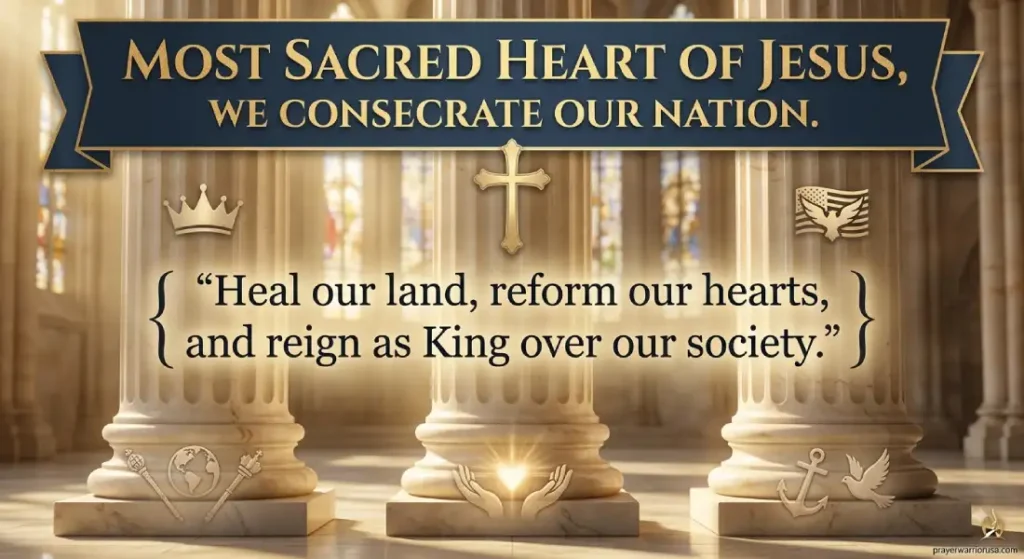
Most Sacred Heart of Jesus, we offer You our nation as we approach its 250th anniversary. We acknowledge Your absolute sovereignty over all peoples and nations.
We ask You to pardon our sins, heal our divisions, and pour out Your divine mercy upon our land. Raise up leaders rooted in wisdom, justice, and integrity. Protect the unborn, defend the family, and grant us the grace to live as faithful witnesses to Your Gospel.
Divine Heart of Jesus, transform our culture from within, so that our laws and society may reflect Your truth and eternal love.
Amen.
Frequently Asked Questions
Consecrating a nation to the Sacred Heart is a formal act of religion where church leaders entrust a country to Christ’s sovereignty. It seeks divine protection, offers reparation for national sins, and asks for moral renewal so societal laws reflect divine justice and love.
While formal consecration is a Catholic liturgical act, its core invitation is universal. All Christians can participate by offering intercessory prayers, turning from sin, fasting for national repentance, and upholding Christian moral values within their local communities.
The Sacred Heart devotion is rooted in Scripture (John 19:34) and formal Magisterial teaching, including Pope Leo XIII’s Annum Sacrum and Pope Pius XI’s Quas Primas. It honors Christ’s incarnate love and calls believers to make reparation for human indifference toward His divine mercy.
The U.S. bishops consecrated the nation to seek divine guidance, healing, and spiritual renewal as America reaches its 250th anniversary in 2026. It serves as a call for national repentance, protection of life, and the restoration of Christian charity across divided communities.
Continue Your Faith Journey
What Is Eucharistic Adoration? A Catholic Guide to the Real Presence
Discover the rich Catholic tradition of Eucharistic adoration and the Real Presence of Christ. Learn how to make a transformative Holy Hour…
Dobbs Decision Anniversary: Why the Battle for Life Has Moved from the Courts to the Heart
On the Dobbs decision anniversary, the pro-life mission shifts from courtrooms to human hearts. Discover how Catholic teaching and Evangelium Vitae call…
Catholic Prayer for Toxic Family Conflict: A Faithful Guide to Boundaries, Healing, and Charity
Navigating family conflict, estrangement, and narcissistic behavior requires balancing Christian charity with prudent boundaries. Discover how Catholic doctrine, Sacred Scripture, and daily…