
Eucharistic Miracle in Lebanon: Hope Amid War’s Ruins
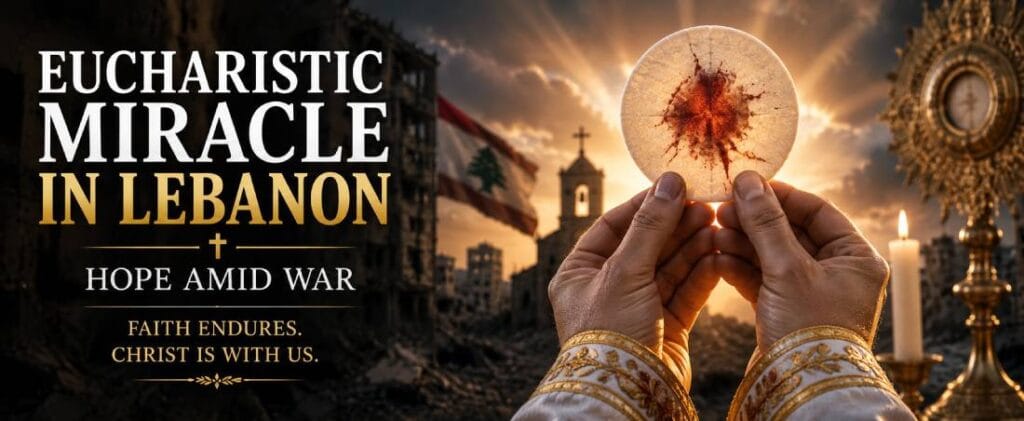
When Lebanese Catholics returned to their bombed parish in the southern town of Tibnine following the April 2026 ceasefire, they expected to find only rubble and ash. Instead, they discovered a sign of hope that local believers hold as a profound testament to God’s enduring presence: despite 47 days of abandonment following severe bombardment, the consecrated Eucharist remained completely intact among the debris, alongside an undamaged statue of the Blessed Virgin Mary.
| Event Detail | Fact Sheet |
| Location | St. George Melkite Greek-Catholic Church, Tibnine, Southern Lebanon |
| Clergy In Charge | Fr. Marios Khairallah |
| Sacred Element | Consecrated Eucharistic Bread (Melkite Leavened Kurban) |
| Time Abandoned | 47 days amidst destruction, dampness, and ruins |
| Canonical Status | Pending official episcopal evaluation by the local Ordinary (cf. CIC Canon 823) |
While canonical protocol reserves the definitive declaration of a “Eucharistic Miracle” to the local Bishop following scientific and theological investigation (cf. Code of Canon Law, Canon 823), the preservation of the Sacred Species in a destroyed sanctuary provides immense spiritual consolation to a suffering population.
The Real Presence Amid Destruction
War brings devastation that consumes physical structures. Buildings crumble, communities scatter, and earthly places of worship turn to dust. Yet, the Catholic faith affirms that God’s sacramental presence transcends human destruction. Christ promised His apostles, “I am with you always, to the very end of the age” (Matthew 28:20).
When parishioners returned to survey St. George Church, debris covered the sanctuary floor and walls had collapsed inward. Natural forces alone cannot easily explain why leavened Eucharistic bread—left in exposed, humid, and damaged surroundings for over six weeks—would avoid natural decay. Scientific norms dictate that unpreserved bread spoils rapidly under such conditions; yet the sacred element remained free of mold or alteration.
As Fr. Marios Khairallah observed upon returning: “After 47 days, it is scientifically impossible to explain why the bread didn’t spoil. But for us, this isn’t strange at all, because we believe it is the Body of Christ.”
This preservation underscores the core Catholic dogma of the Real Presence. As the Council of Trent solemnly defined and the Catechism of the Catholic Church affirms:
“In the most blessed sacrament of the Eucharist ‘the body and blood, together with the soul and divinity, of our Lord Jesus Christ and, therefore, the whole Christ is truly, really, and substantially contained.'” (CCC 1374)
Through transubstantiation, the substance of the bread becomes the Body of Christ while the physical appearances (accidents) remain (CCC 1376). Thus, what was preserved in the ruins of Tibnine was not merely a physical artifact, but the sacramental reality of Our Savior Himself.
Mary at the Foot of the Cross in Lebanon
The discovery was rendered even more striking by the intact statue of the Blessed Virgin Mary standing beside the ruined altar area.
Catholics venerate Mary as the Mother of God (Theotokos) and the Mother of the Church (CCC 963). She stood faithfully at the foot of the Cross during her Son’s crucifixion (John 19:25; CCC 964). Finding her image undamaged amid fallen concrete sent a clear message to the local Eastern Catholic community: Our Lady continues to stand with her suffering children in their hour of trial.
Throughout history, persecuted Christians have witnessed similar signs of divine comfort. From the underground churches of communist Eastern Europe to faithful communities across the Middle East, believers have risked their lives to safeguard the Blessed Sacrament. The Melkite faithful of Tibnine now add their voice to this unbroken witness, demonstrating that darkness cannot extinguish the light of Christ.
Supporting the Persecuted Church
This event in Lebanon serves as a direct call to solidarity for Catholics worldwide. St. Paul reminds the faithful, “If one member suffers, all suffer together” (1 Corinthians 12:26). The Middle Eastern Christian presence, which dates back to the Apostolic Age, faces immense economic and existential pressure due to ongoing conflict.
Practical ways to respond include:
- Targeted Prayer: Offer daily Rosaries and Holy Hours specifically for persecuted Christians in the Middle East and globally.
- Direct Aid: Support verified Catholic charitable agencies, such as Aid to the Church in Need (ACN) or the Catholic Near East Welfare Association (CNEWA), which deliver immediate relief to displaced families in Lebanon.
- Eucharistic Gratitude: Approach the Sacrament of the Eucharist with renewed reverence, never taking for granted the freedom to attend Mass and receive Holy Communion.
Frequently Asked Questions
When an extraordinary event involving the Eucharist occurs, the local bishop forms an investigative commission comprising theologians, canon lawyers, and scientific experts (such as biologists or medical doctors). The team evaluates whether natural or scientific explanations can be ruled out. If no natural explanation exists and the event promotes spiritual good, the bishop may approve it for public devotion.
While Roman (Latin) Catholics use unleavened wheat hosts for the Eucharist, Eastern Catholics—including the Melkite Greek-Catholic Church—traditionally use leavened wheat bread (often called Kurban or Prosphora). Both rites validly consecrate the true Body and Blood of Jesus Christ.
Church buildings are physical structures subject to the temporal realities of a fallen world. While God permits physical destruction due to human free will and war, He guards the spiritual integrity of His Church (Matthew 16:18) and frequently uses trials to purify and strengthen the faith of His people.
To learn more about historical signs of Eucharistic faith in the region, watch this short documentary report on how Lebanese Catholics have historically turned to the Blessed Sacrament during times of crisis:
Source: Zenit
Continue Your Faith Journey
What Is Eucharistic Adoration? A Catholic Guide to the Real Presence
Discover the rich Catholic tradition of Eucharistic adoration and the Real Presence of Christ. Learn how to make a transformative Holy Hour…
Catholic Prayer for Toxic Family Conflict: A Faithful Guide to Boundaries, Healing, and Charity
Navigating family conflict, estrangement, and narcissistic behavior requires balancing Christian charity with prudent boundaries. Discover how Catholic doctrine, Sacred Scripture, and daily…
How to Pray the 54 Day Rosary Novena: Complete Guide and Tracker
Discover how to pray the miraculous 54 Day Rosary Novena with this Catholic guide, complete 27-day petition and thanksgiving schedule, and daily…