
Why Do Catholics Pray to Mary? Church Teaching, Scripture, and Tradition
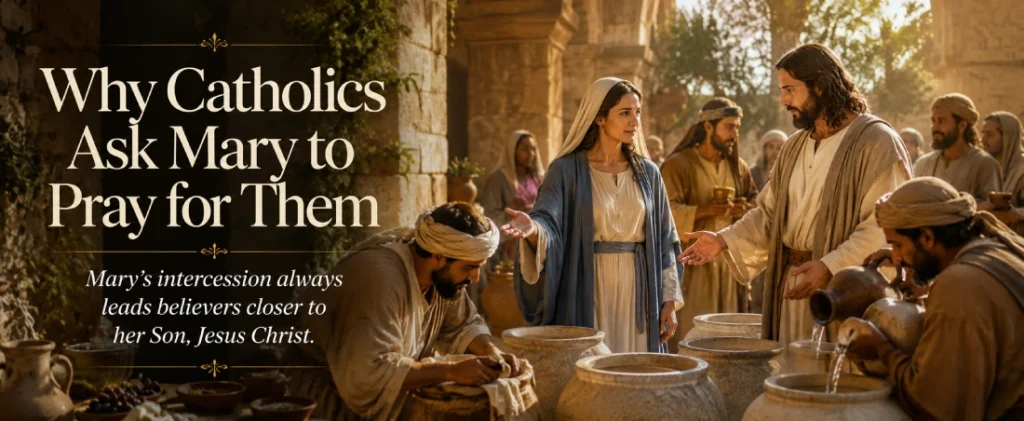
Catholic teaching forbids worshipping the Virgin Mary or any other creature. In Catholic theology, prayer to Mary is an act of intercession and veneration, not adoration. When Catholics pray to Mary, they ask her to pray for them to God, exactly as Christians ask friends and family on earth to pray for their needs.
Because Mary is the Mother of Jesus Christ—who is true God and true man—she holds a unique, exalted place in the communion of saints. Her role does not diminish the saving work of Christ; rather, it magnifies His grace and leads believers directly to Him.
| Term | Target of Honor | Theological Definition | Catholic Practice |
| Latria | God Alone (Holy Trinity) | Sacrificial adoration and supreme worship (Exodus 20:3–5) | The Holy Sacrifice of the Mass, Eucharistic Adoration |
| Hyperdulia | The Blessed Virgin Mary | Highest veneration accorded to the Mother of God (Luke 1:48) | The Rosary, Marian Liturgies, Angelus |
| Dulia | Angels & Canonized Saints | Honor and respect given to God’s faithful servants (CCC 956) | Invocations for intercession, patron saint devotions |
1. Worship vs. Veneration: The Theological Difference
The distinction between worship and honor is fundamental to Catholic dogma. Since the early Church, theologians have preserved clear boundaries between the adoration due to the Creator and the honor given to holy men and women.
- Latria (Adoration): This is the supreme worship offered to the Holy Trinity alone—Father, Son, and Holy Spirit. It involves the offering of sacrifice, complete submission of the soul, and recognition of God as the uncreated Source of all being. To offer latria to any creature, including Mary, is the mortal sin of idolatry.
- Dulia (Veneration): This is the honor and reverence paid to the holy angels and canonized saints. It recognizes the work of God’s grace in their virtuous lives.
- Hyperdulia (Highest Veneration): St. Thomas Aquinas explains that because Mary is the Theotokos (Mother of God), she is entitled to a preeminent degree of veneration (Summa Theologiae II-II, q. 103, a. 4). Hyperdulia is infinitely below the adoration given to God, yet it surpasses the honor given to all other saints and angels due to her singular role in the Incarnation.
As the Second Vatican Council proclaimed in Lumen Gentium (No. 66), authentic Marian devotion “differs essentially from the cult of adoration, which is offered equally to the Incarnate Word and to the Father and the Holy Spirit.”
2. Christ the One Mediator and Marian Intercession
A frequent objection to Marian prayer cites 1 Timothy 2:5: “For there is one God, and there is one mediator between God and men, the man Christ Jesus.”
Catholic dogma completely affirms this passage. Jesus Christ is the sole primary Mediator of salvation; His sacrifice on Calvary alone reconciled humanity to the Father. Mary does not replace, rival, or add to Christ’s finished work.
However, Sacred Scripture also commands Christians to engage in secondary, subordinate intercession for one another:
“I urge that supplications, prayers, intercessions, and thanksgivings be made for all men.” (1 Timothy 2:1)
When believers pray for each other on earth, they participate in Christ’s unique mediation. In the same way, the saints in heaven—who are alive in Christ (Luke 20:38) and offer the prayers of the holy ones before the throne of God (Revelation 5:8)—participate in subordinate intercession. Mary’s intercession flows entirely from the infinite merits of her Son.
The Dogmatic Constitution Lumen Gentium clarifies this relationship:
“Mary’s function as mother of men in no way obscures or diminishes this unique mediation of Christ, but rather shows its power. But the Virgin’s salutary influence on men originates not in any inner necessity, but in the good pleasure of God. It flows forth from the superabundance of the merits of Christ, rests on his mediation, depends entirely on it and draws all its power from it.” (Lumen Gentium, No. 60)
3. The Biblical Foundations of Marian Devotion
Marian prayer is deeply rooted in Sacred Scripture. Far from an unbiblical invention, the Gospels present Mary as the premier intercessor and the first disciple of the New Covenant.
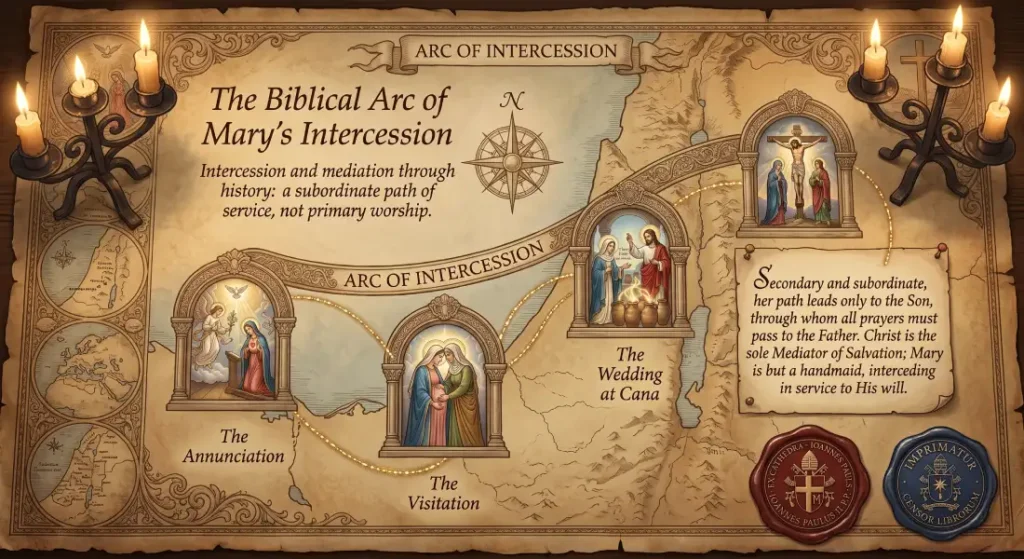
The Wedding at Cana (John 2:1–11)
At the wedding feast of Cana, Mary noticed that the hosts had run out of wine. Without being asked by the bridal party, she brought this temporal need directly to her Son: “They have no wine” (John 2:3).
When Jesus responded that His hour had not yet come, Mary turned to the servants and gave the ultimate command of Christian discipleship: “Do whatever he tells you” (John 2:5). Through her maternal intervention, Jesus worked His first public miracle, and His disciples believed in Him. This biblical encounter illustrates Mary’s perpetual role: she observes our needs, brings them before Christ, and instructs us to obey Him.
Mother of the Church at the Cross (John 19:26–27)
As Christ hung on the cross, He looked down upon Mary and the Apostle John:
“When Jesus saw his mother, and the disciple whom he loved standing near, he said to his mother, ‘Woman, behold, your son!’ Then he said to the disciple, ‘Behold, your mother!’ And from that hour the disciple took her to his own home.” (John 19:26–27, RSV-CE)
Sacred Tradition, affirmed by the Fathers and Doctors of the Church, teaches that St. John stood at Calvary as the representative of all redeemed humanity. In giving Mary to John, Christ entrusted His Mother to every believer, establishing her spiritual motherhood over the Church in the order of grace (CCC 969).
The Annunciation and Visitation (Luke 1:28, 42)
When the Archangel Gabriel greeted Mary, he addressed her as “full of grace” (kecharitomene, Luke 1:28). Soon after, Elizabeth was filled with the Holy Spirit and proclaimed: “Blessed are you among women, and blessed is the fruit of your womb!” (Luke 1:42).
Elizabeth recognized that honoring Mary was not in competition with God, but a direct response to what the Almighty had accomplished through her. Mary herself prophesied in her Magnificat: “For behold, henceforth all generations will call me blessed; for he who is mighty has done great things for me” (Luke 1:48–49).
4. What the Catechism Teaches About Marian Prayer
The Catechism of the Catholic Church summarizes centuries of Magisterial reflection on Marian prayer:
- Cooperation with the Holy Spirit (CCC 2675): Mary’s prayer is characterized by her generous cooperation with the Holy Spirit. She prays with the Church and for the Church as the Mother of the Incarnate Word.
- Entrustment in the Hail Mary (CCC 2677): By asking Mary to pray for us, “we acknowledge ourselves to be poor sinners and we address ourselves to the ‘Mother of Mercy,’ the All-Holy One”. In the second half of the prayer, “we surrender ourselves to her now, in the today of our lives… our trust broadens to surrender the whole of our present life to her, and we ask her to be there at the hour of our death, as she was at her Son’s death on the cross.”
- The Perfect Model of Prayer (CCC 2679): Mary is the “perfect Orans (pray-er), a figure of the Church”. When Catholics pray with her, they join their prayers to the woman who gave the perfect fiat (“let it be done”) to the will of God.
5. The Rosary: Christ-Centered Meditation
The most popular Marian prayer is the Holy Rosary. Non-Catholics often mistake the Rosary for repetitive, unbiblical chanting. In reality, the Rosary is an entirely scriptural, Christ-centered meditation.
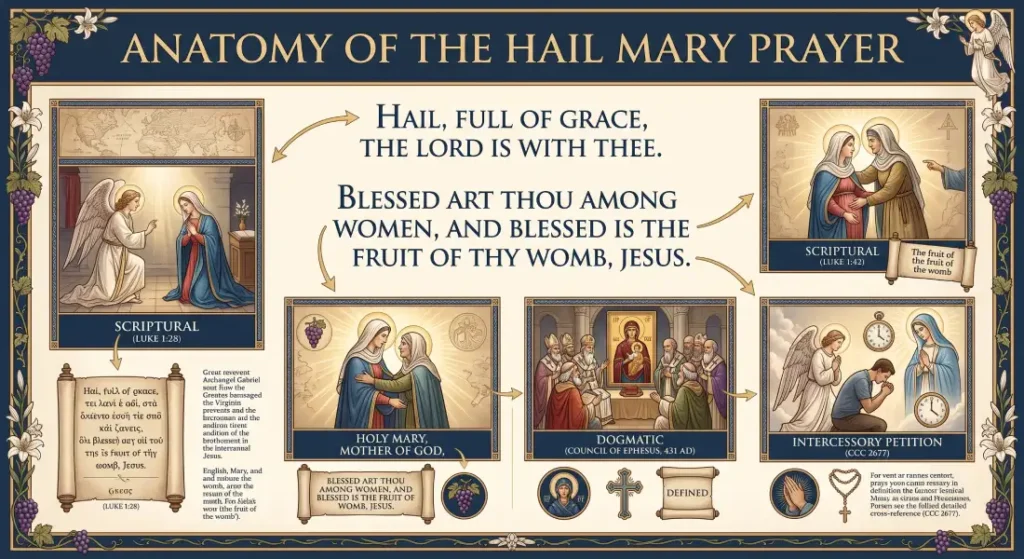
As Pope St. John Paul II emphasized in his Apostolic Letter Rosarium Virginis Mariae (2002), the Rosary is a contemplative prayer designed to help believers “contemplate the face of Christ with Mary.” While the lips repeat the biblical prayers, the mind and heart meditate on the saving mysteries of Christ’s life, passion, death, and resurrection.
6. How Marian Intercession Applies to Daily Life
Marian devotion is not an abstract concept; it is an active spiritual aid for the daily trials of Christian discipleship.
- Perseverance in Spiritual Combat: When facing temptation or spiritual dryness, turning to Mary provides the refuge of a mother who remained steadfast beneath the Cross.
- Defense of the Sanctity of Life: Mary’s unconditional “yes” to an unexpected and perilous pregnancy makes her the natural patroness and intercessor for crisis pregnancy ministries and the pro-life movement.
- Cultivating Humility and Obedience: In a self-reliant culture, Mary teaches believers to surrender their personal will to the sovereign plan of God, echoing her words: “Behold, I am the handmaid of the Lord; let it be to me according to your word” (Luke 1:38).
Honoring Mary always leads believers deeper into the heart of Jesus Christ. As St. Louis de Montfort famously wrote: “The more the soul is consecrated to Mary, the more it is consecrated to Jesus.”
Frequently Asked Questions
No. Catholics worship God alone (latria). Catholic dogma strictly forbids offering adoration to any creature, including Mary. Catholics venerate Mary with highest honor (hyperdulia) because she is the Mother of God, asking for her intercessory prayers to her Son, Jesus Christ.
Catholics pray directly to Jesus daily, but they also ask Mary to pray with and for them. Just as Christians ask earthly friends to intercede for them, Catholics ask Mary in heaven, whose righteous prayers are exceptionally powerful before God (James 5:16; John 2:1–11).
No. First Timothy 2:5 identifies Jesus as the sole Mediator of salvation. However, 1 Timothy 2:1 commands all Christians to offer intercessory prayers for one another. Mary’s maternal intercession is subordinate and draws its entire power from Christ’s unique mediation (Lumen Gentium 60).
The foundational prayers to Mary are taken directly from Scripture: the Archangel Gabriel’s greeting (Luke 1:28) and Elizabeth’s exclamation (Luke 1:42)[cite: 1]. Her intercessory power is demonstrated at the Wedding at Cana (John 2:1–11) and established at the Cross (John 19:26–27).
Continue Your Faith Journey
Catholic Prayer for Toxic Family Conflict: A Faithful Guide to Boundaries, Healing, and Charity
Navigating family conflict, estrangement, and narcissistic behavior requires balancing Christian charity with prudent boundaries. Discover how Catholic doctrine, Sacred Scripture, and daily…
How to Pray the 54 Day Rosary Novena: Complete Guide and Tracker
Discover how to pray the miraculous 54 Day Rosary Novena with this Catholic guide, complete 27-day petition and thanksgiving schedule, and daily…
The 7 Best Catholic Bibles for Beginners and Scholars: The Ultimate Guide to Faithful Scripture Study
Discover the best Catholic Bibles for beginners and scholars. Compare top translations like the RSV-2CE, NABRE, and Douay-Rheims to deepen your daily…