
Healing After Stillbirth Loss: A Mother’s Catholic Counseling Ministry
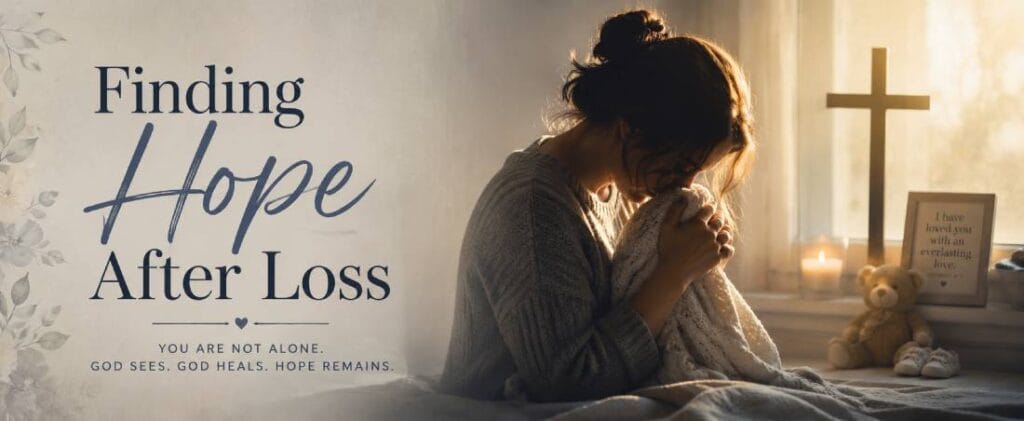
Every parent dreams of holding their newborn child. When that dream shatters through stillbirth, the grief cuts deeper than words can express. Kelly Helsel, a mother of seven and founder of Concordia Counseling, knows this suffering firsthand. In 2023, Kelly and her husband, Doug, suffered the heartbreaking stillbirth of their daughter, Mary Catherine, due to a congenital heart condition.
Rather than allowing loss to permanently shatter her spirit, Kelly turned to her Catholic faith, prayer, and the Sacraments. Her experience became the catalyst to complete her counseling degree at the University of Mary, graduating from an accelerated program to offer grieving families clinical mental health support built upon authentic Catholic anthropology.
The Weight of Stillbirth: Finding Theological Clarity in Grief
Stillbirth forces parents to confront harrowing existential and theological questions. Why did God allow this? Where is my child now? How do I continue when my heart feels broken?
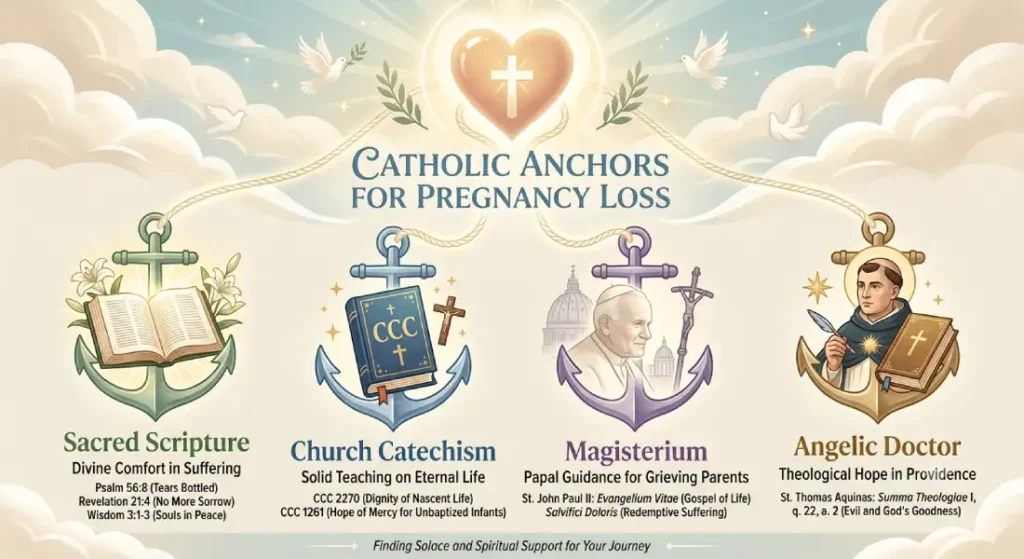
To process these questions, Kelly anchored her heart in the teachings of the Catholic Church. Catholic moral theology affirms that human life begins at conception (Catechism of the Catholic Church, 2270). Every unborn child possesses an immortal soul, inherent dignity, and eternal value in the eyes of the Creator.
“God creates every human soul directly, and life must be respected and protected absolutely from the moment of conception.” — CCC 2270
Kelly found solace in recognizing that Mary Catherine’s existence was not a cosmic accident. Though her life on earth was brief, her soul possesses eternal dignity. Scripture reassures grieving parents that God records every affliction: “You have kept count of my tossings; put my tears in your bottle” (Psalm 56:8).
Uniting Pain to the Cross: The Redemptive Power of Suffering
Catholic teaching on suffering differs fundamentally from secular models. As St. John Paul II taught in his Apostolic Letter Salvifici Doloris (1984), human suffering is not meaningless; when united to the Passion of Christ, it becomes redemptive.
St. Thomas Aquinas explains that God permits physical evils in creation—such as biological malformations or natural grief—not because He desires harm, but to draw forth a greater spiritual good (Summa Theologiae, I, q. 22, a. 2). What was experienced as a heart-wrenching loss in a fallen world, God in His divine providence transformed into a vessel of healing.
Through prayer and the Holy Spirit, Kelly discovered that her suffering could be offered up as a spiritual sacrifice. This redemptive perspective enabled her to return to school to obtain her master’s degree in clinical counseling, establishing Concordia Counseling—named “heart to heart” to honor both the Sacred Heart of Jesus and her daughter Mary Catherine.
Entrusting Stillborn Infants to God’s Divine Mercy
A central concern for Catholic parents experiencing stillbirth is the eternal destination of their unbaptized child. Because Baptism is the Sacrament through which original sin is washed away and sanctifying grace is conferred (CCC 1257), stillbirth deprives an infant of sacramental Baptism before death.
However, the Church does not teach that unbaptized infants are lost. The Catechism of the Catholic Church explicitly provides consolation:
“As regards children who have died without Baptism, the Church can only entrust them to the mercy of God, as she does in her funeral rites for them. Indeed, the great mercy of God who desires that all men should be saved, and Jesus’ tenderness toward children… allow us to hope that there is a way of salvation for children who have died without Baptism.” — CCC 1261
Furthermore, the International Theological Commission’s 2007 document, The Hope of Salvation for Infants Who Die Without Being Baptised, reaffirms that God’s grace is not restricted strictly to the Sacraments. While we avoid dogmatic presumption, parents can rest in firm theological hope, trusting that a loving God holds their children close.
Integrating Catholic Anthropology with Clinical Therapy
Kelly Helsel’s ministry at Concordia Counseling bridges evidence-based therapeutic methods—such as Cognitive Behavioral Therapy (CBT) and trauma-informed grief support—with the Catholic understanding of the human person.
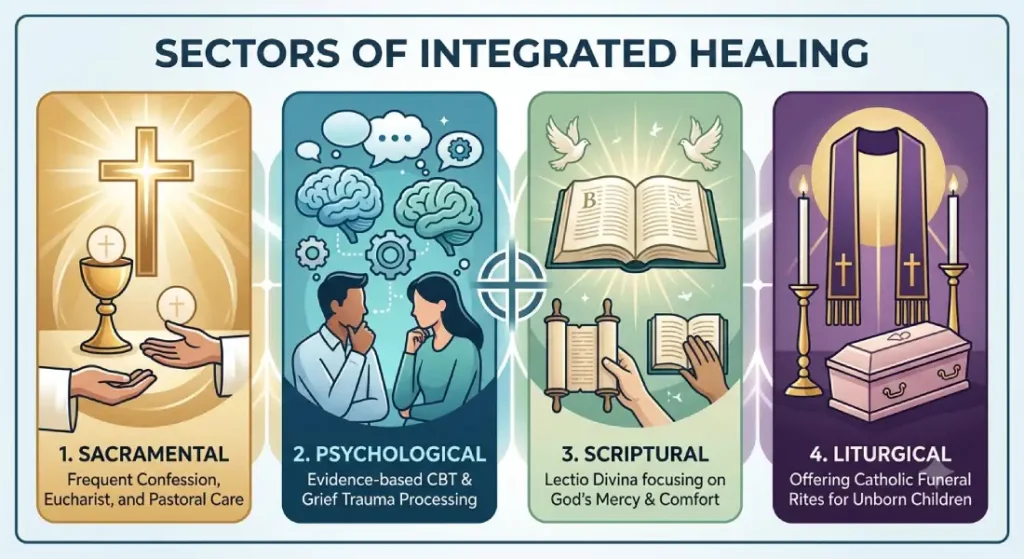
Secular counseling often treats grief merely as a psychological condition to be managed through coping mechanisms. In contrast, Catholic counseling addresses the whole human person—body, mind, and soul. Kelly validates the real emotional pain of parents while guiding them back to the Sacraments, encouraging prayer, and helping them re-establish hope in God’s promises.
Actionable Steps for Grieving Catholic Parents
If you or someone you love has experienced a stillbirth or pregnancy loss, the Church offers immediate spiritual and pastoral care:
- Request a Catholic Funeral or Memorial Service: Canon Law permits official Catholic funeral rites and burials for children who die before Baptism if the parents intended to baptize them (Code of Canon Law, Can. 1183 §2).
- Name Your Baby: Giving your child a name honors their personhood and provides a focus for family prayer and devotion.
- Seek Sacramental Grace: Turn to the Sacrament of Reconciliation and frequent Holy Communion to receive the grace necessary to carry heavy spiritual burdens.
- Engage Professional Faith-Based Counseling: Work with a licensed Catholic mental health professional who respects Catholic moral principles and understands the spiritual dimensions of grief.
Frequently Asked Questions
Yes. Canon 1183 §2 of the Code of Canon Law explicitly states that the local Ordinary may permit children to be given Catholic funeral rites if their parents intended to have them baptized but died before Baptism.
Catholic counseling combines proven psychological techniques with Catholic anthropology. It recognizes the reality of sin, grace, redemptive suffering, and the immortality of the human soul, ensuring that spiritual values are supported rather than undermined during therapy.
St. Gianna Beretta Molla, St. Gerard Majella, and Our Lady of Sorrows are primary intercessors for grieving mothers, pregnancy complications, and child loss.
Hope Beyond Grief
Faith after child loss does not erase emotional pain, but it bestows purpose upon tears. Kelly Helsel’s journey proves that God wastes nothing—every prayer, every tear, and every step through darkness can be redeemed through grace to bring healing to a broken world. Heaven is real, and as we entrust unbaptized children to the infinite mercy of God with firm theological hope, we rest in the knowledge that His love never fails.
Source: CNA
Continue Your Faith Journey
What the Catholic Church Teaches About Surrogacy: Dignity, Marriage, and the Gift of Life
Explore what the Catholic Church teaches about surrogacy, human dignity, and the sacred marital covenant. Learn why the Magisterium protects children as…
Catholic Church Teaching on IVF: Doctrine, Dignity, and Moral Alternatives
Explore the Catholic Church's official teaching on IVF, rooted in the dignity of human life and marital union. Learn about licit alternatives…
Venerable Jérôme Lejeune, Pope Leo XIV, and the Inviolable Dignity of Human Life
Explore how Venerable Jérôme Lejeune's scientific witness and Catholic teaching defend the sacred dignity of human life against modern programmed death. Learn…