
The Ascension of Jesus Christ: Final Victory, Sacramental Presence, and Eternal Hope
The Culmination of the Paschal Mystery
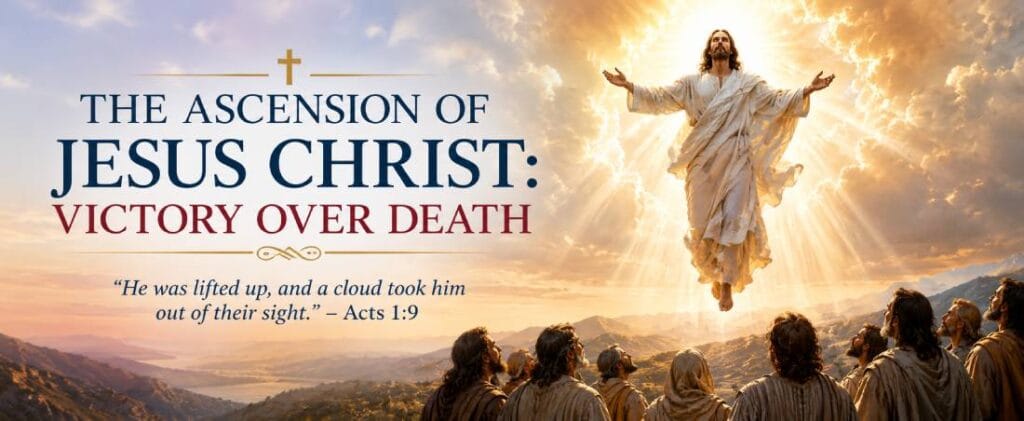
Forty days after His Resurrection, Jesus Christ ascended bodily into heaven in the presence of His Apostles (Acts 1:3, Luke 24:50-51). Far from being a mere historical footnote nestled between Easter Sunday and Pentecost, the Ascension represents the glorious culmination of the Paschal Mystery and the definitive exaltation of human nature into divine glory (Catechism of the Catholic Church, CCC § 659). As St. Thomas Aquinas teaches, Christ ascended into heaven by His own divine power, opening the gates of the heavenly kingdom and establishing His universal sovereignty as Lord of heaven and earth (Summa Theologiae, III, q. 57, a. 1). Understanding this dogma expands our prayer life, deepens our participation in the Sacraments, and strengthens our daily witness as members of the Church Militant.
Too often, believers treat the Ascension as a passive departure. Yet Sacred Scripture and Sacred Tradition reveal that Christ’s entry into heaven inaugurated a new cosmic reality. By bringing His glorified human body into the divine sanctuary, Jesus fulfilled the Father’s master plan for human redemption, granting humanity a permanent share in the eternal life of the Blessed Trinity.
Absolute Authority and Universal Kingship
Through His Ascension, Jesus Christ claimed His rightful seat at the right hand of God the Father, fulfilling the messianic prophecy of Psalm 110:1 and the Apostle Paul’s proclamation that Christ ascended “far above all the heavens, that he might fill all things” (Ephesians 4:10). Death, sin, and the power of Satan were decisively vanquished at the Cross and Resurrection; at the Ascension, Christ publicly declared His heavenly reign (CCC § 668).
In his landmark encyclical Quas Primas, Pope Pius XI reaffirmed that Christ’s Kingship is not a symbolic metaphor or abstract ideal. It is a direct, absolute sovereignty over all creation, human institutions, and individual hearts. Because our Redeemer ascended bodily into heaven, human nature itself now abides within the inner life of God. As St. Leo the Great famously preached in the fifth century, “Christ’s ascension is our exaltation, and where the glory of the Head has gone before, the hope of the Body is called to follow” (Sermo 73 de Ascensione).
Every prayer lifted by the faithful on earth acknowledges this stunning reality. Death has lost its permanent sting not because human suffering has vanished, but because Christ has elevated human nature above the angelic orders, anchoring our eternal destiny in heaven.
Sacramental Reality: How the Ascended Christ Remains on Earth
A frequent theological misconception asserts that Christ’s Ascension resulted in His total physical absence from earth, leaving believers with only a distant memory or purely spiritual presence. Authentic Catholic dogma explicitly rejects this limitation. While Christ’s visible, historical, and localized presence on earth concluded at the Ascension, He did not abandon His flock. Instead, He established a profound sacramental mode of presence.
As declared by the Council of Trent and reiterated in CCC § 1374, Jesus Christ remains truly, really, and substantially present—Body, Blood, Soul, and Divinity—in the Most Holy Sacrament of the Eucharist (DS 1636). St. Thomas Aquinas clarifies that while Christ’s body is locally present in heaven at the right hand of the Father, He is rendered substantially present on every altar throughout the world through the miracle of transubstantiation (Summa Theologiae, III, q. 75, a. 1).
In his encyclical Ecclesia de Eucharistia, Pope St. John Paul II emphasized that the Church draws her entire life from the Blessed Sacrament, wherein the Ascended Lord continually fulfills His abiding promise: “I am with you always, to the close of the age” (Matthew 28:20). Furthermore, through the Holy Spirit sent at Pentecost (Pope Leo XIII, Divinum Illud Munus), Christ indwells the souls of the baptized and acts through His Mystical Body—the Church—across every nation and generation.
The Heavenly High Priest: Perpetual Intercession
The Epistle to the Hebrews reveals that Christ’s ascension into heaven was the formal inauguration of His eternal heavenly liturgy. As our High Priest in the heavenly sanctuary, Jesus presented His once-for-all sacrifice on Calvary before the Father. Scripture assures us that “he is able to save to the uttermost those who draw near to God through him, since he always lives to make intercession for them” (Hebrews 7:25).
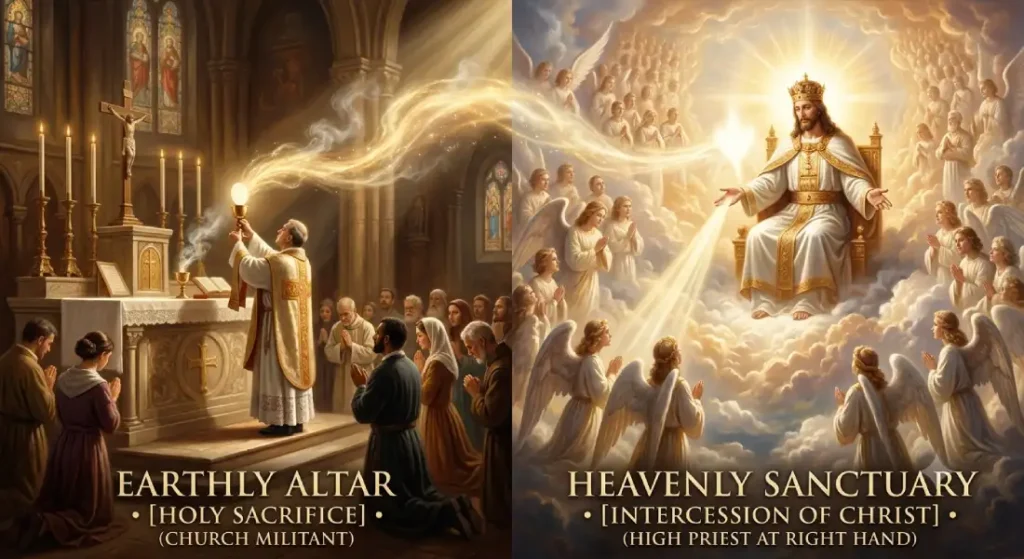
Christ stands before the Father as our perpetual advocate and supreme Mediator (CCC § 662). Every Holy Mass celebrated on earth is a real participation in this heavenly liturgy. This truth provides immense strength for the Church Militant—the faithful on earth engaged in spiritual warfare against sin and secular decay (CCC § 954). When we offer our prayers, sufferings, and works of mercy, we do not address a distant deity. Our petitions are taken up by our Ascended High Priest, who transforms our weak utterances through His infinite merit (CCC § 2688).
Pro-Life Witness and the “Already But Not Yet” Tension
Before ascending, Christ promised His followers: “This Jesus, who was taken up from you into heaven, will come in the same way as you saw him go into heaven” (Acts 1:11). We currently live in the eschatological tension known as the “already but not yet”—a period wherein Christ already reigns as King, yet His Kingdom awaits its final, visible consummation at the Parousia (CCC §§ 670–673).
This glorious expectation directly shapes Catholic moral theology and our unconditional defense of human life. Because the Son of God assumed human flesh, died, rose, and exalted that same human flesh into heaven, every human life possesses an inviolable, transcendent dignity (CCC § 2258). Each person bears the image of God and faces an eternal destiny.
Consequently, our pro-life advocacy, protection of the unborn, care for the elderly, and service to the vulnerable flow directly from the Ascension. We defend temporal life precisely because Christ has elevated human nature to eternal glory. Every soul reached and every life defended participates in the expansion of His heavenly reign.
Summary Matrix: Catholic Anchors on the Ascension
| Aspect of Doctrine | Sacred Scripture | Magisterial Citation / CCC | Doctor of the Church Citation |
| Bodily Ascension & Exaltation | Acts 1:9–11; Ephes. 4:10 | CCC §§ 659–661; Council of Florence | St. Thomas Aquinas (ST III, q. 57, a. 1) |
| Eucharistic Real Presence | Matthew 28:20; John 6:53–56 | CCC §§ 1374, 1377; Council of Trent | St. Thomas Aquinas (ST III, q. 75, a. 1) |
| Heavenly High Priesthood | Hebrews 7:25, 9:24 | CCC § 662; Pope Pius XII (Mediator Dei) | St. John Chrysostom (Homilies on Hebrews) |
| Universal Lordship & Parousia | Psalm 110:1; Phil. 2:9–11 | CCC §§ 668–673; Pope Pius XI (Quas Primas) | St. Augustine (De Civitate Dei) |
Frequently Asked Questions
The forty-day period between Easter and the Ascension was appointed by Christ to provide infallible proofs of His bodily Resurrection to the Apostles (Acts 1:3; CCC § 659). During this time, Jesus ate with His disciples, allowed them to touch His glorified wounds, and instructed them in the mysteries of the Kingdom of God, establishing the foundation of Sacred Tradition prior to His visible departure.
While Christ’s visible, historical presence ended with His Ascension, He remains physically and substantially present on earth in the Most Holy Eucharist (CCC § 1374). Through transubstantiation, the bread and wine become His true Body, Blood, Soul, and Divinity. Christ is not absent from earth; He is sacramentally present in every Catholic tabernacle worldwide.
The fundamental distinction lies in divine power and agency. Jesus Christ ascended into heaven by His own innate divine power (virtute propria), as He is God incarnate (ST III, q. 57, a. 3). By contrast, the Blessed Virgin Mary was assumed into heaven body and soul by the power and grace of God (assumpta), as defined by Pope Pius XII in the dogma of the Assumption (Munificentissimus Deus).
Living the Mystery
The Ascension of Jesus Christ invites every Christian to participate in the apostolic mandate: to be His witnesses “to the end of the earth” (Acts 1:8). As we navigate the trials of the present age, we look to heaven where our High Priest intercedes for us without ceasing. Sustained by the Holy Eucharist and anchored in the sure hope of His glorious return, the Church Militant marches forward in faith, proclaiming that death is defeated, human dignity is redeemed, and Jesus Christ reigns supreme.
Continue Your Faith Journey
What Is the Assumption of Mary? Catholic Dogma, Scripture, and Meaning
Explore the Catholic dogma of the Assumption of the Blessed Virgin Mary. Learn how Munificentissimus Deus, Sacred Scripture, and Church Tradition reveal…
Immaculate Conception vs. Virgin Birth: Key Differences Explained
Discover the essential differences between the Immaculate Conception of Mary and the Virgin Birth of Christ. Learn how Catholic dogma, Scripture, and…
Catholic Prayer for Toxic Family Conflict: A Faithful Guide to Boundaries, Healing, and Charity
Navigating family conflict, estrangement, and narcissistic behavior requires balancing Christian charity with prudent boundaries. Discover how Catholic doctrine, Sacred Scripture, and daily…