
Immaculate Conception vs. Virgin Birth: Key Differences Explained
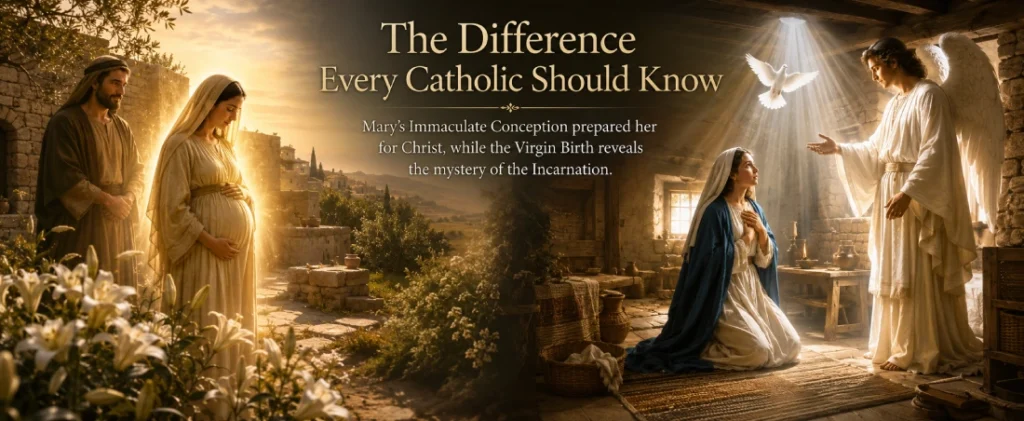
Every December, a common misconception resurfaces across parishes and holiday gatherings: the confusion between the Immaculate Conception and the Virgin Birth. While both dogmas celebrate miraculous interventions of divine grace, they refer to two completely distinct events separated in time, subject, and theological purpose.
- The Immaculate Conception refers to the conception of the Blessed Virgin Mary in the womb of her mother, Saint Anne, preserving her from original sin from the first instant of her existence.
- The Virgin Birth refers to the miraculous conception and birth of Jesus Christ by the power of the Holy Spirit in the womb of the Virgin Mary, without a human biological father.
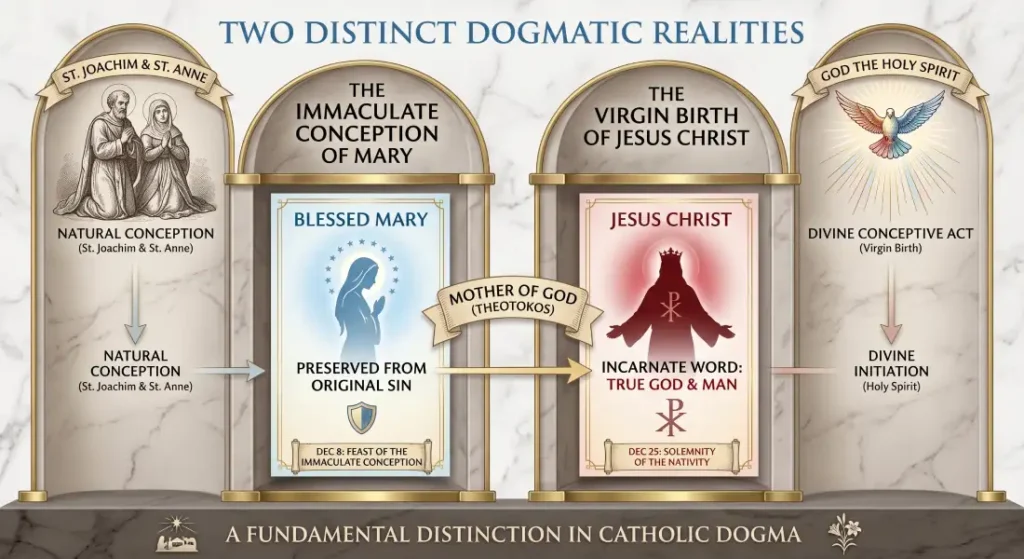
Understanding this distinction is vital for every Catholic who desires to honor Our Lady properly and pass down the deposit of faith intact.
Quick-Reference Guide: Immaculate Conception vs. Virgin Birth
| Feature | The Immaculate Conception | The Virgin Birth |
| Primary Subject | The Blessed Virgin Mary | Jesus Christ (The Incarnate Word) |
| Parents Involved | St. Joachim and St. Anne (Natural Generation) | The Virgin Mary and the Holy Spirit (No human father) |
| Theological Mystery | Preservative Redemption (Praeredemptio) | The Incarnation (Hypostatic Union) |
| Dogmatic Promulgation | Ineffabilis Deus (Pope Pius IX, 1854) | Council of Ephesus (431); Council of Trent |
| Liturgical Calendar | Celebrated on December 8 | Celebrated on December 25 (Christmas) |
| Catechism Reference | CCC 490–493 | CCC 496–498 |
The Immaculate Conception: Mary’s Preserved Beginning
The dogma of the Immaculate Conception was solemnly defined by Pope Bl. Pius IX on December 8, 1854, in his apostolic constitution Ineffabilis Deus. The Magisterium declares:
“The most Blessed Virgin Mary was, from the first moment of her conception, by a singular grace and privilege of almighty God and by virtue of the merits of Jesus Christ, Saviour of the human race, preserved immune from all stain of original sin.”
Preservative Redemption: How Mary Was Saved
A common misunderstanding is the assumption that if Mary was conceived without original sin, she did not require a Savior. Catholic theology definitively rejects this error.
Mary required a Savior just as all human beings do. However, she was redeemed in an entirely unique, sublime manner known as preservative redemption (praeredemptio).
- Restorative Redemption (Our Experience): We are born fallen children of Adam, contracting original sin—the lack of original justice—and are subsequently cleansed and restored through the Sacrament of Baptism.
- Preservative Redemption (Mary’s Experience): Through the foreseen and anticipated merits of Christ’s Passion and Death on Calvary, Mary was prevented from ever contracting the stain of original sin from the very first moment of her existence in St. Anne’s womb.
As the Franciscan Doctor of the Church Blessed John Duns Scotus famously reasoned (Ordinatio III, d. 3, q. 1), it is a greater act of mediation to prevent a person from falling into a pit than to rescue them after they have already fallen. Mary was preserved entirely immune (immunis) from sin by Christ’s grace applied in advance.
Scriptural Anchors for the Immaculate Conception
While the term “Immaculate Conception” is not explicit in the text, the dogma is rooted within Sacred Scripture:
- The Angelic Salutation (Luke 1:28): The Archangel Gabriel addresses Mary not by her given name, but with the title Kecharitomene (“Full of Grace”). In the Greek text, this perfect passive participle indicates an action completed in the past with ongoing effects in the present. Mary was already completely transformed, filled, and perfected by divine grace before the Annunciation took place.
- The Protoevangelium (Genesis 3:15): God places total “enmity” between Satan and the Woman. Total enmity admits no compromise or shared territory with sin; Mary stands in complete opposition to the serpent.
- The Living Ark of the Covenant: In the Old Testament, the Ark made of incorruptible acacia wood held the presence of God. Mary serves as the New Ark, prepared spotless to carry the living Word made flesh.
The Virgin Birth: The Miraculous Incarnation of Christ
The Virgin Birth concerns the physical and biological miracle of the Incarnation. It professes that the Second Person of the Holy Trinity took on true human nature in the womb of the Virgin Mary solely through the power of the Holy Spirit, without the seed of a human father.
The Catechism of the Catholic Church paragraph 496 affirms:
“From the first formulations of her faith, the Church has confessed that Jesus was conceived solely by the power of the Holy Spirit in the womb of the Virgin Mary, affirming also the corporeal aspect of this event: Jesus was conceived ‘by the Holy Spirit without human seed.'”
Christ’s Sinlessness and the Hypostatic Union
Original sin is an inherited condition of human nature stemming from the federal headship of Adam (Council of Trent, Session V). Christ is fully human and fully divine—one divine Person with two complete natures united in the Hypostatic Union.
Because Christ is a Divine Person, He could never possess any stain of original or actual sin (ST III, q. 31, a. 7). By taking His flesh from Mary, Christ became the New Adam (Romans 5:19; 1 Corinthians 15:45), inaugurating a regenerated humanity through His obedience and self-offering on the Cross.
Perpetual Virginity (Aeiparthenos)
Catholic dogma teaches that Mary’s virginity was not merely temporal during the conception of Jesus, but perpetual:
- Virginitas ante partum: Virginity before birth (conception without a human father).
- Virginitas in partu: Virginity during birth (a miraculous, painless delivery preserving her bodily integrity).
- Virginitas post partum: Virginity after birth (remaining a virgin throughout her entire earthly life).
As taught by the Second Council of Constantinople (553 AD) and the Lateran Council of 649 under Pope St. Martin I, Mary is truly Aeiparthenos—the “Ever-Virgin.”
Patristic Typology: The New Eve and the New Adam
The early Church Fathers recognized that salvation history operates on a divine architecture of reversal. Saint Irenaeus of Lyons (c. 130–202 AD) and Saint Jerome highlighted the profound symmetry between Eden and the Incarnation:
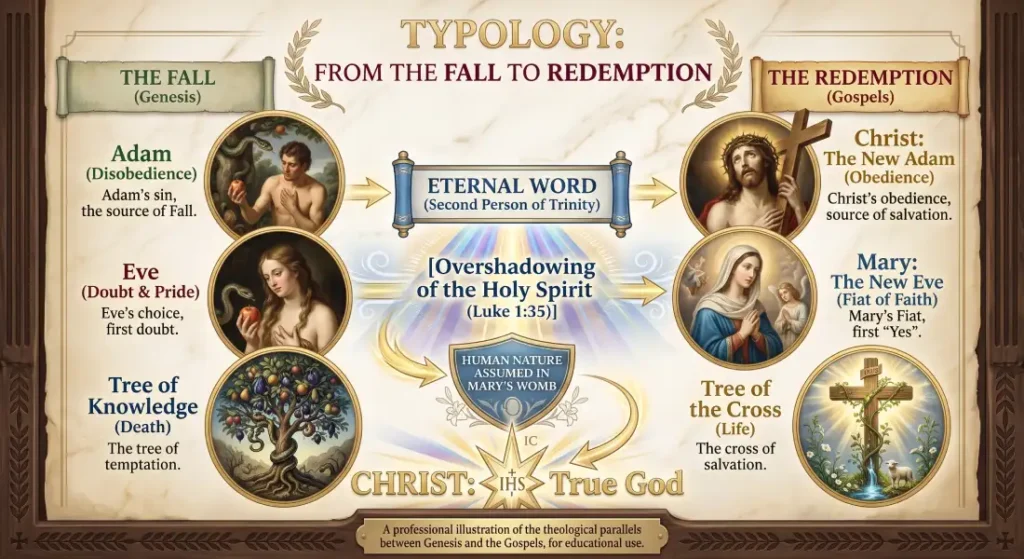
- Eve was created immaculate, yet used her free will to distrust God, bringing death into the world.
- Mary, enriched with the splendor of an entirely unique holiness from her conception (Lumen Gentium 56), gave her unreserved Fiat (“Let it be done to me according to your word”), bringing Life Himself into the world.
As St. Irenaeus wrote in Adversus Haereses (III.22.4): “The knot of Eve’s disobedience was loosed by Mary’s obedience; for what the virgin Eve bound fast through unbelief, this did the virgin Mary set free through faith.”
Why This Distinction Matters for Catholic Life
Conflating these two dogmas reduces the specific actions of God to a generic, vague notion of holiness. When we distinguish them accurately, our prayer life and theological appreciation deepen:
- A Deeper Celebration of Advent and Christmas: Celebrating the Immaculate Conception on December 8 allows us to contemplate how God prepares human souls to receive His grace. When Christmas arrives on December 25, our adoration focuses on the Word made flesh—God dwelling bodily among us.
- Confidence in Preserving Grace: Mary’s Immaculate Conception serves as an icon of hope. It shows what grace accomplishes when it meets zero resistance, offering us a glimpse of the eschatological perfection awaiting the faithful in the heavenly Jerusalem.
- Clarity in Catechesis and Evangelization: Being equipped to explain that Mary’s purity was entirely Christ-centered allows us to answer common Protestant objections with charity and doctrinal precision.
Prayers for Deeper Understanding
Collect for the Solemnity of the Immaculate Conception:
“O God, who by the Immaculate Conception of the Blessed Virgin prepared a worthy dwelling for your Son, grant, we pray, that, as you preserved her from every stain by virtue of the Death of your Son, which you foresaw, so, through her intercession, we, too, may be cleansed and admitted to your presence. Through our Lord Jesus Christ, your Son, who lives and reigns with you in the unity of the Holy Spirit, God, for ever and ever. Amen.”
Frequently Asked Questions
The Immaculate Conception refers to the conception of Mary in the womb of Saint Anne without original sin. The Virgin Birth refers to Jesus Christ being conceived in the womb of the Virgin Mary by the Holy Spirit without a biological human father.
Yes. Mary was redeemed through preservative redemption (praeredemptio). By the anticipated merits of Christ’s sacrifice on the Cross, God preserved Mary completely immune from original sin from the first instant of her conception, rather than cleansing her afterward.
The dogma is anchored in Luke 1:28, where Gabriel calls Mary Kecharitomene (“Full of Grace”), indicating a perfected state of grace. It is also rooted typologically in Genesis 3:15 (the Woman at total enmity with Satan) and the spotless Ark of the Covenant.
The Church observes the Feast of the Immaculate Conception on December 8 precisely nine months prior to the Feast of the Nativity of the Blessed Virgin Mary, which is celebrated on September 8.
Continue Your Faith Journey
What Is the Assumption of Mary? Catholic Dogma, Scripture, and Meaning
Explore the Catholic dogma of the Assumption of the Blessed Virgin Mary. Learn how Munificentissimus Deus, Sacred Scripture, and Church Tradition reveal…
Why Do Catholics Pray to Mary? Church Teaching, Scripture, and Tradition
Explore why Catholics pray to Mary, the biblical roots of Marian intercession, and the vital theological distinction between the adoration due to…

The Cost of Discipleship in Matthew 10: What Christ Demands of Catholics
Explore what Matthew 10:37–42 teaches about the cost of discipleship in Catholic tradition. Learn how the order of charity, the cross, and…