
The Cost of Discipleship in Matthew 10: What Christ Demands of Catholics
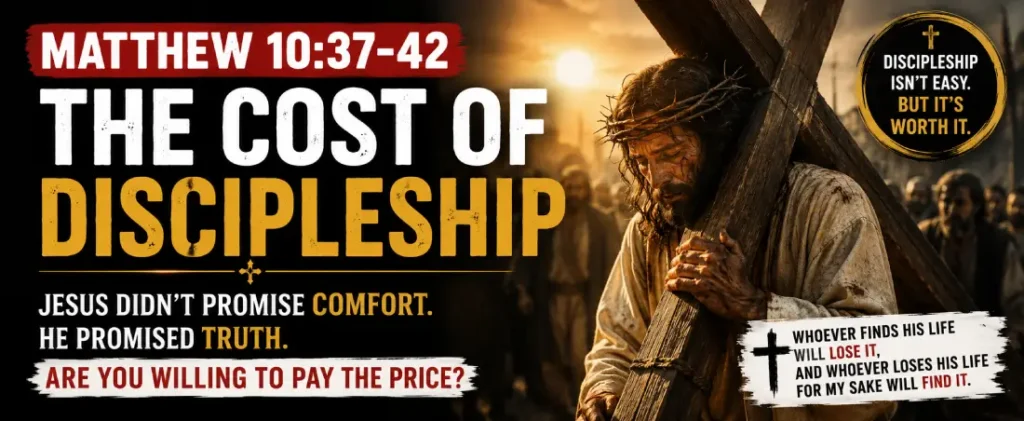
The Gospel of Matthew does not offer a comfortable, watered-down spirituality. In Matthew 10:37–42, Jesus Christ delivers an uncompromising reality check: authentic discipleship requires absolute allegiance to God above every natural comfort, familial bond, and personal ambition. The Catholic Church has consistently taught that picking up one’s cross is not an optional add-on for spiritual elites—it is the foundational price of following Christ.
Modern culture frequently demands a Christianity without sacrifice, a resurrection without a crucifixion, and grace without repentance. Christ rejects this compromise. To follow Him into eternal life, we must understand both the severe cost and the infinite reward He places before us.
1. Ordering Our Loves: The Hierarchy of Charity (Ordo Caritatis)
Christ addresses our deepest, most sacred natural relationships:
“He who loves father or mother more than me is not worthy of me; and he who loves son or daughter more than me is not worthy of me.” (Matthew 10:37, RSV-CE)
This command is not an instruction to despise our families, which would contradict the Fourth Commandment. The original Greek text uses the verb φιλέω (phileo), denoting tender affection and natural human attachment. Christ is not condemning natural familial affection; He is establishing divine order.
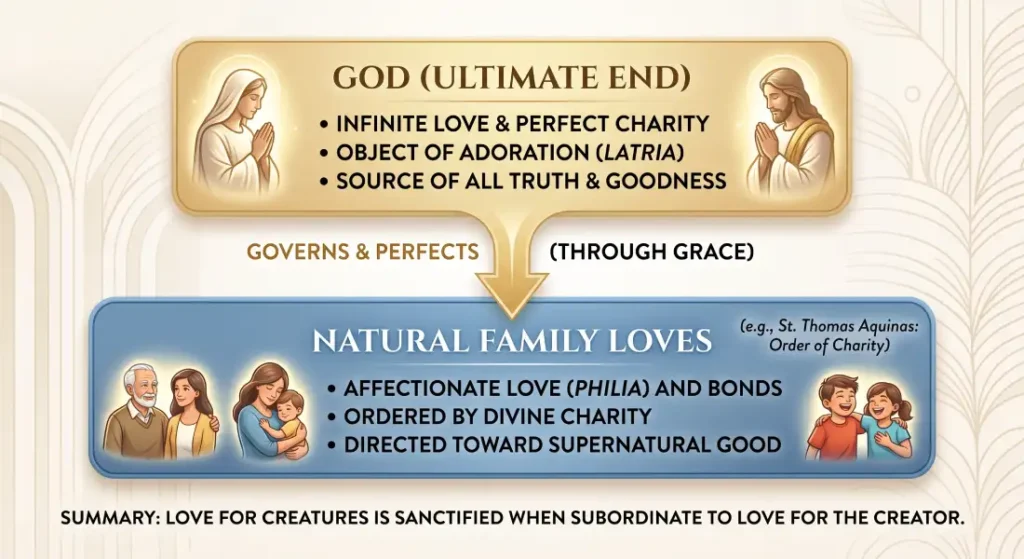
Saint Thomas Aquinas explains in the Summa Theologiae (II-II, Q. 26) that supernatural charity (caritas) must govern and direct all natural loves toward our ultimate end: God. When we love our parents, spouses, and children in God and for God, that love is sanctified and perfected.
However, whenever human loyalty supersedes obedience to divine truth, that relationship becomes an idol. We fall into spiritual disorder whenever we prefer the creature over the Creator.
2. Taking Up the Instrument of Execution
Christ deepens the demand by invoking an image of total surrender:
“And he who does not take his cross and follow me is not worthy of me.” (Matthew 10:38, RSV-CE)
To the original first-century audience, the cross was not a piece of decorative jewelry or a pious metaphor. It was an instrument of Roman execution—a public instrument of agony and humiliation reserved for slaves and insurgents. When Jesus spoke these words before His own Passion, His disciples heard an explicit call to embrace public death to self for the sake of the Kingdom.
The Catechism of the Catholic Church affirms the non-negotiable nature of this call:
“The way of perfection passes by way of the Cross. There is no holiness without renunciation and spiritual battle.” (CCC 2015)
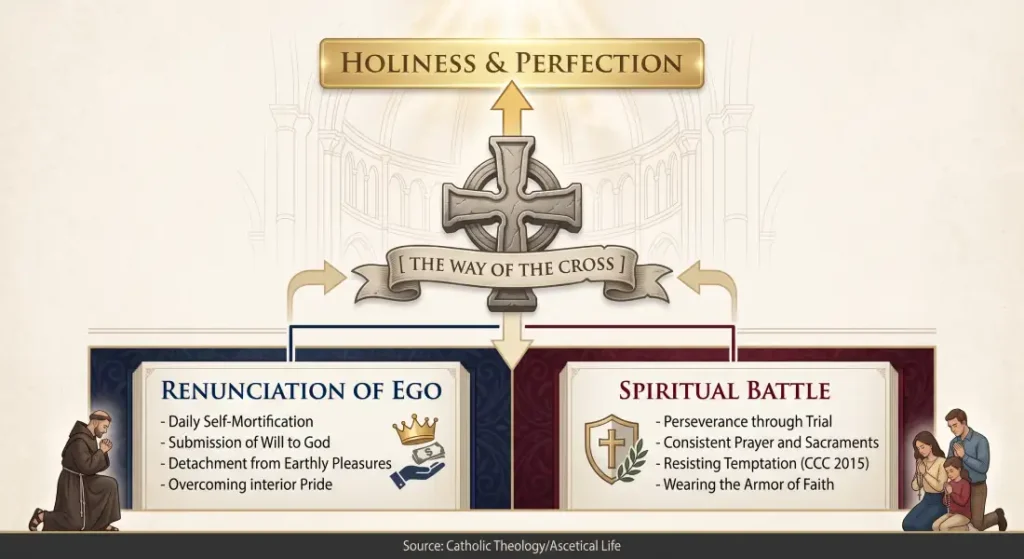
(Catechism of the Catholic Church, 2015)
This spiritual battle is woven into the universal call to holiness. Following Christ requires the daily mortification of the flesh, the renunciation of sinful autonomy, and the willing acceptance of suffering united to the Redemptive Sacrifice of Calvary.
3. Losing the Psyche to Find Eternal Life
In Matthew 10:39, Jesus presents the paradox of Christian existence:
“He who finds his life will lose it, and he who loses his life for my sake will find it.” (Matthew 10:39, RSV-CE)
The Greek word rendered as “life” is ψυχή (psyche), which signifies the soul, the vital animating principle, and one’s self-directed earthly existence. When we grasp tightly to our own autonomy, comfort, and worldly validation, we lose our eternal soul. Conversely, when we surrender our lives entirely to Christ, we gain authentic, everlasting life.
Saint Augustine famously captured this tension in his Confessions (Lib. 1, 1, 1), observing that our hearts remain restless until they find their rest in God. Earthly pursuits—financial wealth, career prestige, social acclaim, or romantic romance—inevitably leave the human spirit hollow when treated as ultimate ends. Only the Creator can satisfy the human soul.
Comparing the World’s Logic to Catholic Discipleship
The expectations of secular culture stand in direct opposition to the requirements of Christ:
| Spiritual Dimension | Secular / Worldly Perspective | Catholic Sacramental Reality (Matthew 10) |
| Ultimate Purpose | Maximizing comfort, autonomy, and status | Total surrender to Christ as our ultimate end (finis ultimus) |
| Family Attachments | Supreme loyalty above moral truth | Loved tenderly within the order of charity (ordo caritatis) |
| Suffering & Crosses | Meaningless pain to be avoided at all costs | Redemptive participation in Christ’s Passion (CCC 2015) |
| Source of Strength | Personal willpower and self-reliance | Sacramental grace through Eucharist and Penance |
| Concept of Reward | Immediate material gratification | Eternal life and communion with the Holy Trinity |
4. The Daily Cross: Discipleship in Modern Life
For modern Catholics, taking up the cross rarely involves literal physical martyrdom, but it always requires moral courage and sacrificial fidelity. The cross takes concrete shapes in daily life:
- Fidelity in Holy Matrimony: Remaining faithful to sacred marital vows and persevering through hardship when secular culture encourages abandonment and divorce.
- Witnessing to Moral Truth: Speaking uncompromised Church teaching on human life, marriage, and sexuality in an increasingly hostile culture.
- Hidden Sacrificial Care: Caring quietly for aging parents, chronically ill family members, or children with special needs without worldly praise or public recognition.
- Crucifying the Passions: Renouncing habitual sins, gossip, material greed, and interior vanity through ongoing mortification and self-discipline.
These daily, unseen sacrifices are not secondary crosses. They are the exact means of sanctification that God has assigned to our individual vocations.
5. Sacramental Grace and the Promise of Reward
Christ does not demand heroic sacrifice while leaving us to our own meager devices. The cost of discipleship is sustained and made joyful through the sacramental life of the Catholic Church:
- The Holy Eucharist: The source and summit of our faith, where we unite our small sacrifices to the infinite, re-presented sacrifice of Christ on Calvary.
- The Sacrament of Penance: The medicinal fountain where our sins are absolved, restoring sanctifying grace whenever we stumble under the weight of our cross.
- Grace of State (Gratia Status): The supernatural assistance given by the Holy Spirit to fulfill the specific moral duties of marriage, holy orders, consecrated life, or dedicated single life.
Jesus concludes His discourse with an astonishing promise of divine economy:
“And whoever gives to one of these little ones even a cup of cold water because he is a disciple, truly, I say to you, he shall not lose his reward.” (Matthew 10:42, RSV-CE)
Through the doctrine of the Mystical Body of Christ, whatever charity we extend to the least of our brethren is received by Christ Himself (cf. Pius XII, Mystici Corporis Christi). God is never outdone in generosity. Every tear, every renounced temptation, and every burden borne for His name is met with divine peace in this life and beatitude in the life to come.
A Catholic Prayer for Carrying the Cross
Lord Jesus Christ, grant me the grace to order my loves according to Your Holy Will, placing You above all worldly attachments.
Give me the fortitude to embrace the cross You have chosen for me today, uniting my daily burdens to Your Passion for the salvation of souls.
Strengthen me by Your Sacraments to die to my own self-will, that I may find true and everlasting life in You.
Amen.
Frequently Asked Questions
No. Catholic theology upholds the Fourth Commandment to honor father and mother. As St. Thomas Aquinas taught regarding the ordo caritatis, Jesus demands that natural family affection (philia) never supersede our supreme love and obedience toward God (caritas).
The cost of discipleship is the total surrender of self-will, autonomy, and worldly attachments to follow Jesus Christ. As the Catechism explains (CCC 2015), spiritual perfection requires embracing the Cross through ascetical renunciation and daily spiritual battle.
Catholics receive supernatural strength through sacramental grace, primarily the Holy Eucharist and the Sacrament of Reconciliation. These sacraments nourish the soul, restore sanctifying grace, and provide the grace of state (gratia status) necessary for one’s vocation.
To “lose your life” (psyche) means crucifying selfish ambition, ego, and sin for Christ’s sake. By dying to self-will, a Christian receives true spiritual transformation on earth and eternal life with God in heaven.
Continue Your Faith Journey
Living Sacred Heart Devotion in the Family: Life After Enthronement
Discover practical ways to live out your Sacred Heart family consecration after the home enthronement. Build daily rhythms of prayer, mutual forgiveness,…
What Is the Assumption of Mary? Catholic Dogma, Scripture, and Meaning
Explore the Catholic dogma of the Assumption of the Blessed Virgin Mary. Learn how Munificentissimus Deus, Sacred Scripture, and Church Tradition reveal…
Immaculate Conception vs. Virgin Birth: Key Differences Explained
Discover the essential differences between the Immaculate Conception of Mary and the Virgin Birth of Christ. Learn how Catholic dogma, Scripture, and…