
Catholic Education Principles Rooted in Truth: The Front Royal Statement
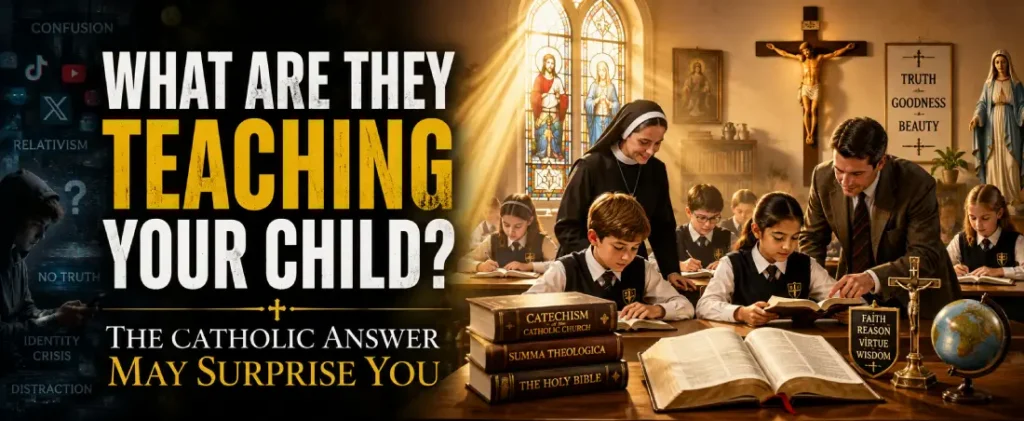
Cultural transformation relies heavily on the classroom. Political or legal victories remain short-lived if an educational system fails to form the moral imagination of the next generation. The Front Royal Statement on Catholic Education Principles addresses this crisis directly. It serves as a vital recovery project, calling educational institutions back to what the Church has timelessly taught regarding human formation in truth, beauty, and goodness.
This document arrives at a critical cultural juncture. Far too many Catholic institutions have gradually absorbed secular assumptions about the ultimate purpose of schooling. Education is frequently reduced to career preparation, social advancement, or ideological conformity thinly packaged as compassion.
In contrast, authentic Catholic teaching insists on something older, deeper, and far truer: the integral formation of the human person as articulated in landmark Magisterial documents like Gravissimum Educationis and Ex Corde Ecclesiae.
The Magisterial Foundation of Catholic Education
The Catholic Church has never viewed instruction as mere information transfer. In Gravissimum Educationis, the Second Vatican Council’s Declaration on Christian Education, the Church affirms that Catholic schools exist to form students in the fullness of their humanity. This encompasses the intellect, the will, the moral conscience, and the ultimate supernatural vocation of the soul.
Character formation is not an extracurricular activity or a side project alongside academic coursework. It is the entire project.
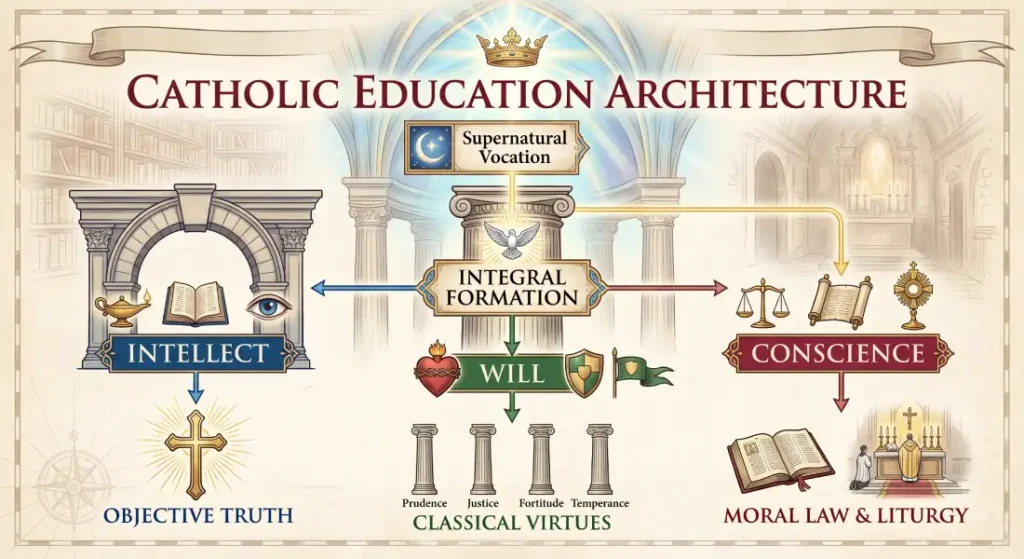
Furthermore, authentic Catholic education rejects the false dichotomy between faith and reason, upholding Catholic doctrine alongside rigorous intellectual inquiry. Faith does not constrain reason; it elevates and purifies it.
In Ex Corde Ecclesiae, his landmark Apostolic Constitution on Catholic Higher Education, Pope St. John Paul II explains that Catholic institutions exist to integrate human knowledge with divine faith. They are called to pursue truth fearlessly because all truth ultimately leads to Jesus Christ.
“Search for truth in everything, and in all things seek to find God.”
— St. Albert the Great, Doctor of the Church
A faithful Catholic curriculum is never about defensive damage control or keeping students sheltered in an artificial bubble. Rather, it is about liberating the human mind and heart toward the fullness of objective reality.
What Sacred Scripture Teaches About Forming Youth
Sacred Scripture speaks directly to the gravity of forming young minds and hearts. The spiritual stakes of Christian education could not be higher:
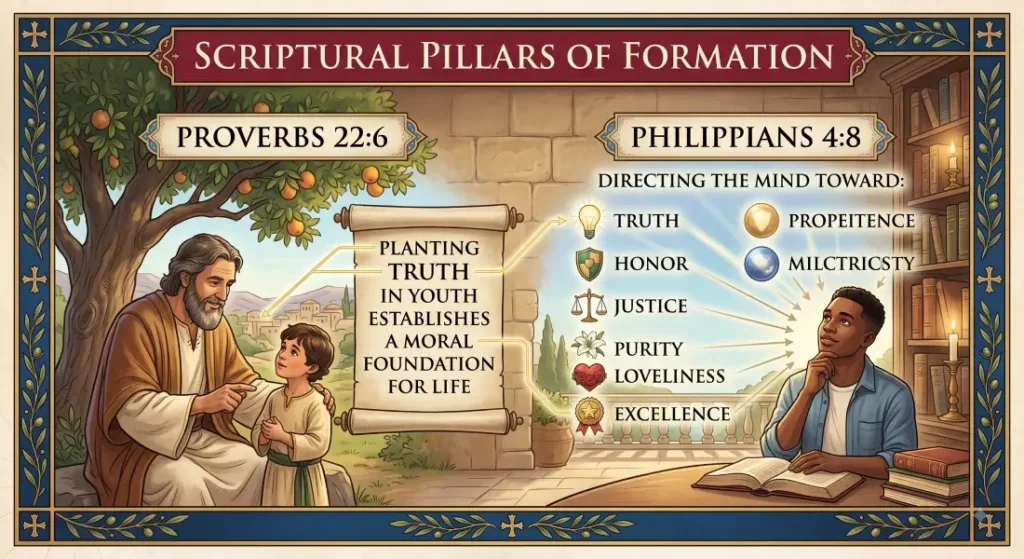
“Train up a child in the way he should go, and when he is old he will not depart from it.”
— Proverbs 22:6 (RSV-CE)
This sacred proverb does not offer an absolute guarantee that faithful parenting eliminates the reality of human free will. Grace operates within nature, and every individual retains moral freedom. However, Scripture highlights an unyielding principle woven into the order of creation: what we plant in young hearts takes deep root. Whatever we model inevitably shapes their moral imagination.
The Catechism of the Catholic Church explicitly reinforces this scriptural mandate. It outlines the fundamental duties of the family in the economy of salvation:
- Primary Educators: Parents are “the first and foremost educators of their children” (CCC 2223).
- Subsidiarity: Catholic schools exist to assist, support, and extend—never to replace—the primary authority of the home.
- Spiritual Stewardship: Entrusting children to institutions that contradict Church teaching on human anthropology, morality, or truth risks far more than academic standard compliance—it risks their eternal souls.
Writing to the Philippians, Saint Paul provides a masterclass in Christian educational philosophy:
“Finally, brethren, whatever is true, whatever is honorable, whatever is just, whatever is pure, whatever is lovely, whatever is gracious, if there is any excellence, if there is anything worthy of praise, think about these things.”
— Philippians 4:8 (RSV-CE)
Paul’s exhortation serves as an enduring blueprint for Catholic educators. Faithful education is not merely about shielding children from dangerous ideas; it is actively teaching them to recognize, desire, and love what is genuinely true, good, and beautiful.
This requires immersing students in classic literature, sacred music, the lives of the saints, the rigorous logic of natural law, and the splendor of the sacred liturgy. It means teaching them that truth is not subjectively constructed or socially negotiated—it is discovered because God has established it.
Actionable Diagnostic for Parents and Educators
For parents discerning school options, the Front Royal Statement provides a practical diagnostic framework for evaluating institutional faithfulness. Parents must ask direct, uncompromising questions about the institutions training their children:
📋 Diagnostic Checklist: Evaluating a Catholic School
Use this quick evaluation tool when reviewing a school’s culture, curriculum, and mission alignment:
- [ ] 1. Objective Truth & Realism: Does the school explicitly teach that objective truth exists, is knowable through reason, and originates in God?
- [ ] 2. Classical Character Virtues: Does the curriculum systematically form students in the cardinal virtues—prudence, justice, fortitude, and temperance?
- [ ] 3. Moral & Human Anthropology: Does the institution uphold the Church’s uncompromised teaching on biological reality, marriage, and the sacred dignity of life from conception to natural death?
- [ ] 4. Primary Role of Parents: Does administration respect and honor parents as the primary educators under CCC 2223?
- [ ] 5. Sacramental & Liturgical Integration: Is the Catholic faith integrated into daily operations through prayer, the Mass, and the Sacraments, rather than treated as a peripheral religion class?
High Catholic educational standards are not a luxury reserved for the intellectually elite or spiritually advanced. They represent the baseline requirement for any institution claiming the name “Catholic”. If an institution abandons these standards, parents are fully justified—and spiritually obligated—to seek or build faithful alternatives.
The Strategic Path Forward for Educators
For teachers, administrators, and school board members, the Front Royal Statement offers both an urgent challenge and an inspiring invitation. It asks us to examine our institutional conscience: Are we forming authentic disciples of Jesus Christ, or are we simply operating a secular school with religious symbols on the wall?
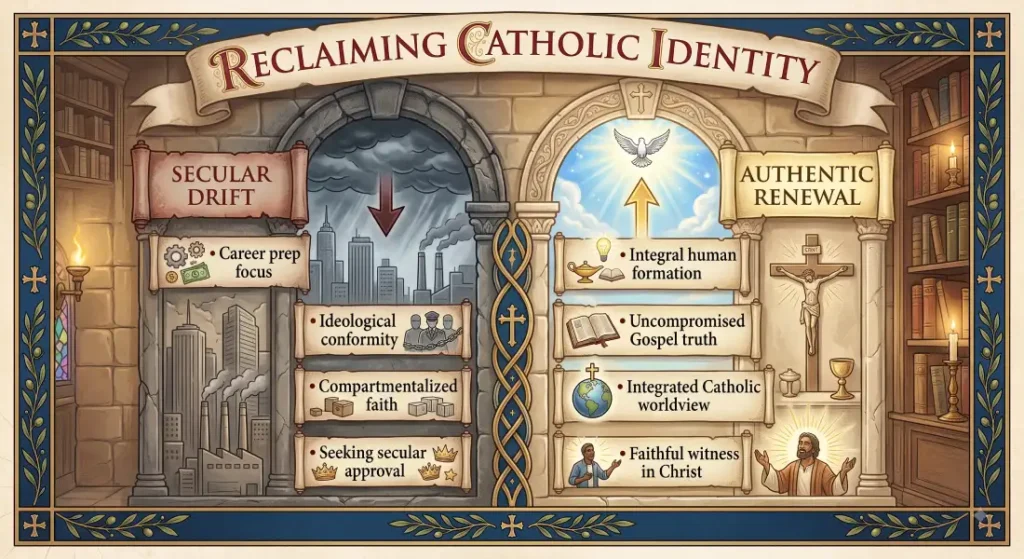
Reclaiming this identity requires grounding education in Thomistic philosophical principles. As St. Thomas Aquinas observed, education must cultivate both the intellect (speculative truth) and the will (moral goodness).
This work demands immense courage. Educational leaders frequently face pressure from state accreditation bodies, secular donors, or cultural movements demanding ideological compromise. Yet, the Church does not promise worldly ease. She offers truth—and confirms that forming young souls in that truth is worth every sacrifice required.
Universal Catholic Educational Principles
To guide institutional renewal, the fundamental principles articulated across Church tradition can be summarized in key foundational pillars:
| Educational Pillar | Theological Source | Practical Application |
| Integral Human Formation | Gravissimum Educationis | Developing intellect, moral virtue, and spiritual identity simultaneously. |
| Integration of Faith & Reason | Ex Corde Ecclesiae | Demonstrating how scientific and historical truths harmonize with Divine Revelation. |
| Parental Primacy | CCC 2223 | Ensuring schools act in supportive partnership with the domestic church. |
| Moral & Character Formation | Philippians 4:8 | Anchoring character development in classical virtues and the natural law. |
Spiritual Intentions for Catholic Education
- For Parents: Lord, grant parents the wisdom and fortitude to select educational pathways that form their children in objective truth, beauty, and virtue, even when countercultural choices require sacrifice.
- For Educators: Holy Spirit, grant Catholic teachers and administrators unwavering courage to withstand cultural pressures, keeping Christ at the center of every classroom.
- Intercession of St. John Bosco: St. John Bosco, patron saint of educators, intercede for all who labor to form youth—fill them with holy joy, patient perseverance, and supernatural vision.
- Christ the Teacher: Lord Jesus, You are the Way, the Truth, and the Life—renew every Catholic school so that all academic pursuits ultimately lead students to know, love, and serve You.
- Intercession of Our Lady: Blessed Virgin Mary, Seat of Wisdom, guide families seeking faithful formation and protect Catholic educational institutions worldwide.
Frequently Asked Questions
The Front Royal Statement is a declaration published by Catholic scholars and educators outlining core principles for renewing Catholic K–12 education. It calls institutions to recover traditional Catholic educational philosophy grounded in objective truth, classical virtue, and integral human formation.
According to the Catechism of the Catholic Church (CCC 2223), parents are “the first and foremost educators of their children.” Church documents such as Gravissimum Educationis emphasize that educational institutions exist to assist and support parents, never to supplant their primary authority
As outlined in Pope St. John Paul II’s Ex Corde Ecclesiae, Catholic education views faith and reason as complementary paths to truth. Rather than treating religion as a separate subject, faithful Catholic schools integrate divine revelation with academic disciplines, showing how all truth ultimately leads to God.
Continue Your Faith Journey
Catholic Prayer for Husband Addicted to Porn: A Spiritual Warfare & Relational Healing Guide
Discover how Catholic spiritual warfare, Eucharistic grace, and deprecatory deliverance prayers can help free a husband from pornography addiction. Learn to combine…
What Is Natural Family Planning? Catholic Teaching, Theology, and Practice
Explore Catholic teaching on Natural Family Planning (NFP). Learn how Humanae Vitae, the Catechism, and modern fertility awareness methods protect the unitive…
Why Do Catholics Make the Sign of the Cross? Meaning, History, and Spiritual Power
Discover why Catholics make the sign of the cross. Explore its biblical origins, bodily symbolism, patristic history, and spiritual power as an…