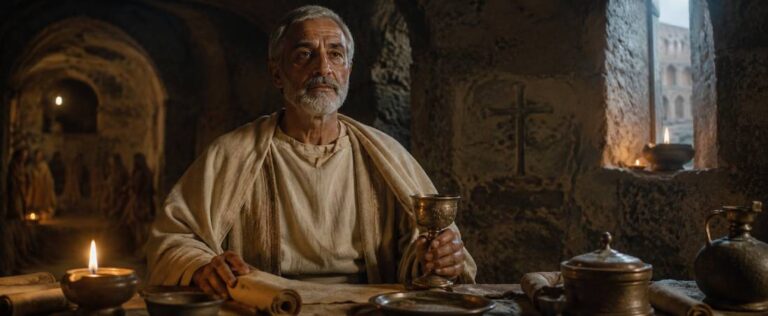
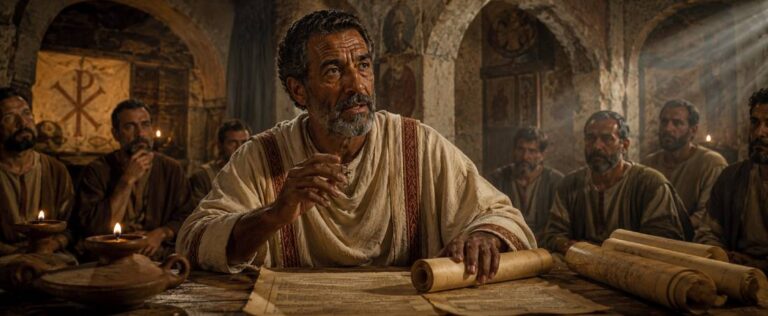
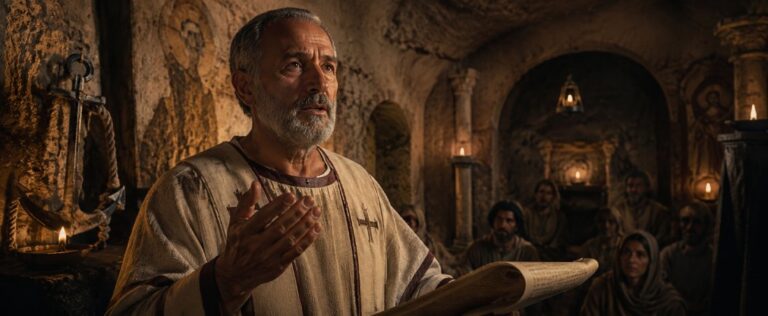
Saint Linus: Successor of Saint Peter and Second Pope of the Catholic Church
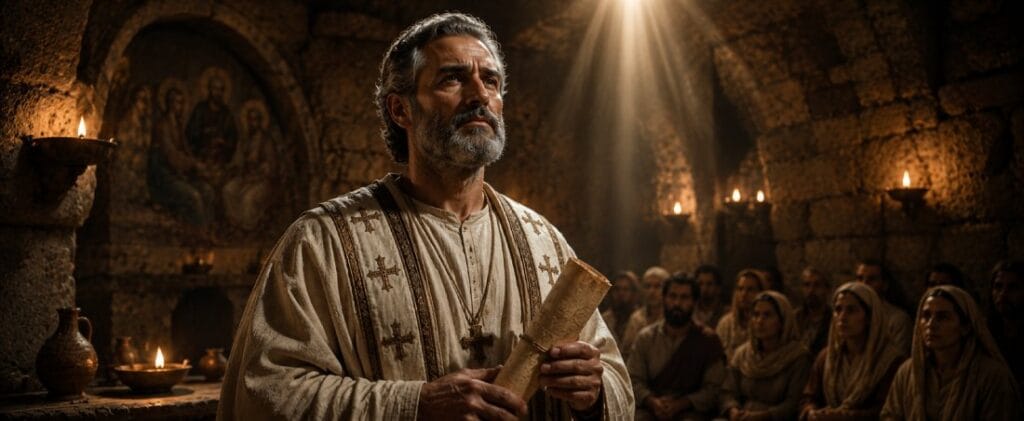
Saint Linus served as the second Bishop of Rome and the immediate successor to Saint Peter, guiding the Catholic Church from approximately AD 67 until his death around AD 76. Governing during the volatile aftermath of Emperor Nero’s persecutions, Linus established early liturgical order, preserved apostolic doctrine, and maintained the continuity of the Papacy during one of the most perilous decades in Christian history.
Quick-Reference Historical Snapshot
| Category | Historical & Theological Record |
| Papal Term | c. AD 67 – c. AD 76 (2nd Bishop of Rome) |
| Scriptural Reference | 2 Timothy 4:21 |
| Patristic Witness | St. Irenaeus of Lyons, Adversus Haereses (Book III, Chapter 3, Paragraph 3) |
| Liturgical Commemoration | Commemorated in the Roman Canon (Eucharistic Prayer I); Feast Day: September 23 |
| Primary Magisterial Anchors | CCC 828, 861–862, 880–882 |
Early Life and Scriptural Evidence
Historical details regarding the early life of Saint Linus are scarce, though ancient tradition records his birthplace as Tuscany, Italy.
The primary scriptural identification of Linus appears in Saint Paul’s Second Letter to Timothy:
“Eubulus sends greetings to you, as do Pudens and Linus and Claudia and all the brothers.” (2 Timothy 4:21)
Writing around AD 180, Saint Irenaeus of Lyons confirmed this identification in his landmark treatise Against Heresies (Adversus Haereses):
“The blessed apostles, then, having founded and built up the Church, committed into the hands of Linus the office of the episcopate. Of this Linus, Paul makes mention in the Epistles to Timothy.” (Book III, Chapter 3.3)
Having received direct formation from both Saint Peter and Saint Paul in Rome, Linus belonged to the first generation of apostolic leaders equipped to preserve the deposit of faith (depositum fidei).
Accession to the Papacy: Preserving Apostolic Succession
Following the martyrdom of Saint Peter under Emperor Nero around AD 67, the Christian community in Rome faced severe instability. The Roman state did not recognize Christianity as a lawful religion (religio licita), subjecting believers to episodic violence and confiscation of property.
Linus was chosen to succeed Peter, assuming the office of universal leadership within the Church. The Catechism of the Catholic Church emphasizes the necessity of this succession:
“In order that the full and living Gospel might always be preserved in the Church, the apostles left bishops as their successors. They gave them their own position of teaching authority.” (CCC 861)
By stepping into the papal office during an era of state-sanctioned persecution, Linus demonstrated that the Petrine ministry was not a temporary arrangement, but a perpetual institution established by Christ to maintain unity and truth (CCC 880–882).
Liturgical Governance and Pastoral Leadership
Enforcing Apostolic Modesty in Divine Worship
The Liber Pontificalis (Book of the Popes) attributes a specific disciplinary decree to Saint Linus: the requirement that women cover their heads during the celebration of the sacred mysteries.
This directive was not a novel creation, but an enforcement of the Apostolic instruction established by Saint Paul in his First Letter to the Corinthians:
“Any woman who prays or prophesies with her head unveiled dishonors her head…” (1 Corinthians 11:5)
This administrative action highlights Linus’s focus on safeguarding reverence, modesty, and sacred order within the early Christian liturgy.
Preservation of Oral and Liturgical Tradition
During the first century, Christian doctrine relied heavily on oral instruction and liturgical repetition. Linus oversaw the continued organization of the Roman clergy, ensuring that priests and deacons accurately transmitted the teachings of the Apostles to scattered congregations meeting in private homes (ecclesia domestica) and subterranean burial sites.
Sacramental Integrity and Moral Courage
The Eucharist as the Center of Early Christian Life
The papacy of Saint Linus operated without temporal power, cathedrals, or legal protections. Pastoral care was centered entirely on the administration of the Sacraments, primarily the Holy Sacrifice of the Mass.
Linus prioritized access to the Eucharist, reinforcing the early Church’s conviction that sacramental grace provides the strength required to endure public hostility and martyrdom.
Virtues of the Early Papacy
- Doctrinal Fidelity: Safeguarding the teachings of Peter and Paul against early Gnostic distortions.
- Pastoral Courage: Administering the Church from hiding while exposed to constant risk of arrest.
- Ecclesiastical Order: Reinforcing structure within the local Roman clergy to prepare the Church for long-term survival.
Death, Burial, and Continuous Veneration
Saint Linus died around AD 76 after serving as Bishop of Rome for approximately nine years. Early historical sources indicate he was buried on Vatican Hill, adjacent to the tomb of Saint Peter.
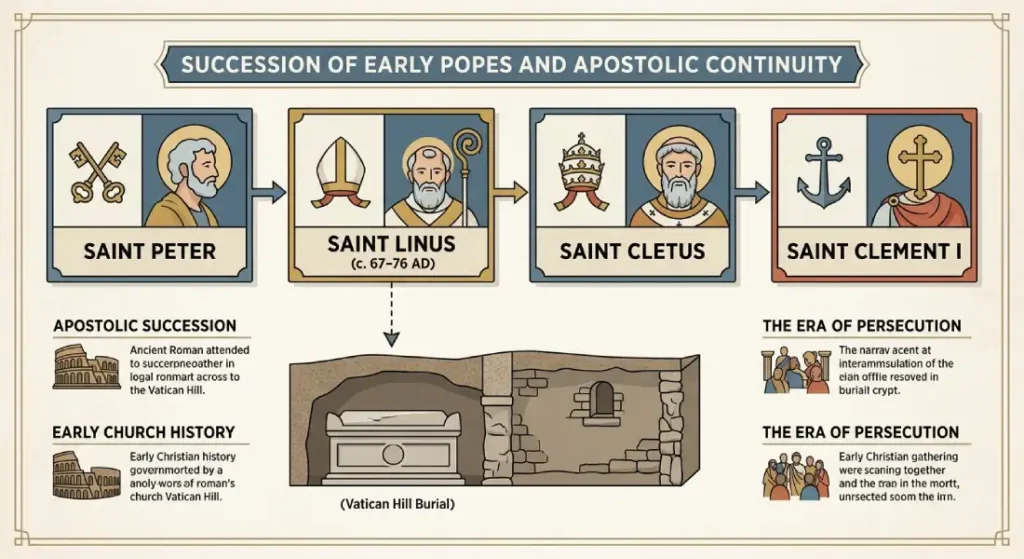
The Church has continually honored Saint Linus in her central act of worship. His name is recited in the Roman Canon (Eucharistic Prayer I), immediately following the names of the Apostles:
“In communion with those whose memory we venerate, especially the glorious ever-Virgin Mary… blessed Joseph, her Spouse, your blessed Apostles and Martyrs, Peter and Paul, Andrew… Linus, Cletus, Clement…”
Saint Linus was venerated as a saint from antiquity through the authentic witness of the early Church’s liturgical memory, long before the formal papal canonization process was codified. As the Catechism of the Catholic Church notes:
“By canonizing certain of the faithful, i.e., by solemnly proclaiming that those faithful have practiced heroic virtue and lived in fidelity to God’s grace, the Church recognizes the power of the Spirit of holiness within her.” (CCC 828)
Key Theological Takeaways
- Unbroken Continuity: Saint Linus proves the early operation of Apostolic Succession immediately following the deaths of Peter and Paul (CCC 861–862).
- Primacy of Faith Over Power: Early papal authority was established on spiritual fidelity and martyrdom, not worldly influence or political status.
- Liturgical Tradition: The early Church actively regulated worship to preserve sacred reverence, setting precedent for centuries of Catholic liturgical law.
Frequently Asked Questions
Saint Linus was the second Pope of the Catholic Church, succeeding Saint Peter around AD 67. He served as the Bishop of Rome until approximately AD 76, preserving apostolic unity and establishing early liturgical order during a period of Roman persecution.
Yes, Saint Linus is mentioned in 2 Timothy 4:21, where Saint Paul sends greetings to Timothy from Christian companions in Rome: “Eubulus sends greetings to you, as do Pudens and Linus and Claudia.” Saint Irenaeus confirms this Linus became the second Pope.
Church tradition historically venerates Saint Linus as a martyr who gave his life for Christ around AD 76 during Roman persecutions. He was buried on Vatican Hill near the tomb of Saint Peter, and his memory is preserved in the Roman Canon.
Related Popes