
How the Eucharist Transforms Us: What Pope Leo XIV and Vatican II Teach About Holy Communion
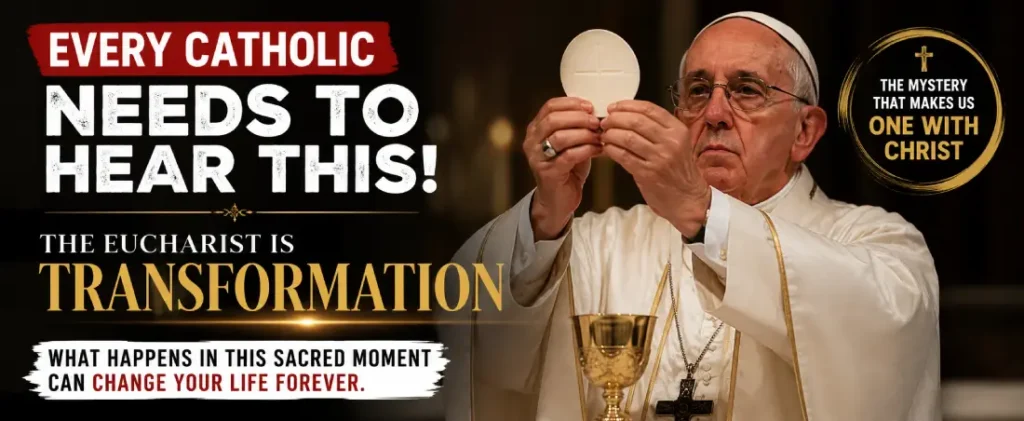
In his recent General Audience, Pope Leo XIV drew from Sacrosanctum Concilium to remind the faithful that the Eucharist isn’t just a central Catholic practice — it is the transformative force that conforms our lives to Christ. The Holy Father’s catechesis highlights a foundational truth of the Catholic faith: Holy Communion is not a passive symbol. The Eucharist creates the very union it signifies, enabling Catholics to adopt “the very way of the Lord”.
Understanding this teaching marks the difference between attending Mass out of routine obligation and stepping out of the church doors fundamentally transformed. At a time when Catholics are called to give an account for what they believe, the Church’s constant doctrine remains clear: the Eucharist doesn’t merely represent our union with Christ. It accomplishes it.
What Sacrosanctum Concilium Teaches About Sacred Liturgy
The Second Vatican Council’s Constitution on the Sacred Liturgy, Sacrosanctum Concilium, did not introduce novel doctrine regarding the Blessed Sacrament. Instead, it re-articulated what Sacred Tradition has maintained since the Apostolic Age. The Council declared that the liturgy is “the summit toward which the activity of the Church is directed” and “the fount from which all her power flows” (Sacrosanctum Concilium, 10).

The Catechism of the Catholic Church underscores this reality by naming the Eucharist “the source and summit of the Christian life” (CCC 1324). It is not merely one source of grace among many. It is the source.
When Catholics receive Holy Communion, they receive the Body and Blood, Soul and Divinity of Jesus Christ. This divine reception is intended to yield tangible spiritual conversion. Authentic liturgical participation is not about emotional sentimentality; it is about ontological conformity to Jesus Christ, allowing His divine life to animate our human existence.
How the Mass Changes Who We Are
Sacred Scripture reveals the mechanics of this spiritual reality. Saint Paul explained the profound nature of Holy Communion to the Church at Corinth:
“The cup of blessing which we bless, is it not a participation in the blood of Christ? The bread which we break, is it not a participation in the body of Christ? Because there is one bread, we who are many are one body, for we all partake of the one bread.” (1 Corinthians 10:16–17, RSV-CE)
The key term is participation (koinonia). Reception of the Blessed Sacrament is neither static observation nor mere historical commemoration. It is direct participation in Christ’s living sacrifice.
Furthermore, this union is both vertical and horizontal. By being united to Christ the Head, communicants are simultaneously united to every member of His Mystical Body. The Eucharist does not simply nourish individual souls; the Eucharist makes the Church.
Examining Your Heart: Receiving Holy Communion Worthily
St. Paul delivers a stark warning regarding this reality:
“Whoever, therefore, eats the bread or drinks the cup of the Lord in an unworthy manner will be guilty of profaning the body and blood of the Lord. Let a man examine himself, and so eat of the bread and drink of the cup.” (1 Corinthians 11:27–28, RSV-CE)
Because the Eucharist is the real, substantially present Body and Blood of Christ, approaching the altar casually or without proper spiritual disposition carries grave consequences. This is why Catholic moral theology dictates that anyone conscious of grave or mortal sin must be reconciled with God through the Sacrament of Penance before receiving Holy Communion (CCC 1385).
Proper preparation requires honest self-examination, reverent posture, and interior stillness. We cannot approach the source of all holiness while willfully holding onto grave sin.
4 Steps to Prepare for Worthy Communion
To assist the faithful in approaching the Blessed Sacrament with optimal spiritual fruitfulness, the Church recommends four practical steps of preparation:
| Step | Action | Theological & Scriptural Basis |
| 1. Examine Conscience | Honestly reflect on personal sins, persistent habits, and any stored unforgiveness prior to Mass. | 1 Corinthians 11:28 — “Let a man examine himself…” |
| 2. Seek Reconciliation | Receive sacramental Absolution in Confession if conscious of any mortal sin before approaching the altar. | CCC 1385 — Requirement for the state of grace. |
| 3. Observe the Fast | Abstain from all food and drink (except water or medicine) for at least one hour before Communion. | Canon Law 919 — Physical discipline for spiritual readiness. |
| 4. Practice Active Charity | Direct the grace received at Mass toward loving God and serving the poor, vulnerable, and unborn. | CCC 1397 — The Eucharist commits us to the poor. |
Living the Liturgy: Practical Steps for Daily Life
The liturgy is designed to form the human soul. The prayers, sacred gestures, silence, and readings are not arbitrary traditions. They are the means by which the Church trains the faithful how to worship, pray, and live.
When we engage fully in the Holy Mass — remaining mentally alert and spiritually receptive — grace transforms our daily interior life. We begin to think with the mind of Christ, judge with His wisdom, and love with His Sacred Heart. Adopting “the very way of the Lord” requires four practical commitments in daily life:
1. Honor the Sunday Mass Obligation
Sunday Mass is not an optional spiritual activity. The precept of the Church requiring attendance on Sundays and Holy Days of Obligation (CCC 2042) is not arbitrary legalism. It reflects the spiritual reality that human souls cannot survive without Eucharistic nourishment. Intentionally skipping Mass without a serious reason (such as grave illness) isolates the soul from the primary fount of grace.
2. Regular Use of the Sacrament of Reconciliation
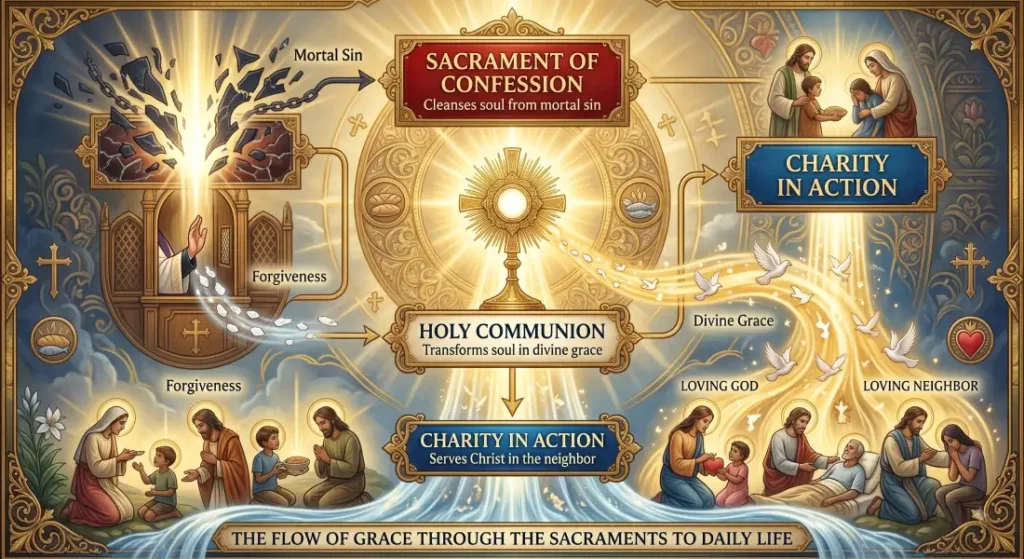
Self-examination before Communion should be honest rather than scrupulous. If you recognize serious sin or unforgiveness in your heart, the Sacrament of Reconciliation offers immediate healing. Confession is not a barrier keeping us from the Eucharist; it is the gift that prepares us to receive Jesus worthily. Real transformation cannot occur if we hold onto grave sin with one hand while reaching for Holy Communion with the other.
3. Commit to Eucharistic Adoration
Silent contemplation before the Blessed Sacrament allows the reality of Christ’s Real Presence to penetrate deep within the soul. Spending time in Eucharistic Adoration — even fifteen minutes a week — fosters deep intimacy with the Lord. Dramatic emotional experiences are not required; silent fidelity before the Monstrance allows God to work quiet transformation.
4. Direct Grace Toward Social Charity and Pro-Life Action
Authentic reception of the Body of Christ demands that we recognize Christ in the suffering members of His Mystical Body. If receiving Holy Communion unites us into one single body, that unity must extend to those who are most vulnerable:
- Protecting the unborn and upholding the dignity of human life at every stage.
- Serving the poor, the sick, the lonely, and the marginalized.
- Practicing forgiveness within our families and communities.
We cannot worthily receive the Body of Christ at the altar while remaining indifferent to His suffering members in the world.
Prayers for Eucharistic Renewal
To cultivate a deeper devotion to the Blessed Sacrament, incorporate these petitions into your daily prayer routine:
Prayer for Worthy Reception:
Lord Jesus Christ, grant me the grace to approach Your Holy Altar with deep reverence, purity of heart, and proper preparation. Deliver me from routine and indifference, and let Your Sacred Body and Blood transform my entire life. Amen.
Prayer for Liturgical Focus:
Holy Spirit, guard my mind against distractions during the Holy Sacrifice of the Mass. Keep my eyes, heart, and intellect fixed upon the Altar, that I may actively participate in the unbloody renewal of Calvary. Amen.
Prayer for Contrition and Purity:
Heavenly Father, reveal to me any unconfessed sin or unforgiveness lurking within my heart. Give me the humility to seek Your mercy in the Sacrament of Reconciliation so that I may receive Your Son worthily. Amen.
Prayer for Eucharistic Charity:
Blessed Virgin Mary, Mother of the Eucharist, teach me to carry Jesus into the world as you did. May the grace of Holy Communion compel me to recognize and serve Your Son in the unborn, the poor, the sick, and the abandoned. Amen.
Frequently Asked Questions
No. Church law and Catholic doctrine state that anyone conscious of mortal sin must receive sacramental Absolution in the Sacrament of Reconciliation before receiving Holy Communion (CCC 1385). Receiving Holy Communion in a state of mortal sin constitutes a sacrilege against the Blessed Sacrament.
The Eucharist is the source and summit because it contains the real Body, Blood, Soul, and Divinity of Jesus Christ (CCC 1324). All other sacraments, Church ministries, and works of apostolate stem from the Eucharist and lead back to it.
According to Canon 919 of the Code of Canon Law, Catholics must abstain from all food and drink (with the exception of water and necessary medicine) for at least one full hour prior to the actual reception of Holy Communion.
Holy Communion cleanses venial (minor) sins and preserves the soul from future mortal sin (CCC 1393–1395). However, it does not forgive mortal sins, which require sacramental confession and absolution in the Sacrament of Penance before approaching the altar.
Continue Your Faith Journey

Catholic Prayer for Toxic Family Conflict: A Faithful Guide to Boundaries, Healing, and Charity
Navigating family conflict, estrangement, and narcissistic behavior requires balancing Christian charity with prudent boundaries. Discover how Catholic doctrine, Sacred Scripture, and daily…
The 7 Best Catholic Bibles for Beginners and Scholars: The Ultimate Guide to Faithful Scripture Study
Discover the best Catholic Bibles for beginners and scholars. Compare top translations like the RSV-2CE, NABRE, and Douay-Rheims to deepen your daily…
Catholic Prayer for Anxiety: How to Find Peace Through Divine Providence
Learn how Catholic prayer for anxiety transforms fear into trust through Divine Providence. Discover practical steps using the Holy Rosary, Sacramental grace,…