
The First Worldwide Marian Eucharistic Procession: Dogma, Devotion, and Global Unity
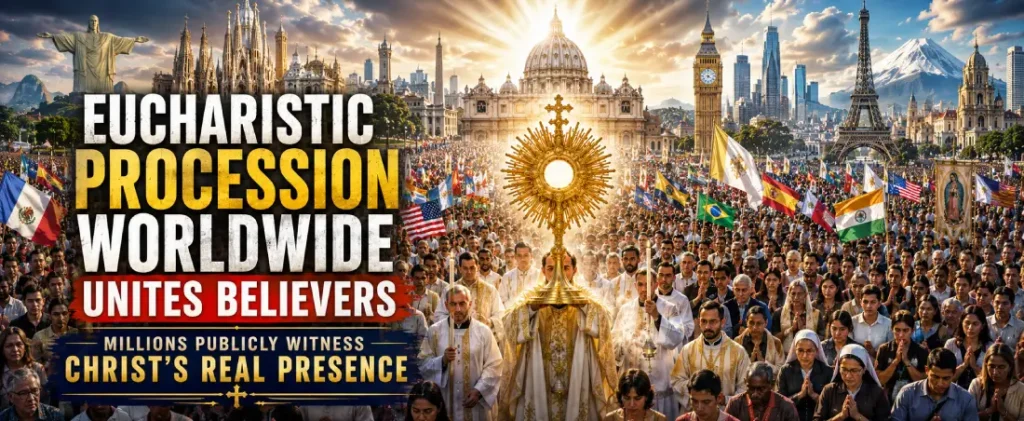
On June 13, 2026, over 6,000 Catholics gathered at St. Mary’s Chapel in Creggan, Derry, Northern Ireland, to lead the first coordinated Worldwide Marian Eucharistic Procession. Joining Derry in real-time were faithful across six continents, encompassing over 550 parishes and 15 major international shrines, including Fátima, Lourdes, and Knock.
This historic gathering was not a mere cultural tradition, nor was it a non-denominational prayer initiative. It was a public, solemn manifestation of latria—the supreme adoration owed to God alone—rendered to Our Lord Jesus Christ, truly, really, and substantially present in the Most Holy Eucharist (CCC 1374).
| Event Overview | Key Details |
| Originating Host | St. Mary’s Chapel, Creggan, Derry (Northern Ireland) |
| Global Reach | 550+ Parishes & 15 International Shrines across 6 Continents |
| Liturgical Context | Feast of the Immaculate Heart of Mary / Our Lady of Fátima |
| Theological Core | Public Adoration (Latria), Marian Intercession, and Reparation |
The Real Presence: Source and Summit of Christian Life
When Catholics carry the Sacred Host through public streets, they do not carry a symbol. They accompany the King of Kings. The Second Vatican Council teaches that the Eucharist is “the source and summit of the whole Christian life” (Lumen Gentium 11; CCC 1324).
In his encyclical Ecclesia de Eucharistia, Pope St. John Paul II reminded the Church that “the Church draws her life from the Eucharist”. A Eucharistic procession is the visible expression of this truth. It publicly proclaims that Christ’s Eucharistic Kingdom extends beyond parish walls into every corner of human society.
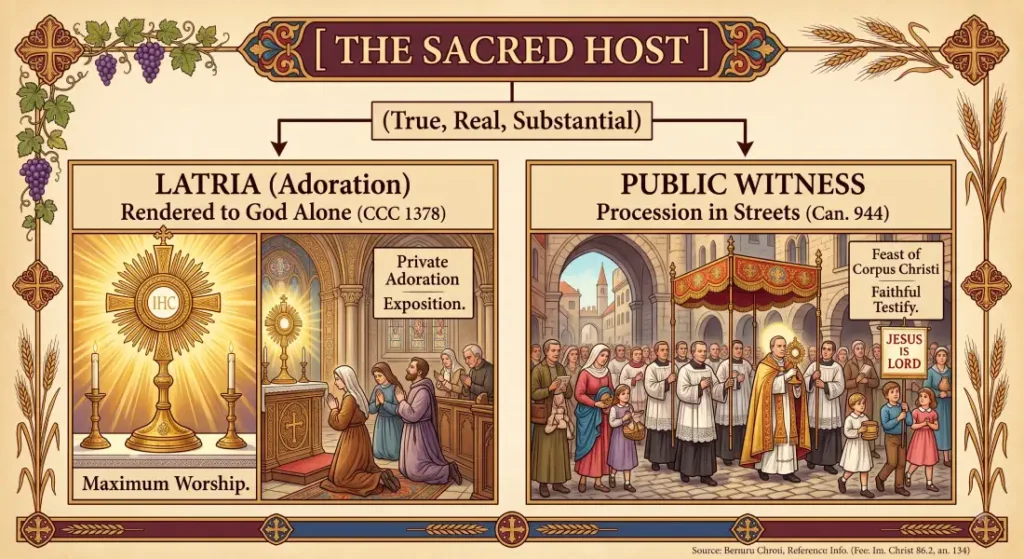
St. Thomas Aquinas explains in the Summa Theologiae that in the Most Holy Sacrament of the Eucharist, the whole Christ—His Body, Blood, Soul, and Divinity—is contained (ST III, q. 75, a. 1). Therefore, the worship given to the Eucharist is the very same worship due to Almighty God.
“The Catholic Church has always offered—and still offers—to the sacrament of the Eucharist the cult of adoration, not only during Mass, but also outside of it, by reserving the consecrated hosts with the utmost care, exposing them to the solemn veneration of the faithful, and carrying them in procession.” — Catechism of the Catholic Church, Paragraph 1378
“To Jesus Through Mary”: The Role of the Blessed Mother
The procession in Derry was explicitly Marian, uniting devotion to the Immaculate Heart of Mary with adoration of the Blessed Sacrament. In Catholic doctrine, devotion to the Blessed Virgin Mary (hyperdulia) is intrinsically ordered toward her Divine Son, Jesus Christ.
The Dogmatic Constitution on the Church, Lumen Gentium, emphasizes that Mary’s maternal role toward humanity in no way obscures or diminishes the unique mediation of Christ, but rather shows its power (LG 60). Mary always points the faithful to the Eucharist. Her final recorded words in Sacred Scripture remain her perpetual instruction to the Church: “Whatever he says to you, do it” (John 2:5, RSV-CE).
Why Marian Devotion Is Essential to Catholic Faith
- The Mystery of the Incarnation: By her Fiat (Luke 1:38), Mary provided the very flesh and blood that Christ gives to us in the Holy Eucharist.
- Spiritual Motherhood: At the foot of the Cross, Christ entrusted the Church to His Mother in the person of St. John: “Behold, your mother” (John 19:27, RSV-CE).
- Model of Adoration: St. John Henry Newman observed that Mary was the first human monstrance, carrying the Incarnate Word within her womb for nine months.
Far from being a secondary preference or an optional spiritual style, honoring the Mother of God is an integral dimension of authentic Christian tradition (CCC 971). St. Augustine taught that Mary was more blessed in accepting the faith of Christ than in conceiving the flesh of Christ (De Sancta Virginitate). When Catholics honor Mary, they magnify her Son.
Authentic Unity vs. False Compromise
The worldwide coordination across Derry, Lourdes, Fátima, and hundreds of global parishes naturally brings Our Lord’s High Priestly Prayer to mind:
“I do not pray for these only, but also for those who believe in me through their word, that they may all be one; even as thou, Father, art in me, and I in thee, that they also may be in us, so that the world may believe that thou hast sent me.” — John 17:20–21 (RSV-CE)
Our Lord prayed for genuine unity, built on truth. However, authentic Catholic ecumenism must not be confused with religious indifferentism—the false notion that dogma can be minimized to achieve consensus.
In his landmark encyclical Mortalium Animos, Pope Pius XI warned against attempts to foster a superficial unity that compromises revealed doctrine. True unity cannot be achieved by reducing essential Catholic truths regarding the Sacraments, the Papacy, or Our Lady to minor differences.
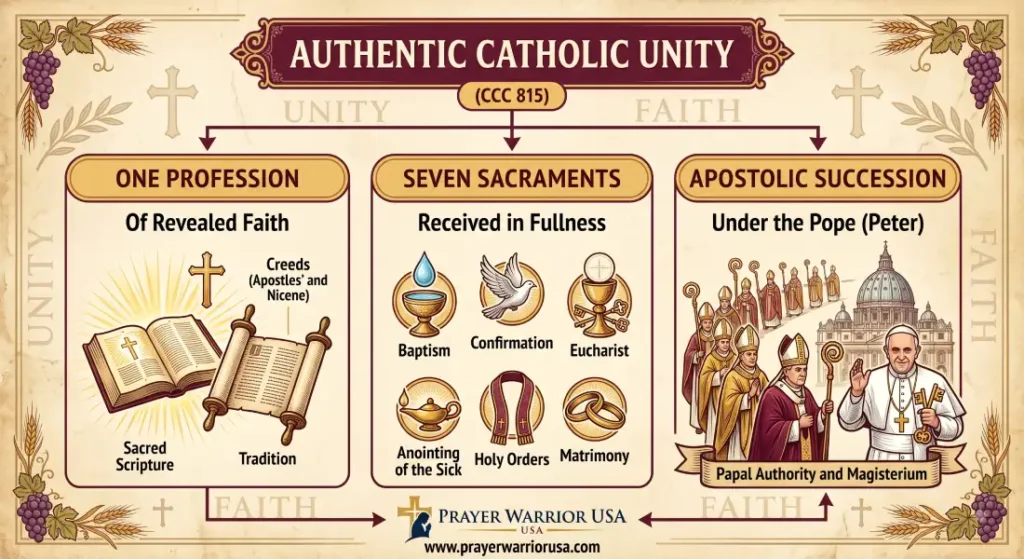
The Decree on Ecumenism, Unitatis Redintegratio, established by the Second Vatican Council, outlines the visible bonds of true Christian communion (CCC 815):
- Profession of One Faith: Unbroken adherence to the Deposit of Faith handed down from the Apostles.
- Common Sacramental Celebration: Participation in the seven Sacraments instituted by Christ, centered on the Holy Sacrifice of the Mass.
- Apostolic Succession: Governance under the Bishops in communion with the Successor of Peter, the Bishop of Rome.
When faithful Catholics worldwide join in a Eucharistic procession, they do not participate in a syncretic event. They demonstrate the visible, apostolic unity that already subsists in the Catholic Church (Lumen Gentium 8).
The Biblical Model of Community Intercession
The global witness of the Derry procession reflects the liturgical life of the early Church as recorded in the Acts of the Apostles:
“And they devoted themselves to the apostles’ teaching and fellowship, to the breaking of bread and the prayers.” — Acts 2:42 (RSV-CE)
Scripture highlights four foundational pillars of Catholic life:
- The Apostles’ Teaching: Adherence to sacred doctrine without distortion.
- Fellowship: Communion within the visible Body of Christ.
- The Breaking of Bread: The Holy Sacrifice of the Mass and Holy Communion.
- The Prayers: Sacred liturgical prayer and public intercession.
The phrase “the prayers” in Acts 2:42 indicates structured, communal worship rather than purely private devotions. When thousands of Catholics assemble globally to adore the Blessed Sacrament, they continue this uninterrupted apostolic tradition (CCC 949).
Restoring Public Witness in an Age of Secularism
In an increasingly secular world, faith is often pushed into the private sphere. Yet Canon Law explicitly highlights the value of Eucharistic processions:
“When it can be done in the judgment of the diocesan bishop, as a public witness of faith and devotion toward the Most Blessed Sacrament, a procession is to be held through the public streets, especially on the solemnity of the Body and Blood of Christ.” — Code of Canon Law, Canon 944 §1
Public Eucharistic processions offer powerful spiritual benefits for the modern world:
1. A Public Profession of Christ’s Kingship
By taking Christ out of the sanctuary and into the streets, the Church publicly proclaims His sovereignty over civil society, family life, and human culture.
2. An Act of Reparation
Public adoration serves as an act of reparation for blasphemies, sacrileges, and indifference committed against the Most Holy Eucharist throughout the world.
3. A Beacon of Evangelization
Seeing thousands of faithful silently accompanying the Blessed Sacrament provides non-believers with a compelling witness of reverence, faith, and sacred order.
Conclusion: Responding to the Eucharistic Call
The historic procession originating in Derry, Northern Ireland, serves as a compelling reminder of the Church’s global identity and Eucharistic heart. True Christian unity is not manufactured by human efforts or doctrinal compromises; it flows directly from the Eucharistic Heart of Jesus through the intercession of His Holy Mother.
Every Catholic is called to respond to this witness by renewing their devotion to the Blessed Sacrament:
- Commit to Weekly Adoration: Spend dedicated time before the Blessed Sacrament exposed in the monstrance or reserved in the tabernacle.
- Foster Marian Devotion: Pray the Holy Rosary daily, offering intention for the restoration of Christian unity in full Catholic truth.
- Participate in Parish Processions: Accompany Our Lord proudly during Corpus Christi and local Eucharistic events, giving bold public witness to your faith.
As the Church continues her earthly pilgrimage, her anchor remains unchanged: Jesus Christ, truly present in the Eucharist, guided by Mary, leading all souls to eternal life.
Frequently Asked Questions
A Eucharistic procession is a public act of worship (latria) where the Blessed Sacrament is carried in a monstrance through the streets (Canon 944 §1). It gives public witness to Christ’s Real Presence—Body, Blood, Soul, and Divinity—in the Holy Eucharist (CCC 1374, 1378).
Catholic doctrine teaches that Mary always leads believers directly to Jesus (“To Jesus through Mary“). Marian intercession (hyperdulia) points the faithful directly to Christ’s Real Presence in the Eucharist, emphasizing her role in the Incarnation and her maternal care for the Church (Lumen Gentium 60; CCC 971).
According to Unitatis Redintegratio and the Catechism of the Catholic Church (CCC 815), authentic unity requires three visible bonds: profession of one uncorrupted faith, common celebration of the seven Sacraments, and apostolic governance under the Successor of Peter (the Pope). True unity cannot compromise revealed dogmas.
Continue Your Faith Journey
What Is Eucharistic Adoration? A Catholic Guide to the Real Presence
Discover the rich Catholic tradition of Eucharistic adoration and the Real Presence of Christ. Learn how to make a transformative Holy Hour…
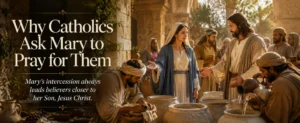
Why Do Catholics Pray to Mary? Church Teaching, Scripture, and Tradition
Explore why Catholics pray to Mary, the biblical roots of Marian intercession, and the vital theological distinction between the adoration due to…
Catholic Prayer for Toxic Family Conflict: A Faithful Guide to Boundaries, Healing, and Charity
Navigating family conflict, estrangement, and narcissistic behavior requires balancing Christian charity with prudent boundaries. Discover how Catholic doctrine, Sacred Scripture, and daily…