
How to Pray the Rosary: A Step-by-Step Beginner’s Guide
Learning to pray the Rosary is far simpler than it appears. Whether you are holding beads for the first time or returning after years away, this guide breaks down every prayer, mystery, and step with clear instructions and scriptural foundations.
The Rosary is a scriptural, Christocentric prayer. Pope St. John Paul II described it in his Apostolic Letter Rosarium Virginis Mariae as a “compendium of the Gospel”. Through the intercession of the Virgin Mary, we contemplate the face of Christ by meditating on the mysteries of His life, death, and resurrection.
Quick-Reference Rosary Guide
Use this visual guide to follow the step-by-step physical sequence of the Rosary:
| Sequence | Physical Bead Location | Prayer to Recite |
| Start | Crucifix | Make the Sign of the Cross & pray the Apostles’ Creed |
| Step 1 | First Single Bead | Pray 1 Our Father |
| Step 2 | Next 3 Small Beads | Pray 3 Hail Marys (for Faith, Hope, and Charity) |
| Step 3 | Space / Chain | Pray 1 Glory Be (Optional: Fatima Prayer) |
| Decades (x5) | 1 Large Bead + 10 Small Beads | Announce Mystery, pray 1 Our Father, 10 Hail Marys, 1 Glory Be, and 1 Fatima Prayer |
| Conclusion | Centerpiece / Crucifix | Pray the Hail, Holy Queen, concluding prayer, and Sign of the Cross |
Understanding the Rosary Beads
The physical Rosary consists of five decades—groups of ten small beads separated by individual larger beads—connected to a crucifix and short strand.
The beads are non-liturgical tools designed to keep count seamlessly, freeing your mind to focus entirely on interior prayer and meditation (CCC 2708). As St. Thomas Aquinas observed, external bodily actions in prayer serve to excite interior devotion (Summa Theologiae, II-II, q. 84, a. 2).
Step-by-Step: The Opening Prayers
Every Rosary begins on the short strand starting at the crucifix.
1. The Sign of the Cross and Apostles’ Creed
Hold the crucifix in your right hand, make the Sign of the Cross, and recite the Apostles’ Creed:
“I believe in God, the Father Almighty, Creator of heaven and earth…”
This ancient baptismal symbol grounds your meditation in Catholic dogma—affirming the Trinity, the Incarnation, and the Communion of Saints.
2. The First Our Father
On the first single bead above the crucifix, recite the Our Father (The Lord’s Prayer), recorded in Matthew 6:9–13. This anchors the devotion in the exact prayer taught by Jesus Christ Himself.
3. Three Hail Marys for the Theological Virtues
On the next three small beads, pray three Hail Marys. Petition Our Lady’s intercession for an increase in the three theological virtues: Faith, Hope, and Charity (CCC 1813).
4. The Glory Be (Doxology)
On the chain following the three small beads, pray the Glory Be. The Glory Be closes each opening petition with a Trinitarian doxology, directing all worship and honor to the Holy Trinity.
How to Pray the Five Decades
The core of the Rosary consists of five decades. Each decade focuses on a specific “Mystery”—a pivotal event in the life of Jesus Christ and the Virgin Mary.
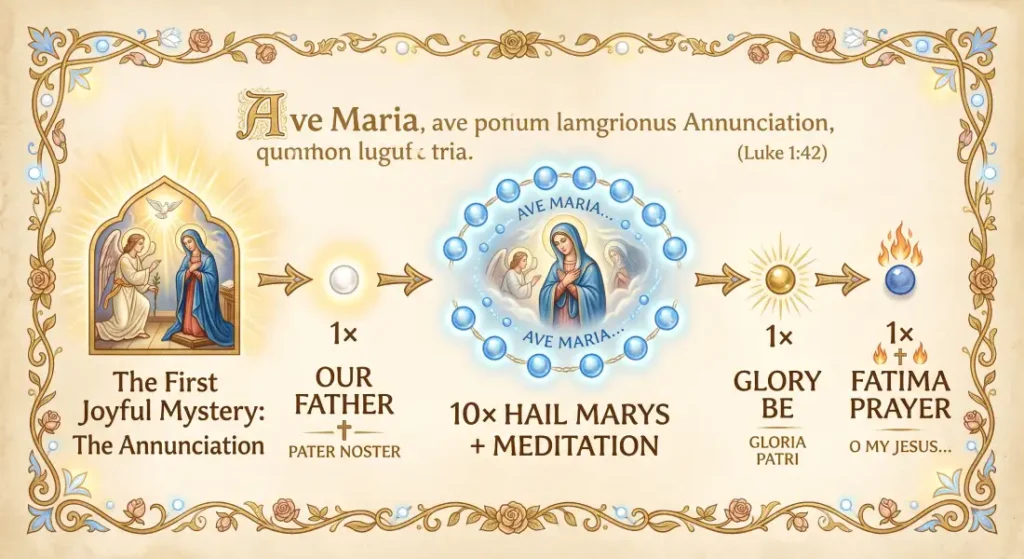
- Announce the Mystery: Name the event (e.g., “The First Joyful Mystery: The Annunciation”).
- Pray the Our Father: Recite one Our Father on the single large bead before the decade.
- Pray Ten Hail Marys: Recite one Hail Mary on each of the ten decade beads while quietly reflecting on the announced mystery.
- Pray the Glory Be: Recite the doxology on the space before the next large bead.
- Pray the Fatima Prayer (Optional): Recite the petition requested by Our Lady at Fátima: “O my Jesus, forgive us our sins, save us from the fires of hell, lead all souls to Heaven, especially those most in need of Thy mercy.”
The Four Sets of Rosary Mysteries
There are 20 total mysteries divided into four distinct sets. Catholic tradition assigns specific sets to days of the week.
The Joyful Mysteries
Traditionally prayed on Mondays, Saturdays, and Sundays during Advent.
- 1. The Annunciation: The Archangel Gabriel announces the Incarnation to Mary (Luke 1:26–38).
- 2. The Visitation: Mary visits her cousin Elizabeth in haste (Luke 1:39–56).
- 3. The Nativity: Jesus Christ is born in poverty in Bethlehem (Luke 2:1–20).
- 4. The Presentation: Mary and Joseph present the infant Jesus in the Temple (Luke 2:22–38).
- 5. The Finding in the Temple: Mary and Joseph find the young Jesus teaching the doctors of the Law (Luke 2:41–52).
The Luminous Mysteries (Mysteries of Light)
Instituted by Pope St. John Paul II in 2002; traditionally prayed on Thursdays.
- 1. The Baptism in the Jordan: God the Father proclaims Christ His beloved Son (Matthew 3:13–17).
- 2. The Wedding at Cana: Christ performs His first public miracle at Mary’s request (John 2:1–11).
- 3. The Proclamation of the Kingdom: Jesus calls all people to repentance and faith (Mark 1:14–15).
- 4. The Transfiguration: Christ reveals His divine glory on Mount Tabor (Matthew 17:1–8).
- 5. The Institution of the Eucharist: Jesus gives His true Body and Blood at the Last Supper (Luke 22:14–20).
The Sorrowful Mysteries
Traditionally prayed on Tuesdays, Fridays, and Sundays during Lent.
- 1. The Agony in the Garden: Jesus prays in sorrow before His arrest in Gethsemane (Matthew 26:36–46).
- 2. The Scourging at the Pillar: Christ is brutally tortured by Roman soldiers (Matthew 27:26).
- 3. The Crowning with Thorns: Soldiers mock Christ’s kingship with a crown of thorns (Matthew 27:27–31).
- 4. The Carrying of the Cross: Jesus carries His heavy cross to Calvary (John 19:16–17).
- 5. The Crucifixion and Death: Christ offers His life on the cross for human salvation (Luke 23:33–46).
The Glorious Mysteries
Traditionally prayed on Wednesdays and Sundays during Easter and Ordinary Time.
- 1. The Resurrection: Christ rises triumphantly over death on the third day (Mark 16:1–8).
- 2. The Ascension: Jesus ascends into heaven to sit at the right hand of the Father (Acts 1:6–11).
- 3. The Descent of the Holy Spirit: The Holy Spirit descends upon Mary and the Apostles at Pentecost (Acts 2:1–4).
- 4. The Assumption of Mary: The Immaculate Virgin Mary is assumed body and soul into heavenly glory upon completing her earthly life (CCC 966; Pius XII, Munificentissimus Deus).
- 5. The Coronation of Mary: Mary is crowned Queen of Heaven and Earth, standing as an icon of the Church fully redeemed (CCC 966; Lumen Gentium 59).
Closing Prayers of the Rosary
After completing all five decades, complete the Rosary using the centerpiece of the beads.
1. The Hail, Holy Queen (Salve Regina)
Recite the ancient Marian antiphon:
“Hail, Holy Queen, Mother of Mercy, our life, our sweetness, and our hope! To thee do we cry, poor banished children of Eve. To thee do we send up our sighs, mourning and weeping in this valley of tears. Turn then, most gracious advocate, thine eyes of mercy toward us, and after this our exile, show unto us the blessed fruit of thy womb, Jesus. O clement, O loving, O sweet Virgin Mary.”
2. Concluding Rosary Prayer
Pray the traditional concluding collect:
“O God, whose only begotten Son, by His life, death, and resurrection, has purchased for us the rewards of eternal life, grant, we beseech Thee, that meditating upon these mysteries of the Most Holy Rosary of the Blessed Virgin Mary, we may imitate what they contain and obtain what they promise, through the same Christ our Lord. Amen.”
3. Final Sign of the Cross
Touch the crucifix, state any personal intentions, and finish by making the Sign of the Cross.
Pastoral Advice for Beginners
- Start Small: If praying five full decades feels overwhelming, begin by praying one decade per day.
- Focus on Meditation: Vocal prayer serves mental prayer. Do not rush through the words; focus gently on Christ’s life through the eyes of Mary.
- Handling Distractions: If your mind wanders, gently return your focus to the mystery. The intentional turn back to God is itself a act of love and prayer.
The Rosary carries into daily life, transforming routine duties through the graces contemplated in each mystery. Pick up your beads today and let Mary lead you closer to her Son.
Frequently Asked Questions
The Joyful Mysteries are prayed on Mondays and Saturdays (and Sundays during Advent).
The Luminous Mysteries are prayed on Thursdays.
The Sorrowful Mysteries are prayed on Tuesdays and Fridays (and Sundays during Lent).
The Glorious Mysteries are prayed on Wednesdays and Sundays throughout Ordinary Time and Easter.
Yes, you can pray the Rosary without physical beads. Rosary beads are simply counting tools to keep your mind focused on meditation. You can easily keep track of the ten Hail Marys using your fingers or by counting silently.
Praying five decades of the Rosary typically takes between 15 to 20 minutes at a reflective, meditative pace. Beginners can also pray a single decade in under five minutes when starting out.
While your voice recites the Hail Marys, your mind should gently focus on the announced scriptural mystery for that decade. The vocal prayers act as a background rhythm supporting your meditation on the life, death, and glory of Jesus Christ.
Continue Your Faith Journey
Why Do Catholics Pray to Mary? Church Teaching, Scripture, and Tradition
Explore why Catholics pray to Mary, the biblical roots of Marian intercession, and the vital theological distinction between the adoration due to…
How to Pray the 54 Day Rosary Novena: Complete Guide and Tracker
Discover how to pray the miraculous 54 Day Rosary Novena with this Catholic guide, complete 27-day petition and thanksgiving schedule, and daily…
How to Conduct a Catholic Night Prayer Examination of Conscience: A Step-by-Step Spiritual Guide
Learn how to conduct a daily Catholic night prayer examination of conscience using the timeless five-step method of the saints. Cultivate true…