
Catholic Civic Duty and National Prayer: A Magisterial Analysis of the 2026 Call to Revival
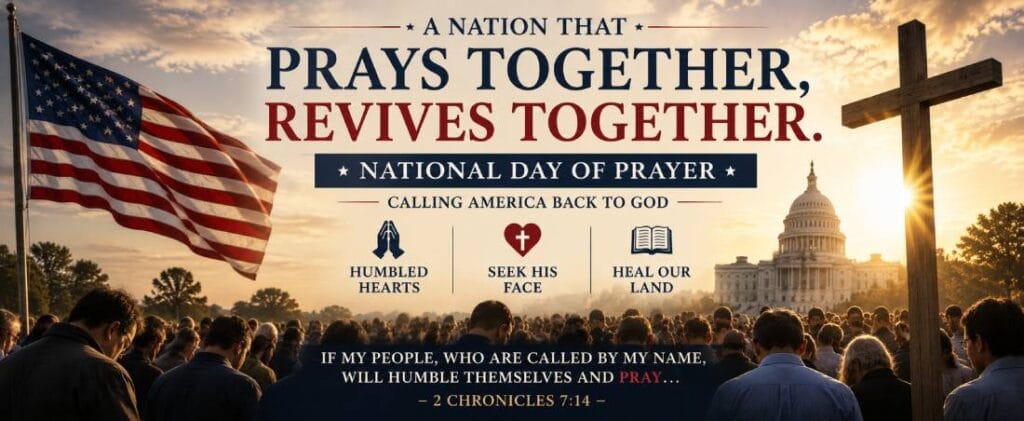
President Donald Trump’s proclamation for the 2026 National Day of Prayer—coinciding with the nation’s semiquincentennial (250th anniversary)—has renewed widespread discussion on the relationship between faith, governance, and spiritual revival. The announcement urges citizens across the United States to seek God’s direction and reflect upon the spiritual foundations that have accompanied the nation throughout its history. For faithful Catholics, public calls to prayer provide an opportunity to examine our civic obligations through the lens of Sacred Scripture, Sacred Tradition, and the authoritative teaching of the Magisterium.
While civic proclamations appropriately recognize human dependence on Divine Providence, Catholics must evaluate calls for national renewal with dogmatic clarity. Genuine spiritual restoration cannot be achieved through generic sentimentalism, political maneuvering, or extra-sacramental enthusiastic assemblies. Instead, authentic revival requires an adherence to the Natural Law, a clear understanding of the order of grace, and active participation in the Sacramental Economy established by Jesus Christ.
Civic Obligation, Natural Law, and the Order of Grace
Catholic political theology has long maintained that civil authority derives its ultimate moral authority from God (Catechism of the Catholic Church [CCC], 1900). As St. Paul instructs in 1 Timothy 2:1–2, Christians are morally obligated to offer supplications, prayers, intercessions, and thanksgivings for kings and all who are in high positions, that we may lead a quiet and peaceable life. St. Thomas Aquinas builds upon this scriptural foundation in his Summa Theologiae (I-II, q. 94), explaining that human laws and civil societies are bound to respect the Natural Law—the rational creature’s participation in the Eternal Law of God.
When civil leaders call upon citizens to pray, they acknowledge a truth accessible to human reason: human government alone is insufficient to secure justice, virtue, or true peace. However, Catholics must avoid the theological error of conflating any secular republic with Old Testament Israel or the Church. In De Civitate Dei (The City of God), St. Augustine carefully distinguishes between the Civitas Terrena (the earthly city) and the Civitas Dei (the heavenly city). Earthly nations belong entirely to the temporal order. They do not possess a divine covenant, nor are they recipients of infallible dogmatic promises of temporal prosperity.
Consequently, popular citations of Old Testament texts such as 2 Chronicles 7:14 (“if my people who are called by my name humble themselves, and pray and seek my face…”) must be applied with theological precision. In the Old Covenant, this promise pertained specifically to the theocratic kingdom of Israel under the Mosaic Law. In the New Covenant, God’s covenanted people is the Holy Catholic Church—the Mystical Body of Christ (CCC 781). While the principle of divine mercy toward repentant sinners remains universally true (CCC 1430), 2 Chronicles 7:14 does not constitute a mechanical “divine guarantee” of geopolitical restoration or economic flourishing for the United States or any other secular nation.
Correcting ‘Americanism’ and Word-of-Faith Misinterpretations
In evaluating civic prayer initiatives, Catholics must be vigilant against two theological distortions common in modern discourse: the heresy of Americanism and the errors of Word-of-Faith theology.
1. The Heresy of Americanism
In his 1899 Apostolic Letter Testem Benevolentiae Nostrae, Pope Leo XIII explicitly condemned the heresy of Americanism, which sought to adapt Catholic doctrine to modern democratic culture or suggest that the United States possesses a unique, quasi-messianic spiritual mandate. While Catholics are called to be exemplary, patriotic citizens who love their homeland (CCC 2239), our primary allegiance belongs unconditionally to Jesus Christ and His Holy Church. Patriotism becomes distorted whenever national identity is elevated to an object of religious devotion or when temporal political restoration is substituted for eternal salvation.
2. Word-of-Faith and ‘Decreeing’ Terminology
Popular Protestant movements frequently urge intercessors to “declare Scripture,” “speak life,” or “claim territorial breakthrough” over geographical regions. This language reflects a Word-of-Faith anthropology that attributes creative power to human vocalization. In Catholic theology, prayer is defined by St. John Damascene as “the raising of one’s mind and heart to God or the requesting of good things from God” (CCC 2559). Human beings do not command spiritual authority over nations through vocal declarations. Catholic intercession relies entirely upon humble petition (oratio), liturgical worship, and the invocation of divine mercy through legitimate channels of grace (CCC 2629–2636).
3. Christ’s Presence and Matthew 18:20
Civic prayer events often cite Matthew 18:20 (“where two or three are gathered in my name, there am I among them”) as the ultimate fulfillment of Christian unity. While Christ is truly present in the prayerful assembly of the faithful (CCC 1373), Holy Mother Church teaches that His presence is realized par excellence in the Holy Sacrifice of the Mass and the Most Blessed Sacrament (CCC 1374). As Pope Paul VI reaffirmed in his encyclical Mysterium Fidei, while Christ is present in His Word and in corporate prayer, these modes of presence must never eclipse or replace the substantial Real Presence of Christ—Body, Blood, Soul, and Divinity—in the Eucharist.
The Sacramental Economy as the True Engine of Renewal
Spiritual revival is not a vague emotional movement; it is a concrete interior transformation wrought by divine grace (CCC 1428). If a nation is to experience moral elevation, its citizens must be reconciled with Almighty God through the Sacramental Economy.
| Aspect of Renewal | Generic Civic / Evangelical Approach | Authentic Catholic Sacramental Approach |
| Primary Method | Mass prayer rallies and verbal declarations. | The Sacraments of Penance and the Holy Eucharist (CCC 1324, 1422). |
| Understanding of Sin | Societal decline viewed primarily as political/cultural loss. | Personal offense against God requiring sacramental absolution (CCC 1440). |
| Basis of Authority | Subjective conviction and civic patriotism. | Sacred Scripture, Sacred Tradition, and the Magisterium (CCC 85–87). |
| Role of Grace | Presumed through collective national repentance. | Infused through the Sacraments and nourished by sanctifying grace (CCC 1999). |
To achieve true spiritual renewal, Catholics must champion four foundational pillars of grace:
- Sacramental Confession (CCC 1422–1470): National moral restoration begins with individual repentance. The faithful must frequently approach the Sacrament of Reconciliation to confess grave sins, receive absolution, and restore sanctifying grace in their souls.
- The Holy Sacrifice of the Mass (CCC 1324–1419): The Mass is the highest form of prayer on earth. Offering Holy Masses for civil leaders, the conversion of sinners, and the protection of life carries infinite value because it presents the unbloody re-presentation of Christ’s sacrifice on Calvary.
- Eucharistic Adoration (CCC 1378–1381): Spending time before the Blessed Sacrament in silent adoration brings true spiritual light to communities and repairs offenses committed against the Divine Majesty.
- Marian Intercession (CCC 963–975): The United States is canonically placed under the patronage of the Blessed Virgin Mary under her title of the Immaculate Conception. True intercession for the nation must include devout recitation of the Most Holy Rosary, asking Our Lady to intercede for our land.
A Four-Fold Action Plan for Catholic Citizens
In response to public calls for prayer, Catholic citizens should avoid passive sentimentality and undertake specific, virtuous actions:
- Fulfill the Duty of Intercession: Incorporate daily prayers for the President, public officials, judges, and local leaders (1 Tim 2:1–2). Pray that they receive the cardinal virtue of prudence and govern according to the Natural Law (CCC 1901).
- Engage in Public Witness and Faithful Citizenship: Exercise the right to vote and advocate for laws that defend the sanctity of human life from conception to natural death, protect religious freedom, and support the traditional family (CCC 2246).
- Practice Personal Mortification and Penance: Combine prayer with fasting, almsgiving, and penance on Fridays, offering these acts for the moral healing of society (CCC 1434).
- Promote Catholic Social Teaching: Work actively in local communities to alleviate poverty, defend human dignity, and foster the common good, demonstrating that faith is animated by charity (James 2:17; CCC 1886).
Frequently Asked Questions
Yes. Catholic moral theology and Sacred Scripture (1 Tim 2:1–2) explicitly require the faithful to pray for public authorities. The Catechism of the Catholic Church (CCC 2240) teaches that submission to authority and co-responsibility for the common good make it a moral obligation to pray for civil leaders, pay taxes, and exercise the right to vote.
No. In its proper historical and canonical context, 2 Chronicles 7:14 applied to the Old Testament Kingdom of Israel under the Mosaic Covenant. While the spiritual principle of divine mercy toward repentant people remains valid, Catholic doctrine does not interpret this verse as a dogmatic guarantee of geopolitical or economic prosperity for secular modern states.
While Protestant prayer rallies often emphasize vocal decrees, territorial spiritual warfare, and informal gatherings, Catholic intercession is rooted in the Sacramental Economy. Catholic intercession centers on the Holy Sacrifice of the Mass, Eucharistic Adoration, the Sacrament of Penance, and traditional devotions such as the Holy Rosary, acknowledging that all grace flows through Christ and His Church.
Source: CharismaNews
Continue Your Faith Journey
What Is Eucharistic Adoration? A Catholic Guide to the Real Presence
Discover the rich Catholic tradition of Eucharistic adoration and the Real Presence of Christ. Learn how to make a transformative Holy Hour…
How the Eucharist Transforms Us: What Pope Leo XIV and Vatican II Teach About Holy Communion
Discover how Pope Leo XIV and Vatican II explain the transforming power of the Holy Eucharist. Learn practical steps to prepare your…
Catholic Prayer for Toxic Family Conflict: A Faithful Guide to Boundaries, Healing, and Charity
Navigating family conflict, estrangement, and narcissistic behavior requires balancing Christian charity with prudent boundaries. Discover how Catholic doctrine, Sacred Scripture, and daily…