
The Eucharistic Miracle of Peru: 375 Years of Divine Presence and Transubstantiation
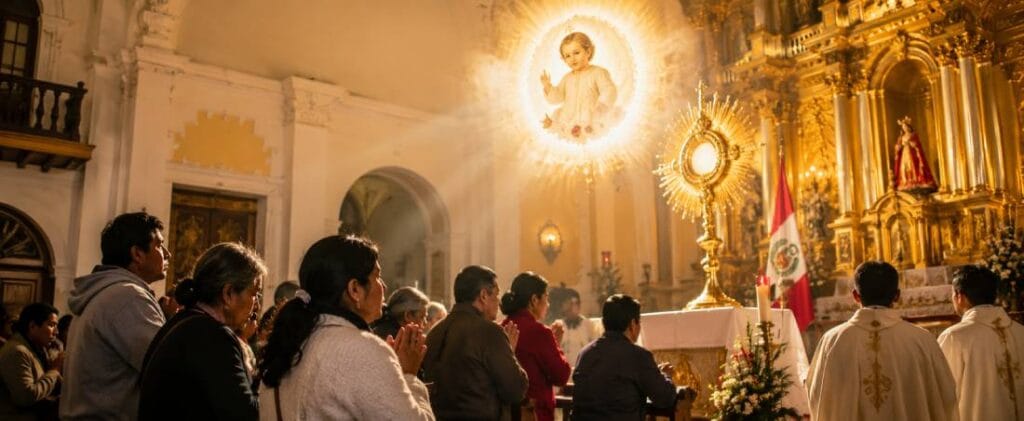
The Supernatural Event at Puerto Eten: 375 Years of Grace
In 1649, during the solemn celebration of Corpus Christi in the coastal village of Puerto Eten, Peru, Almighty God manifested a profound Eucharistic miracle that continues to inspire Catholic devotion worldwide. On the eve of June 2, as Friar Jerome Silva de Manrique placed the consecrated Host into the monstrance, the assembled faithful witnessed a miraculous vision. Within the Sacred Species, the Child Jesus appeared with glowing curls, dressed in a denim-colored tunic and traditional indigenous Mochica attire.
This miraculous apparition demonstrated Christ’s intimate love for the native peoples of the New World and confirmed the reality of His Sacramental Presence. On July 22 of the same year, during the Feast of Saint Mary Magdalene, a second miraculous sign occurred within the same Host. The Divine Child reappeared, followed shortly by a vision of three intertwined red hearts, symbolizing the Holy Trinity united in the divine Victim of the altar.
Commemorating its 375th anniversary, the Diocese of Chiclayo and Catholics globally honor Puerto Eten as the “City of the Eucharistic Miracle”. This historical testimony challenges believers to reject casual attitudes toward Holy Communion. It serves as a celestial confirmation that the Holy Sacrifice of the Mass is not a mere symbolic ritual, but the true presence of the King of Kings.
Transubstantiation: Defined Dogma vs. Symbolic Misinterpretations
The supernatural occurrence at Puerto Eten directly points to the central mystery of the Catholic Faith: the Holy Eucharist. The Council of Trent dogmatically defined that in the Most Holy Sacrament of the Eucharist, “the Body and Blood, together with the Soul and Divinity, of our Lord Jesus Christ, and, consequently, the whole Christ is truly, really, and substantially contained” (Session 13, Canon 1).
This substantial change is brought about through Transubstantiation. By the consecration of the bread and wine, there takes place a change of the entire substance of bread into the substance of the Body of Christ, and of the entire substance of wine into the substance of His Blood (Council of Trent, Session 13, Canon 2; CCC 1376). While the outward physical properties—such as taste, texture, and color—remain unchanged, the underlying reality is entirely converted.
As St. Thomas Aquinas teaches, this conversion is unique in all of reality, occurring solely by the divine power of God (Summa Theologiae, III, q. 75, a. 4). Viewing the Eucharist as a mere symbol, emblem, or memorial table fundamentally distorts divine revelation. The Catechism of the Catholic Church notes that Christ makes Himself present in this sacrament not as a metaphor, but in maximum reality (CCC 1374).
Eucharistic miracles across Church history do not alter Catholic doctrine or create new revelations. Instead, they function as mercy from God, momentarily pulling back the veil of the sacramental accidents. They visually confirm the invisible spiritual reality that takes place upon every Catholic altar during the Consecration.
Exegesis of John 6: The Uncompromising Reality of Christ’s Flesh
In the sixth chapter of St. John’s Gospel, Jesus established the non-negotiable biblical requirement of eating His actual Flesh and drinking His Blood. Following the miraculous multiplication of the loaves, Christ declared to the crowds: “Whoever feeds on my flesh and drinks my blood has eternal life, and I will raise him up on the last day. For my flesh is true food, and my blood is true drink” (John 6:54–55).
Modernist interpretations often claim that Jesus was using poetic metaphors to describe spiritual faith. However, authentic biblical exegesis and Sacred Tradition reveal that Christ spoke with absolute literalness. In the original Greek text, St. John transitions from the general word for eating (phagein) to the explicit verb trogon (John 6:54), which literally translates to “chewing” or “munching”.
When His hearers expressed disgust at this command, Jesus did not qualify His statement or claim to be speaking figuratively (John 6:60). He allowed those who rejected the literal reality of His words to walk away and abandon Him entirely (John 6:66). Turning to the Twelve Apostles, Jesus asked: “Do you also want to leave?” (John 6:67).
St. Peter, speaking on behalf of the Church, submitted to the mystery with faithful obedience: “Lord, to whom shall we go? You have the words of eternal life” (John 6:68). The Catholic Church maintains this same unwavering faith, affirming that the Eucharistic feast grants spiritual nourishment and eternal life to worthy recipients (CCC 1384; St. Thomas Aquinas, ST III, q. 79, a. 1).
Sacramental Integrity, Worthy Reception, and Canon Law
Because Holy Communion is the true Body and Blood of Christ, receiving the Sacrament carries immense spiritual weight and moral responsibility. St. Paul issued an explicit warning against sacrilegious reception to the Corinthians: “Whoever, therefore, eats the bread or drinks the cup of the Lord in an unworthy manner will be guilty concerning the body and blood of the Lord” (1 Corinthians 11:27).
To safeguard the dignity of the Sacrament and the salvation of souls, the Apostle instructs: “Let a person examine himself, then, and so eat of the bread and drink of the cup” (1 Corinthians 11:28). Catholic moral theology and Canon Law dictate that anyone conscious of having committed a grave or mortal sin must not receive Holy Communion without prior sacramental absolution (CCC 1385; Code of Canon Law, Can. 916). Receiving Holy Communion in a state of mortal sin adds the grave guilt of sacrilege.
Furthermore, the Church maintains clear boundaries regarding Eucharistic hospitality. While Protestant communion rituals may express sincere intentions, they lack valid Holy Orders and valid sacramental consecration through Apostolic Succession (Declaration Dominus Iesus, 17; CCC 1400). Consequently, intercommunion between Catholics and non-Catholic communities is prohibited, as Holy Communion presupposes full ecclesial unity and shared dogmatic faith.
Practical Spiritual Disciplines for Eucharistic Renewal
Recovering holy reverence for the Blessed Sacrament requires intentional daily practices and proper interior disposition. Faithful Catholics can deepen their love for the Eucharistic Lord through the following spiritual disciplines:
- Prioritize Sacramental Reconciliation: Make regular use of the Sacrament of Penance, ensuring that grave sins are confessed before approaching the Holy Altar (CCC 1385).
- Observe the Eucharistic Fast: Abstain from all food and drink (except water and essential medicine) for at least one hour before receiving Holy Communion as an act of mortification and physical preparation.
- Practice Eucharistic Adoration: Visit the Blessed Sacrament reserved in the tabernacle or exposed in the monstrance, spending quiet time in personal prayer, thanksgiving, and reparation (CCC 1378).
- Arrive Early for Mass: Dedicate five to ten minutes prior to Mass to quiet mental prayer, asking the Holy Spirit to cleanse your heart and focus your mind on the Divine Liturgy.
- Foster Family Catechesis: Teach children the profound reality of Transubstantiation, explaining the difference between ordinary food and the consecrated Body of Christ.
- Offer Prayers of Thanksgiving: Remain in the pew for several minutes following the dismissal at Mass to render silent thanks to Jesus for indwelling your soul.
Dogmatic Comparison: Catholic Doctrine vs. Protestant Memorialism
| Feature / Dimension | Catholic Dogma (Transubstantiation) | Protestant Memorialism |
| Substantial Presence | True, real, and substantial Presence of Christ’s Body, Blood, Soul, and Divinity (CCC 1374) | Symbolic or figurative representation of Christ’s sacrifice |
| Ontological Change | Entire substance of bread and wine changed into Christ; accidents remain (Trent, Sess. 13) | Elements remain bread and wine in substance and form |
| Scriptural Basis | Literal mandate of John 6:54 and Luke 22:19 (“This is my body”) | Metaphorical interpretation of the Last Supper narratives |
| Required Dispositions | State of sanctifying grace, 1-hour fast, and sacramental absolution if in mortal sin (CCC 1385) | General subjective remembrance and personal prayer reflection |
Prayers for Eucharistic Adoration and Reparation
Act of Faith and Adoration O Sweetest Jesus, true God and true Man, I firmly believe that You are really and substantially present in the Most Holy Sacrament of the Altar. I adore You from the depths of my heart, uniting my worship with the angels and saints who surround Your heavenly throne. Forgive my past lukewarmness, my distractions, and my failures to recognize Your glorious Majesty during the Holy Sacrifice of the Mass. Grant me the grace to receive You always with a pure, humble, and contrite heart, so that my soul may be transformed into Your divine image.
Act of Reparation for Outrages Against the Blessed Sacrament Most Holy Trinity—Father, Son, and Holy Spirit—I offer You profound adoration and praise. I offer You the most precious Body, Blood, Soul, and Divinity of Our Lord Jesus Christ, present in all the tabernacles throughout the world, in reparation for the insults, sacrileges, and indifferences by which He is offended. Through the sacred merits of His Most Sacred Heart and the Immaculate Heart of Mary, I pray for the conversion of poor sinners and the revival of Eucharistic faith across every parish in the world. Amen.
Frequently Asked Questions
In 1649, during Corpus Christi celebrations in Puerto Eten, Peru, the Divine Child Jesus appeared inside the consecrated Host wearing traditional indigenous Mochica attire. Weeks later, three intertwined hearts appeared within the same Host, symbolizing the Holy Trinity.
Transubstantiation is the dogmatically defined change of the entire substance of bread and wine into the true Body, Blood, Soul, and Divinity of Jesus Christ during the Consecration at Mass (CCC 1376). While physical species remain, the underlying substance becomes Christ Himself.
Non-Catholics cannot receive Holy Communion because reception signifies total unity in Catholic faith, doctrine, and apostolic governance (CCC 1400). Furthermore, valid sacramental reception requires freedom from mortal sin through prior sacramental confession within the Catholic Church (CCC 1385).
A Catholic must perform an examination of conscience, ensure freedom from unconfessed mortal sin through Sacramental Reconciliation (CCC 1385), observe a one-hour Eucharistic fast from food and drink, and approach Holy Communion with prayerful reverence and faith in Christ’s Real Presence.
Continue Your Faith Journey
Are Intrusive Thoughts Mortal Sins in Catholic Teaching? Peace for the Anxious Soul
Struggling with sudden, uninvited blasphemous or impure thoughts? Discover what Catholic moral theology, the Catechism, and the saints teach about deliberate consent,…
What Is the Assumption of Mary? Catholic Dogma, Scripture, and Meaning
Explore the Catholic dogma of the Assumption of the Blessed Virgin Mary. Learn how Munificentissimus Deus, Sacred Scripture, and Church Tradition reveal…
Immaculate Conception vs. Virgin Birth: Key Differences Explained
Discover the essential differences between the Immaculate Conception of Mary and the Virgin Birth of Christ. Learn how Catholic dogma, Scripture, and…