
What Does the Bible Say About Integral Ecology? A Catholic Family Guide

When the Vatican issues documents on family life and creation, many Catholics ask a fundamental question: What is the biblical basis for “integral ecology,” and how does it apply to daily Christian living?
While the term entered mainstream Catholic vocabulary through Pope Francis’s 2015 encyclical Laudato si’, its foundation rests squarely on Sacred Scripture, Sacred Tradition, and the Catechism of the Catholic Church. Integral ecology is not a secular political agenda—it is the full expression of a consistent pro-life ethic.
At a Glance: Integral Ecology vs. Secular Environmentalism
| Dimension | Secular Environmentalism | Catholic Integral Ecology |
| View of Humanity | Often views humans as a strain on earth’s resources. | Views humans as made in the image of God (Imago Dei), called to loving stewardship. |
| Core Ethic | Resource preservation, often linked to population control. | Consistent pro-life protection from conception to natural death (Laudato si’, 120). |
| Moral Center | Creation as self-existing worship object. | Creation as a divine gift pointing directly to the Creator (CCC 341). |
1. The Theological Definition: What Is Integral Ecology?
In Laudato si’, Pope Francis notes that “we are not faced with two separate crises, one environmental and the other social, but rather one complex crisis which is both social and environmental” (LS 137).
Integral ecology teaches that every aspect of God’s creation is interconnected:
- Natural Ecology: Caring for the physical environment, ecosystems, and resources.
- Human Ecology: Protecting human dignity, traditional family structures, the unborn, the elderly, and the poor.
- Cultural & Economic Ecology: Building economic and social systems that serve human flourishing rather than consumerist greed.
As St. Thomas Aquinas observed in the Summa Theologiae (I, q. 47, a. 1), God created a multiplicity of distinct creatures so that the divine goodness might be reflected more fully across the entire created order. To destroy creation recklessly is to obscure a reflection of God Himself.
2. The Biblical Foundations of Creation Stewardship
Sacred Scripture outlines a clear, balanced mandate regarding our relationship with the earth:
Genesis: Dominion as Loving Guardianship
In Genesis 1:28, God commands humanity to “subdue” the earth and have “dominion.” In Hebrew, the terms used (kavash and radah) reflect royal stewardship under God’s ultimate authority—not tyrannical destruction.
In Genesis 2:15, God places Adam in the Garden of Eden “to till it and keep it” (‘avad and shamar).
- Till (‘avad): To serve, work, and cultivate.
- Keep (shamar): To guard, protect, and preserve.
Human authority over creation is a delegated responsibility, not absolute ownership.
Psalmody and the Prophets: The Earth Belongs to God
King David reminds us: “The earth is the Lord’s and all it holds, the world and those who dwell in it” (Psalm 24:1). Creation exists primarily to give glory to God (Psalm 19:1).
When humanity breaks God’s covenant through sinful exploitation, creation itself suffers. As the Prophet Hosea warns, “Therefore the land mourns, and everything that dwells in it languishes” (Hosea 4:3).
The New Covenant: Creation Redeemed in Christ
Jesus frequently used agricultural imagery—seeds, vineyards, soil, and shepherds—to illustrate the Kingdom of God. In Colossians 1:16–20, St. Paul clarifies that all things were created through Christ and for Christ, and that through His Cross, God reconciled all things on earth and in heaven to Himself.
3. The Pro-Life Connection: Human Ecology and the Family
A central principle of integral ecology is the protection of human ecology. Pope Benedict XVI emphasized this connection in his encyclical Caritas in Veritate (51):
“The book of nature is one and indivisible: it includes not only the environment but also individual, family, and social ethics. Our duties towards the environment are linked to our duties towards the human person, considered in himself and in relation to others.”
You cannot claim to protect the planet while supporting the destruction of vulnerable human life. Pope Francis explicitly reinforced this in Laudato si’ (120):
“How can we genuinely teach the importance of concern for other vulnerable beings… if we fail to protect a human embryo, even when its presence is uncomfortable or causes difficulties?”
Integral ecology upholds:
- Protection of the Unborn: Human life must be defended from conception.
- Strengthening the Family: The natural family is the fundamental cell of human ecology (CCC 2207).
- Option for the Poor: Environmental degradation uniquely harms impoverished communities who rely directly on local resources for survival.
4. Practical Ways Families Can Live Integral Ecology Daily
Living integral ecology does not require radical lifestyle overhauls or environmental anxiety. Instead, it relies on virtues taught in the Catholic home: prudence, temperance, gratitude, and charity.
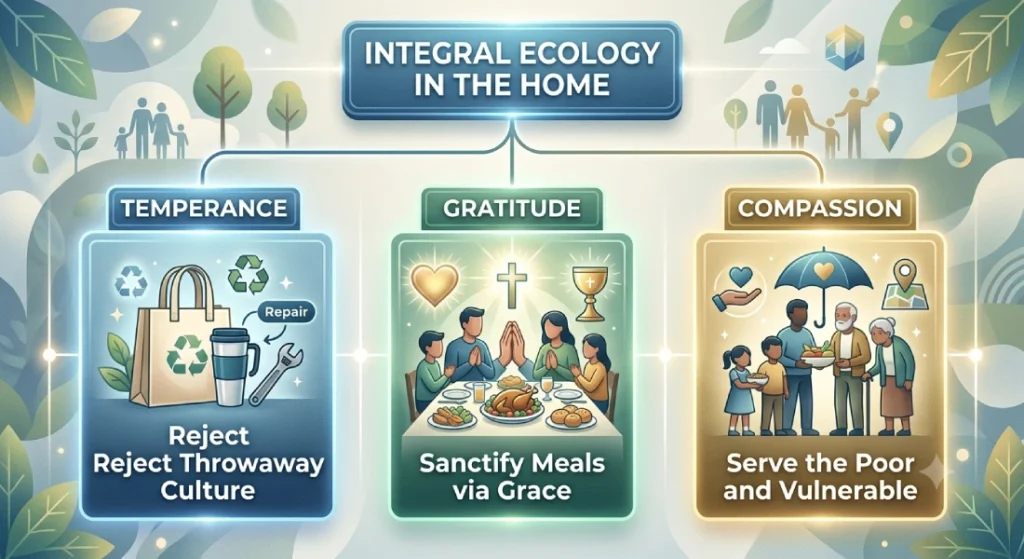
1. Reject the “Throwaway Culture” (Temperance)
- Repair and Reuse: Teach children to care for their belongings, fix broken items when possible, and avoid unnecessary waste.
- Limit Digital Excess: Reduce digital consumption and screen time, reclaiming energy for face-to-face family interaction and outdoor exploration.
2. Sanctify Daily Habits (Gratitude)
- Mealtime Prayers: Pray grace before and after meals, thanking God for the land, farmers, and resources that produced the food.
- Sunday Rest: Honor the Sabbath by spending time together outdoors, observing God’s creation without shopping or commercial entertainment.
3. Practice Generosity (Charity)
- Support Local Families & Farmers: Buy locally sourced food when feasible, supporting ethical land management and fair wages for workers.
- Almsgiving: Donate surplus household items and clothes directly to local shelters rather than discarding usable goods.
Frequently Asked Questions (PAA)
What does the Catechism of the Catholic Church say about animal and environmental care?
The Catechism notes that the seventh commandment requires respect for the integrity of creation (CCC 2415). Animals, plants, and inanimate beings are destined for the common good of past, present, and future humanity. However, CCC 2418 balances this by stating that while it is contrary to human dignity to cause animals to suffer or die needlessly, one should not spend on them resources that should priority-wise relieve human misery.
Is integral ecology associated with political activism?
No. While secular environmental movements may advocate for policies that conflict with Catholic teaching (such as population reduction or radical nature worship), Catholic integral ecology is rooted in moral theology, the sanctity of life, and personal virtue.
How does integral ecology view technological progress?
Catholic teaching does not reject technology. However, Laudato si’ warns against a “technocratic paradigm”—the belief that every problem can be solved purely through technological control without moral guidelines or spiritual discernment (LS 106).
Family Prayer for Biblical Stewardship
Heavenly Father,
Creator of heaven and earth, You have entrusted Your creation to our care and called us to be faithful stewards of Your gifts.
Forgive us for the times we have succumbed to wastefulness, selfishness, or indifference toward the beauty of Your world and the dignity of human life.
Help our family to live the gospel of life fully. Grant us the grace to protect the unborn, care for the poor, honor the dignity of the family, and cherish the earth You have entrusted to us.
Protect our hearts from environmental despair and reckless consumerism. Grant us wisdom, temperance, and gratitude in our everyday decisions, so that our home may reflect Your love and glorify Your Holy Name.
Through Jesus Christ our Lord, who lives and reigns with You in the unity of the Holy Spirit, God, forever and ever.
Amen.
Source: Vatican News — Referenced for topic inspiration. Article content is original.
Continue Your Faith Journey
What Is the Assumption of Mary? Catholic Dogma, Scripture, and Meaning
Explore the Catholic dogma of the Assumption of the Blessed Virgin Mary. Learn how Munificentissimus Deus, Sacred Scripture, and Church Tradition reveal…
Immaculate Conception vs. Virgin Birth: Key Differences Explained
Discover the essential differences between the Immaculate Conception of Mary and the Virgin Birth of Christ. Learn how Catholic dogma, Scripture, and…
The Cost of Discipleship in Matthew 10: What Christ Demands of Catholics
Explore what Matthew 10:37–42 teaches about the cost of discipleship in Catholic tradition. Learn how the order of charity, the cross, and…