
Bible Verses About God’s Purpose for Every Life: Scripture on Human Dignity
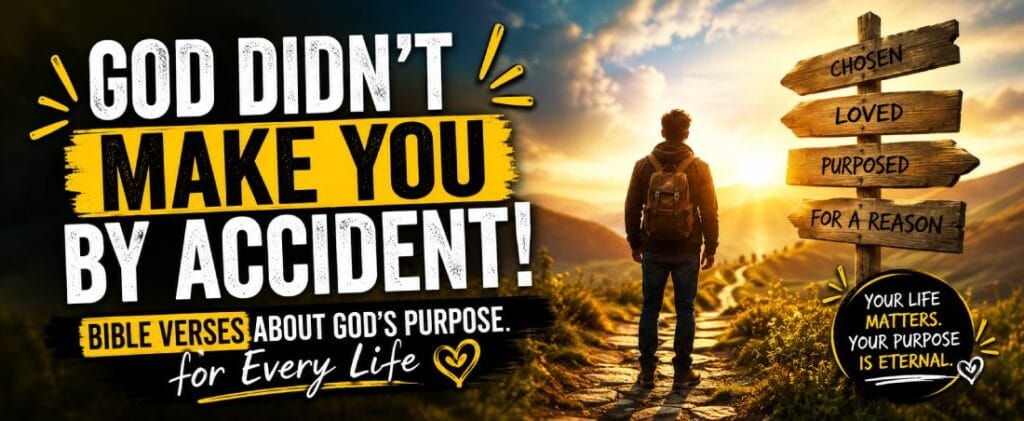
In a culture that measures personal worth by economic productivity, independence, or physical capability, Scripture reveals an unchanging truth: every human life is intentionally created by God from the moment of conception for an unrepeatable purpose.
When we search for Bible verses about God’s purpose, we uncover the foundation of human dignity. The child in the womb, the elderly person experiencing cognitive decline, and the vulnerable person written off by society each bear the sacred image of God (Imago Dei).
Below is an authoritative collection of 45 Scripture passages and Magisterial anchors affirming God’s eternal plan for every human life.
Quick Reference: Biblical & Magisterial Anchors
| Theme / Search Need | Key Scripture Passage | Catholic Doctrinal Anchor |
| Prenatal Human Dignity | Psalm 139:13–16 | Catechism of the Catholic Church 2270 |
| Creation in the Divine Image | Genesis 1:27 | St. Thomas Aquinas (Summa Theologiae I, q. 93) |
| Sovereignty Over Life & Death | Deuteronomy 32:39 | Pope John Paul II (Evangelium Vitae §53) |
| Divine Call & Foreknowledge | Jeremiah 1:5 | Catechism of the Catholic Church 600 |
Scriptures on God’s Plan Before Birth
1. Psalm 139:13
“For you formed my inward parts; you knitted me together in my mother’s womb.”
David affirms that human existence begins long before birth. The creative action of God occurs intentionally within the womb. Every biological pathway and heartbeat reflects divine craftsmanship (CCC 2270).
2. Psalm 139:14
“I praise you, for I am fearfully and wonderfully made. Wonderful are your works; my soul knows it very well.”
Human complexity is not a biological accident. St. Thomas Aquinas observes that the wisdom of God is reflected in physical creation (Summa Theologiae I, q. 44). The beauty of human life from its earliest developmental stages reveals a loving Creator.
3. Psalm 139:16
“Your eyes saw my unformed substance; in your book were written, every one of them, the days that were formed for me, when as yet there was none of them.”
God’s providence encompasses every stage of our existence. Before a human embryo begins to develop distinct features, God’s loving gaze rests upon it.
4. Jeremiah 1:5
“Before I formed you in the womb I knew you, and before you were born I consecrated you; I appointed you a prophet to the nations.”
God’s knowledge of the human person precedes physical formation. Identity and purpose are gifts bestowed by God rather than attributes granted by human society.
5. Galatians 1:15
“But when he who had set me apart before I was born, and who called me by his grace…”
St. Paul acknowledges that divine grace guides our lives from before birth. To God, all moments of time are present in their immediacy (CCC 600), ordering His grace so that human freedom may fulfill His eternal design.
6. Isaiah 49:1
“The Lord called me from the womb, from the body of my mother he named my name.”
Identity is not self-constructed after birth. God establishes human identity and vocation within the mother’s womb.
7. Psalm 22:9
“Yet you are he who took me from the womb; you made me trust you at my mother’s breasts.”
Divine care accompanies human life across every developmental milestone, establishing trust from infancy onward.
Verses Affirming God’s Sovereign Design and Image (Imago Dei)
8. Genesis 1:27
“So God created man in his own image, in the image of God he created him; male and female he created them.”
The Imago Dei is stamped upon humanity at the moment of conception. Human dignity does not depend on developmental viability, physical ability, or social utility.
9. Genesis 2:7
“Then the Lord God formed the man of dust from the ground and breathed into his nostrils the breath of life, and the man became a living creature.”
God is the author and source of physical and spiritual life. Human life is sacred because it originates directly from the divine breath (CCC 2258).
10. Job 31:15
“Did not he who made me in the womb make him? And did not one fashion us in the womb?”
Job recognizes universal human equality. The same Creator fashions both the powerful and the vulnerable, leaving no room for partiality or discrimination.
11. Job 33:4
“The Spirit of God has made me, and the breath of the Almighty gives me life.”
Existence is maintained moment-by-moment through divine power. Human life is a continuous gift from the Holy Spirit.
12. Psalm 100:3
“Know that the Lord, he is God! It is he who made us, and we are his; we are his people, and the sheep of his pasture.”
We belong to God by right of creation. Because human beings are not self-created, no individual or government possesses absolute ownership over human life.
13. Isaiah 42:5
“Thus says God, the Lord, who created the heavens… who gives breath to the people on it and spirit to those who walk in it.”
The God who creates the cosmos actively sustains every human life. No person is invisible to the Almighty.
14. Ephesians 1:11
“In him we have obtained an inheritance, having been predestined according to the purpose of him who works all things according to the counsel of his will.”
God governs creation with infinite wisdom. His providence encompasses the creation, preservation, and divine calling of every human person.
15. Romans 8:29
“For those whom he foreknew he also predestined to be conformed to the image of his Son…”
God’s foreknowledge includes His eternal plan to restore humanity through Jesus Christ, inviting every person to share in divine life through grace (CCC 1999).
16. Acts 17:26
“And he made from one man every nation of mankind to live on all the face of the earth, having determined allotted periods and the boundaries of their dwelling place.”
The timing and circumstances of our existence are governed by divine providence. Human life is never a matter of chance.
17. Ephesians 2:10
“For we are his workmanship, created in Christ Jesus for good works, which God prepared beforehand, that we should walk in them.”
Every human person is a masterpiece (poiema) of divine art. God prepares specific acts of charity and service for each person to fulfill.
18. Psalm 119:73
“Your hands have made and fashioned me; give me understanding that I may learn your commandments.”
Physical creation is directed toward a moral and spiritual end: knowing, loving, and obeying God.
Scriptures on the Inviolable Sanctity of Life
19. Genesis 9:6
“Whoever sheds the blood of man, by man shall his blood be shed, for God made man in his own image.”
The absolute prohibition against murder is rooted directly in the Imago Dei. To assault human life is to attack the image of the Creator.
20. Exodus 20:13
“You shall not murder.”
The Fifth Commandment draws an inviolable boundary around human life. Pope John Paul II affirms in Evangelium Vitae (§53) that direct killing of innocent human beings is intrinsically evil.
21. 1 Corinthians 3:16
“Do you not know that you are God’s temple and that God’s Spirit dwells in you?”
Through Baptism, the human person is elevated to a temple of the Holy Spirit (CCC 1265). Even prior to baptism, every person possesses an inherent capacity to receive divine grace.
22. 1 Corinthians 6:19–20
“Or do you not know that your body is a temple of the Holy Spirit within you… You are not your own, for you were bought with a price. So glorify God in your body.”
Redeemed by the Precious Blood of Jesus Christ, the Christian body is sacred ground. We are called to treat our bodies and those of others with reverence.
23. 1 Corinthians 3:17
“If anyone destroys God’s temple, God will destroy him. For God’s temple is holy, and you are that temple.”
Vandalizing human life is an offense against the holiness of God. God remains the defender of the defenseless.
24. 2 Corinthians 5:4
“For while we are still in this tent, we groan, being burdened… so that what is mortal may be swallowed up by life.”
Human longing points naturally toward eternal life. Catholic moral theology defends biological life while ordering it toward eternal salvation.
25. John 10:10
“The thief comes only to steal and kill and destroy. I came that they may have life and have it abundantly.”
Jesus Christ came to bestow full, abundant, and eternal life. Culture and practices that promote death align with the adversary, whereas Christ builds a culture of life.
26. Proverbs 6:16–17
“There are six things that the Lord hates… hands that shed innocent blood.”
The shedding of innocent human blood—most notably through abortion or euthanasia—is explicit in Scripture as an offense against divine justice.
Verses on God’s Unfailing Promises and Purpose
27. Jeremiah 29:11
“For I know the plans I have for you, declares the Lord, plans for welfare and not for evil, to give you a future and a hope.”
God’s intentions toward His creation are oriented toward ultimate good, spiritual flourishing, and hope.
28. Romans 8:28
“And we know that for those who love God all things work together for good, for those who are called according to his purpose.”
God’s providence weaves all suffering, weakness, and hardship into a higher good for those who yield to His grace.
29. Psalm 138:8
“The Lord will fulfill his purpose for me; your steadfast love, O Lord, endures forever. Do not forsake the work of your hands.”
We can rely on God to complete His work of grace within us. He never abandons His creation.
30. Proverbs 19:21
“Many are the plans in the mind of a man, but it is the purpose of the Lord that will stand.”
Human social trends and ideologies change, but God’s truth regarding human dignity remains firm across history.
31. Psalm 33:11
“The plans of the Lord stand firm forever, the purposes of his heart through all generations.”
The moral law and divine order span every generation, outlasting secular ideologies.
32. Isaiah 14:24
“The Lord of hosts has sworn: ‘As I have planned, so shall it be, and as I have purposed, so shall it stand.'”
God’s sovereign purpose for life cannot be thwarted by human laws or cultural shifts.
33. Isaiah 46:10
“Declaring the end from the beginning… saying, ‘My counsel shall stand, and I will accomplish all my purpose.'”
God views all human history simultaneously. Every life He calls into being fits within His salvation plan.
34. Proverbs 16:9
“The heart of man plans his way, but the Lord establishes his steps.”
While human beings exercise free will, divine providence guides history toward God’s ultimate purpose.
Scriptures Affirming God’s Absolute Sovereignty
35. Romans 9:20
“But who are you, O man, to answer back to God? Will what is molded say to its molder, ‘Why have you made me like this?'”
Human beings do not determine the value of creation. The Creator alone establishes the purpose and dignity of every vessel.
36. Romans 9:21
“Has the potter no right over the clay, to make out of the same lump one vessel for honorable use and another for dishonorable use?”
God possesses absolute authority over human life and creation.
37. Isaiah 64:8
“But now, O Lord, you are our Father; we are the clay, and you are our potter; we are all the work of your hand.”
Our relationship with God as Father and Creator grounds our human dignity. We are handcrafted by God.
38. Deuteronomy 32:39
“See now that I, even I, am he, and there is no god beside me; I kill and I make alive; I wound and I heal…”
God alone is Lord over life and death. Euthanasia and direct abortion usurp a prerogative that belongs to God alone (Evangelium Vitae §53).
39. 1 Samuel 2:6
“The Lord kills and brings to life; he brings down to Sheol and raises up.”
Hannah’s prayer confirms that human life is held within God’s sovereign hands from start to finish.
40. Job 12:10
“In his hand is the life of every living thing and the breath of all mankind.”
Every human breath is sustained by divine love. No person, regardless of physical or cognitive limitation, is abandoned by God.
41. Romans 11:36
“For from him and through him and to him are all things. To him be glory forever. Amen.”
All human existence originates in God, is sustained by Him, and returns to Him.
42. Colossians 1:17
“And he is before all things, and in him all things hold together.”
Jesus Christ, the Incarnate Word, holds all creation together. Apart from His sustaining power, nothing remains in existence.
43. Revelation 4:11
“Worthy are you, our Lord and God, to receive glory and honor and power, for you created all things, and by your will they existed…”
Every person exists because God willed them into being out of love. Creation is an act of divine love.
44. Acts 17:24–25
“The God who made the world… gives to all mankind life and breath and everything.”
God is completely self-sufficient, yet He generously bestows life upon humanity. Human existence is a gift.
45. Matthew 10:29–31
“Are not two sparrows sold for a penny? And not one of them will fall to the ground apart from your Father… Fear not, therefore; you are of more value than many sparrows.”
Christ confirms that the Father tracks every detail of our lives. If God cares for the smallest creatures, His care for human beings is infinite.
Conclusion: Living the Gospel of Life
These 45 passages demonstrate that human value is not conditional. It is established by God’s creative design and divine love.
As Pope John Paul II wrote in Evangelium Vitae:
“The Gospel of life is not simply a reflection on human existence… it is a luminous, life-giving truth that demands to be proclaimed with courage.”
Standing for human dignity requires prayer, charity, advocacy, and direct support for women, families, the sick, and the elderly. By anchoring our lives in these scriptural truths, we participate in building a culture that welcomes and protects every human life.
Frequently Asked Questions
The Catholic Church teaches that human life begins at the moment of conception (CCC 2270). From this initial instant, the embryo possesses the full dignity of a human person and must be respected, protected, and defended absolutely in its moral rights, most fundamentally the right to life.
Imago Dei is Latin for “Image of God” (Genesis 1:27). Catholic theology teaches that human dignity is derived directly from being created in God’s image rather than from individual productivity, developmental stage, or physical capability. This makes all innocent human life inviolable.
Physical life is a divine gift given to all humans at conception, carrying the Imago Dei. However, the supernatural indwelling of the Holy Spirit (Inhabitatio Spiritus Sancti) is conferred through Sanctifying Grace via Baptism (CCC 1265), elevating the person into a child of God and a living temple of the Spirit.
Continue Your Faith Journey
Catholic Church Teaching on IVF: Doctrine, Dignity, and Moral Alternatives
Explore the Catholic Church's official teaching on IVF, rooted in the dignity of human life and marital union. Learn about licit alternatives…
What the Catholic Church Teaches About Surrogacy: Dignity, Marriage, and the Gift of Life
Explore what the Catholic Church teaches about surrogacy, human dignity, and the sacred marital covenant. Learn why the Magisterium protects children as…
Venerable Jérôme Lejeune, Pope Leo XIV, and the Inviolable Dignity of Human Life
Explore how Venerable Jérôme Lejeune's scientific witness and Catholic teaching defend the sacred dignity of human life against modern programmed death. Learn…