
Reclaiming God’s Design: What the Shift in Birth Control Acceptance Means for the Church
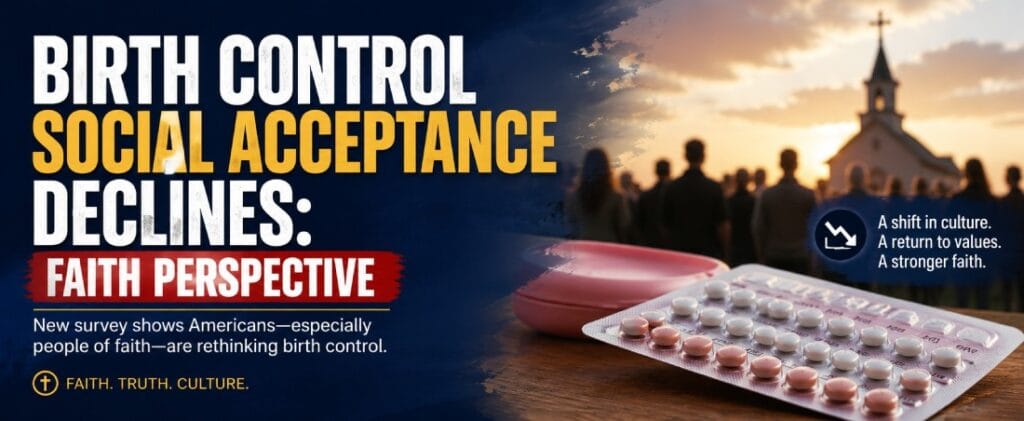
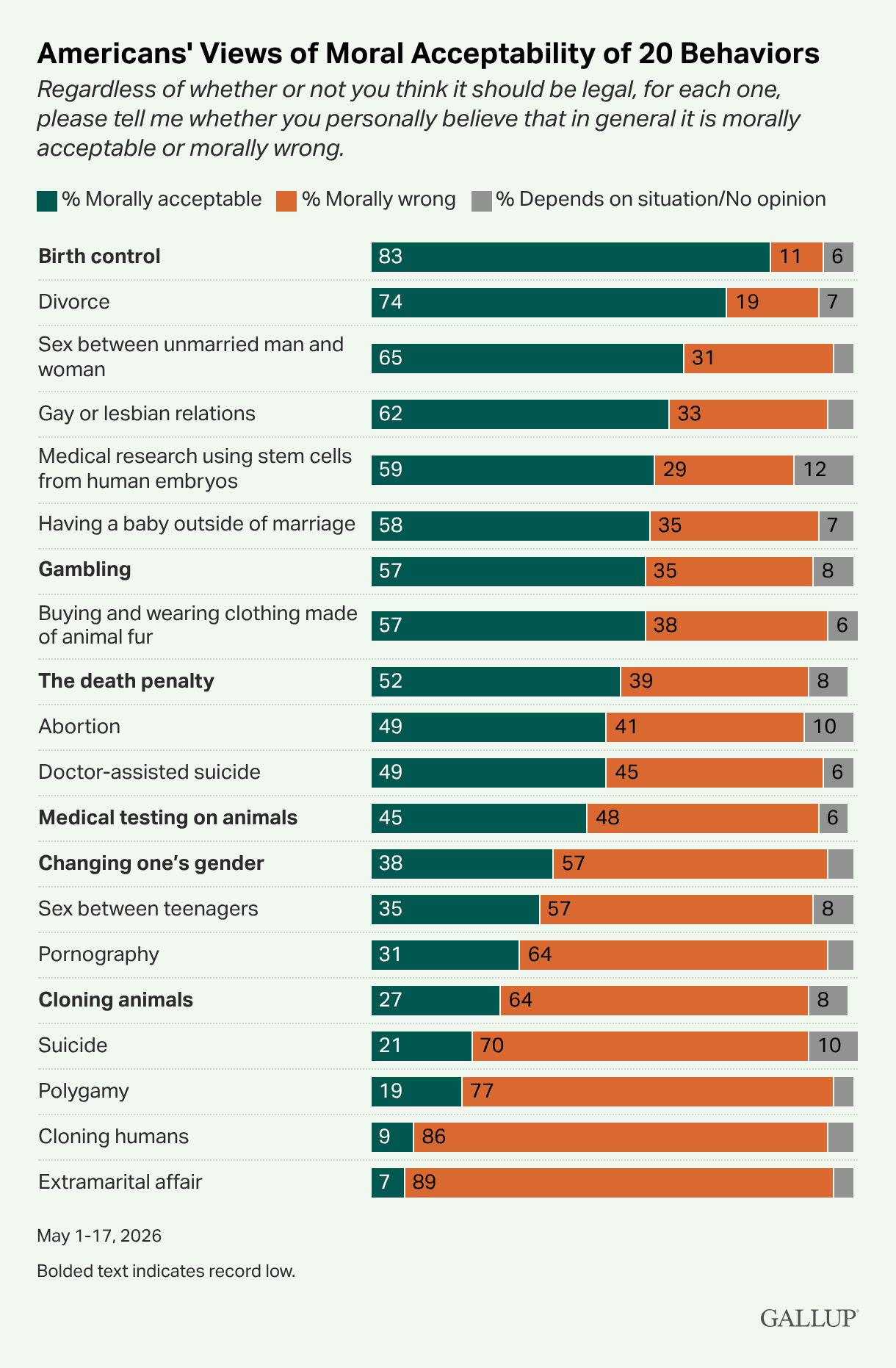
Something significant is shifting in the American cultural landscape. Recent data from the Gallup Values and Beliefs Survey reveals a measurable tremor in public attitudes toward marriage, family, and human sexuality. Social acceptance of birth control has dropped by seven percentage points, while acceptance of having children outside of marriage has fallen by nine points.
These double-digit and near-double-digit shifts represent more than minor statistical noise. After decades of cultural drift away from God’s design for life and relationships, these figures suggest that society is reconsidering the normalized assumptions of the sexual revolution. For the Catholic Church, this moment presents an unprecedented opening to articulate the beauty of Catholic moral theology and the true dignity of human love.
At-a-Glance: Cultural Data vs. Catholic Dogma
| Cultural Shift (Gallup Data) | Magisterial Anchor & Church Teaching | Pastoral Application |
| 7-Point Drop in birth control social acceptance | Inseparable Conjugal Order: Every marital act must remain open to life (Humanae Vitae, 12; CCC 2366). | Educate couples in Natural Family Planning (NFP) and periodic continence. |
| 9-Point Drop in accepting out-of-wedlock birth | Sacramental Foundation: Children have a right to be conceived within Holy Matrimony (CCC 2378). | Strengthen parish marriage preparation and support covenantal family units. |
| Growing Skepticism toward anti-fertility culture | Dignity of Life: Children are gifts from God, not burdens to be managed (Evangelium Vitae, 13; CCC 2378). | Foster a parish culture that welcomes children and supports mothers in need. |
Beyond the Statistics: The Re-Discovery of Natural Law
For over half a century, modern society has treated artificial contraception as a morally neutral standard of personal convenience. The cultural narrative insisted that biological fertility was a problem to be solved rather than a God-given gift to be stewarded. However, as secular acceptance begins to fracture, society is encountering the undeniable reality of natural law.
Catholic moral theology teaches that God’s law is written upon the human heart (cf. Romans 2:15). St. Thomas Aquinas famously defined the natural law as the rational creature’s participation in the eternal law of God (Summa Theologiae, I-II, q. 91, a. 2). When human beings attempt to alter the inherent order of bodily design, moral and social instability inevitably follow.
The statistical drop in birth control acceptance reflects a growing recognition that separating fertility from human intimacy has fractured relationships, devalued human life, and obscured personal identity. Rather than viewing human bodies as raw material for manipulation, people are beginning to rediscover that human biology possesses intentional design, purpose, and intrinsic dignity.
The Contraceptive Mentality and the Anti-Life Ethic
In his landmark 1995 encyclical Evangelium Vitae, Pope St. John Paul II identified a deep theological truth: a direct connection exists between the “contraceptive mentality” and the broader culture of death (EV 13). When a culture views human fertility as an inconvenient illness to be chemically or surgically suppressed, human life itself becomes conditional.
The Catholic Church’s opposition to artificial birth control is grounded in divine truth and natural law. In his prophetic 1968 encyclical Humanae Vitae, Pope Paul VI reaffirmed that the conjugal act possesses two intrinsic, indivisible meanings: the unitive and the procreative (HV 12). God Himself established an inseparable connection between these two aspects, which man may not break on his own initiative (HV 12).
When couples deliberately sever these meanings through artificial contraception, they alter the nature of marital love. As the Catechism of the Catholic Church explains, deliberate contraception acts as a barrier to total self-giving, replacing full mutual self-surrender with a conditional union (CCC 2370). Re-establishing society’s respect for human life requires healing this contraceptive mentality at its root.
The Sacramental Dignity of Holy Matrimony
The declining cultural acceptance of out-of-wedlock childbearing points to another fundamental truth written into human nature: children thrive when born into covenantal stability. Sociology repeatedly confirms what Sacred Scripture and Holy Tradition have taught for millennia—the married, two-parent home offers the safest, most stable environment for raising children.
Scripture reveals that marriage is no mere human invention or changeable social contract:
“Therefore a man leaves his father and his mother and cleaves to his wife, and they become one flesh.” (Genesis 2:24, RSV-CE)
Our Lord Jesus Christ cited this passage directly to affirm the lifelong indissolubility of marriage (cf. Matthew 19:6). Furthermore, Christ elevated the marriage covenant between baptized persons to the supernatural dignity of a Sacrament (CCC 1601).
Through the Sacrament of Holy Matrimony, spouses receive specific graces to love each other with the sacrificial, enduring love of Christ for His Church (cf. Ephesians 5:25; CCC 1642). Marriage is the divine sanctuary where covenant shelters the vulnerable, where permanence provides security, and where children are welcomed as the supreme gift of marital love.
Scripture Speaks: Children as Divine Blessings
The secular mindset often treats children as economic liabilities or obstacles to personal self-fulfillment. In contrast, Sacred Scripture presents a radical, joyful vision of childbearing and family life.
As the Psalmist beautifully proclaims:
“Behold, sons are a heritage from the Lord, the fruit of the womb a reward. Like arrows in the hand of a warrior are the sons of one’s youth. Happy is the man who has his quiver full of them!” (Psalm 127:3–5, RSV-CE)
Every child—whether conceived as planned or unplanned by human calculations—is known, willed, and loved by God from all eternity (cf. Jeremiah 1:5). The Catechism reminds us that a child is not something owed to parents, but a gift; the “supreme gift of marriage” (CCC 2378).
When society treats fertility as a biological hazard rather than a sacred gift, it inverts the Creator’s design. The recent shift in public opinion indicates a cultural hunger to rediscover this timeless truth: openness to human life is not an oppressive burden, but an act of profound trust in God’s providence.
Understanding Responsible Parenthood vs. Providentialism
While Catholic theology firmly rejects artificial contraception, the Church does not teach providentialism—the erroneous belief that married couples must have as many children as physically possible without moral reflection. Rather, Catholic moral theology calls spouses to practice Responsible Parenthood (generatio responsabilis) (Humanae Vitae, 10; CCC 2368).
Responsible parenthood requires spouses to exercise prudent, prayerful discernment regarding their physical, financial, psychological, and social circumstances (HV 10). When serious reasons exist to space or limit births, couples may legitimately utilize periodic continence and Natural Family Planning (NFP) (Humanae Vitae, 16; CCC 2370).
NFP differs fundamentally from artificial contraception. Contraception actively renders a fertile conjugal act infertile, severing the unitive from the procreative meaning (HV 14; CCC 2370). In contrast, NFP respects God’s natural biological rhythms by choosing abstinence during fertile periods, preserving the integrity of the conjugal act whenever spouses unite (CCC 2370). NFP fosters mutual respect, self-mastery, and spiritual unity between spouses.
The Mission of the Domestic Church in a Searching Culture
As cultural assumptions shift, Catholic Christians must refrain from self-righteous gloating or political triumphalism. Instead, we are called to teach God’s truth with unyielding clarity and love our neighbor with Christ-like devotion. If people are reconsidering long-held errors about sexuality, marriage, and life, they need the authentic witness of the Church.
The Church calls the Christian home the Domestic Church (Ecclesia Domestica) (CCC 1655–1658). It is within the family that the next generation learns the sanctity of marriage, the joy of sacrifice, and the love of God.
To meet the demands of this cultural moment, our parishes and communities must act with practical vigor:
- Revitalize Marriage Preparation: Parishes must provide robust catechesis on Catholic moral theology, the Sacramental reality of marriage, and Theology of the Body long before engagement.
- Promote Authentic Fertility Awareness: Catholic healthcare systems and parishes should make instruction in Natural Family Planning accessible to all couples.
- Support Mothers and Families: We must offer compassionate financial, material, and spiritual aid to single mothers and struggling families, erasing social stigma while upholding God’s moral standards.
- Welcome Large Families: Catholic communities must celebrate open-handed generosity in childbearing, eliminating cultural attitudes that treat third or fourth children as planning failures.
Frequently Asked Questions
The Catholic Church teaches that artificial contraception is intrinsically evil because it deliberately severs the unitive and procreative meanings of the marital act (Humanae Vitae, 14; CCC 2370). Spouses are called to honor the natural design of fertility, keeping every conjugal act open to life.
Yes. Catholic moral theology permits couples to space births for serious physical, financial, or psychological reasons through Natural Family Planning (NFP) and periodic continence (Humanae Vitae, 16; CCC 2368). NFP respects God’s natural biological rhythms without altering the intrinsic order of the conjugal act.
Catholic theology teaches that children are the supreme gift of marriage and deserve to be conceived, born, and raised within the permanent, sacramental covenant of Holy Matrimony (CCC 1601, 2378). Covenantal marital stability offers the optimal environment for human flourishing and child development.
The “Domestic Church” (Ecclesia Domestica) refers to the Christian family as a living sanctuary of faith, grace, and prayer (CCC 1655–1658). Within the home, parents evangelize their children, cultivate moral virtues, and manifest God’s self-sacrificing love to the surrounding culture.
Conclusion: A Time for Joyful Witness
The recent shift in public opinion offers a promising glimpse of cultural renewal. Yet, statistical trends alone cannot transform society; only the grace of Jesus Christ operating through His Church can heal human hearts.
We stand before a unique window of evangelization. By living as vibrant domestic churches, defending the sanctity of human life from conception to natural death, and proclaiming the beauty of Holy Matrimony, we give witness to a truth the world is eager to rediscover. Let us pray for the wisdom to teach without compromise and the charity to welcome all into God’s divine plan.
Continue Your Faith Journey
Catholic Church Teaching on IVF: Doctrine, Dignity, and Moral Alternatives
Explore the Catholic Church's official teaching on IVF, rooted in the dignity of human life and marital union. Learn about licit alternatives…
Venerable Jérôme Lejeune, Pope Leo XIV, and the Inviolable Dignity of Human Life
Explore how Venerable Jérôme Lejeune's scientific witness and Catholic teaching defend the sacred dignity of human life against modern programmed death. Learn…
Dobbs Decision Anniversary: Why the Battle for Life Has Moved from the Courts to the Heart
On the Dobbs decision anniversary, the pro-life mission shifts from courtrooms to human hearts. Discover how Catholic teaching and Evangelium Vitae call…