
Spiritual Motherhood in Catholic Teaching: Embracing God’s Calling for Every Woman
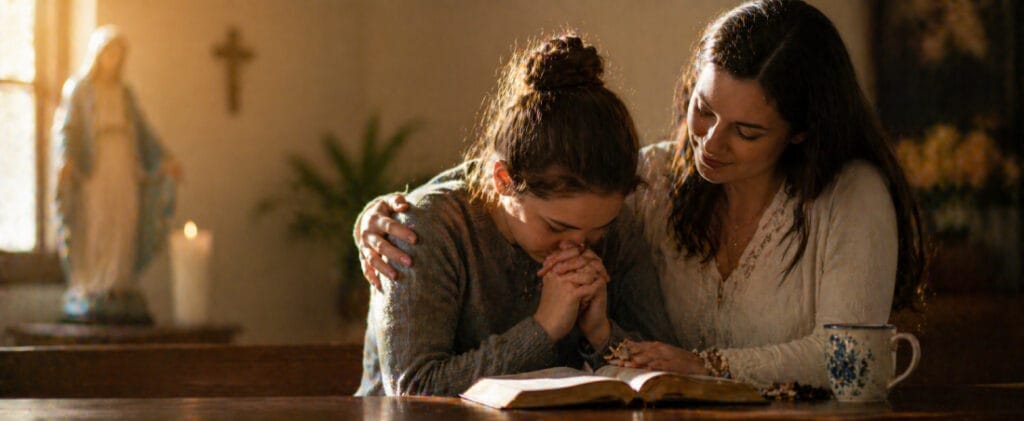
Have you ever felt God calling you to a path completely different from what you imagined? For many Catholic women, discovering the doctrine of spiritual motherhood begins with this exact surrender—a gift that often arrives through unexpected circumstances yet carries the clear mark of divine providence.
A recent encounter outside a campus chapel brought this reality into clear focus. Standing on the steps on a warm spring evening, I said goodbye to a student who had transformed over his college years. When we first met during his freshman year, he was withdrawn, overwhelmed, and hesitant to engage with others. I prayed for his healing, spiritual maturation, and peace. Years later, he stood before me as a confident young man ready to graduate and step faithfully into his vocation. In that moment, the depth of God’s plan for the feminine vocation became undeniable.
The deepest truth about spiritual motherhood is that it is not limited to biological maternity. It is a fundamental vocation written into the dynamic structure of the feminine soul, extending to every woman regardless of her state in life.
What Is Spiritual Motherhood in Catholic Teaching?
Saint John Paul II articulated that every woman is called to spiritual motherhood—whether through physical motherhood, consecrated life, or single life lived in generous service. As he explained in his Apostolic Letter Mulieris Dignitatem, “God entrusts the human being to her in a special way”. Spiritual motherhood is never a consolation prize for those who do not bear biological children; it is an essential dimension of the “feminine genius” created in the image of God.
Scripture highlights the depth of divine love using maternal imagery: “Can a mother forget her infant, be without tenderness for the child of her womb? Even should she forget, I will never forget you” (Isaiah 49:15). As the Catechism of the Catholic Church teaches, God transcends human gender—He is neither man nor woman, but the origin and archetype of all fatherhood and motherhood (CCC 239). Therefore, this tender love of God is uniquely reflected and expressed through all women who open their hearts to His grace, participating directly in His divine care for souls.
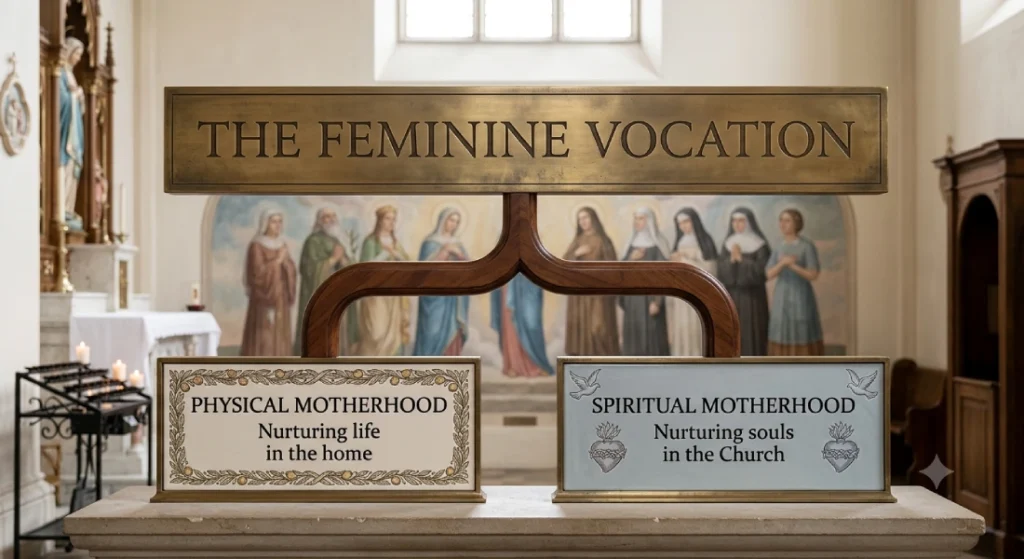
The Heart of the Call: Cooperation with Grace and Marian Fiat
The essence of spiritual motherhood consists in nurturing souls, interceding in persistent prayer, and participating in Christ’s redemptive work through self-gift. Saint Thomas Aquinas notes that the highest act of charity is leading others toward their ultimate end, which is union with God (Summa Theologiae, II-II, q. 23). Spiritual mothers actively participate in this work of grace.
This calling requires continuous trust and surrender, modeled perfectly by Our Lady at the Annunciation:
- The Fiat of Mary: When Mary answered, “May it be done to me according to your word” (Luke 1:38), she did not possess full foresight of the sorrow and glory ahead. Yet her complete trust opened the door for the Incarnation.
- Active Cooperation: Marian surrender is not passive resignation; it is active cooperation with divine grace (CCC 2014).
- Motherhood at the Cross: Jesus explicitly established Mary’s spiritual motherhood over the Church from the Cross: “When Jesus saw his mother and the disciple there whom he loved, he said to his mother, ‘Woman, behold, your son.’ Then he said to the disciple, ‘Behold, your mother'” (John 19:26–27). Mary’s maternal care extends to all whom Christ came to save (CCC 501).
Comparing Expressions of Motherhood in Catholic Tradition
| Dimension | Physical Motherhood | Spiritual Motherhood |
| Primary Scope | Nurturing bodily life, moral foundation, and faith within the domestic family. | Nurturing the life of grace, virtue, and spiritual healing in the Church and society. |
| Primary Actions | Physical nourishment, daily sacrifice, instruction in virtue, family prayer. | Intercessory prayer, spiritual accompaniment, mentorship, hospitality, works of mercy. |
| Biblical Archetype | Hannah presenting Samuel to the Lord (1 Samuel 1). | Our Lady interceding at Cana and comforting disciples at the Cross (John 2, John 19). |
| Magisterial Source | Casti Connubii (Pope Pius XI) | Mulieris Dignitatem, #18–21 (Pope St. John Paul II) |
How Campus Ministry and Daily Life Reveal Spiritual Motherhood
Catholic campus ministry provides a vivid example of spiritual motherhood in action. Young adults navigating higher education face significant spiritual trials—loneliness, confusion regarding moral truth, pressures to abandon their faith, and existential anxiety. They desperately need spiritual mothers who will invest in their spiritual well-being, intercede for them during spiritual dryness, and offer grounded guidance.
The student mentioned earlier did not mature simply through administrative programs or academic coursework. He grew because someone chose to love him with the heart of a spiritual mother—praying persistently, listening attentively, and recognizing his worth in Christ.
This maternal dimension operates across every sphere of life:
- Consecrated Religious: Offering total self-consecration to Christ as spouses of the Church, serving as mothers to all souls placed in their spiritual care.
- Single Laywomen: Offering their time, counsel, and professional gifts to parishes, charities, and communities, uplifting the vulnerable.
- Teachers, Nurses, and Mentors: Directing daily labor toward affirming the inherent dignity of every human person.
- Godmothers and Aunts: Guiding nieces, nephews, and godchildren toward sacramental maturity and authentic Christian living.
Living Out Your Vocation as a Spiritual Mother
Every act of genuine feminine love participates in the spiritual motherhood that Catholic doctrine holds sacred. When women surrender personal control and align their lives with God’s design, they discover an eternal fruitfulness that human effort alone cannot achieve.
To begin practicing spiritual motherhood today:
- Adopt a Soul in Prayer: Commit to daily intercession for a specific person who is struggling with faith, grief, or personal trials.
- Offer Works of Mercy: Practice hospitality, spiritual counsel, or comfort for someone isolated in your community.
- Seek Mary’s Intercession: Ask the Blessed Virgin Mary to form your heart after her own, enabling you to bring Christ to those around you.
Frequently Asked Questions (FAQ)
Is spiritual motherhood only for single or consecrated women?
No. Every Catholic woman is called to spiritual motherhood. While consecrated religious and single women live out this calling without biological children, married mothers are also called to exercise spiritual motherhood toward their husbands, Godchildren, parish communities, and neighbors.
Does calling God’s love “maternal” mean God has a gender?
No. According to paragraph 239 of the Catechism of the Catholic Church, God transcends all human categories, including biological sex. God is neither man nor woman; He is pure spirit. Scripture uses both paternal and maternal imagery as analogies to express His infinite care, but God remains the Eternal Father, Son, and Holy Spirit.
How does Saint Thomas Aquinas explain the spiritual care of others?
Saint Thomas Aquinas emphasizes in the Summa Theologiae (II-II, q. 32) that spiritual almsgiving—such as instructing the ignorant, counseling the doubtful, and praying for others—surpasses physical almsgiving because it directly serves the immortal soul and orders the human person toward eternal life.
Source: Catholic Exchange
Continue Your Faith Journey
Catholic Prayer for Husband Addicted to Porn: A Spiritual Warfare & Relational Healing Guide
Discover how Catholic spiritual warfare, Eucharistic grace, and deprecatory deliverance prayers can help free a husband from pornography addiction. Learn to combine…

What Is Natural Family Planning? Catholic Teaching, Theology, and Practice
Explore Catholic teaching on Natural Family Planning (NFP). Learn how Humanae Vitae, the Catechism, and modern fertility awareness methods protect the unitive…
Why Do Catholics Make the Sign of the Cross? Meaning, History, and Spiritual Power
Discover why Catholics make the sign of the cross. Explore its biblical origins, bodily symbolism, patristic history, and spiritual power as an…