Pope Saint Evaristus: History, Papacy, and Apostolic Legacy
| Attribute | Historical & Ecclesiastical Record |
| Papal Reign | c. 97/99 AD – c. 105/107 AD (Fifth Bishop of Rome) |
| Predecessor | Pope Saint Clement I |
| Successor | Pope Saint Alexander I |
| Feast Day | October 26 |
| Key Innovations | Division of Rome into parish tituli; assignment of seven regional deacons |
| Burial Site | Vatican Hill, near the Tomb of Saint Peter |
| Primary Sources | St. Irenaeus of Lyons (Adversus Haereses); Liber Pontificalis |
The Fifth Successor of Peter: An Apostolic Bridge
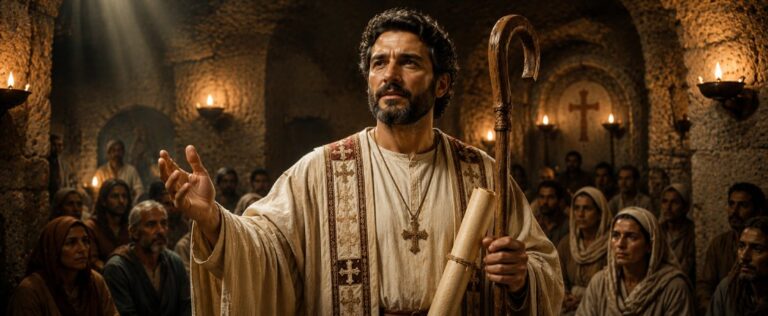
Pope Saint Evaristus governed as the fifth Bishop of Rome at the turn of the first century, succeeding Pope Saint Clement I. Guiding the Catholic Church during the critical transition from the apostolic age to the early patristic period, his papacy spanned from approximately 97 AD to 105 AD under Emperors Nerva and Trajan. During this era, professing the Christian faith remained an illicit and capital offense under Roman imperial law. Despite relentless suspicion, uncertainty, and persecution, Evaristus provided vital administrative stability, preserved doctrinal orthodoxy, and safeguarded the unity of believers.
His pontificate served as an enduring institutional bridge between the living memory of the Twelve Apostles and the emerging structure of the Church. Rather than allowing imperial oppression to scatter the faithful, Evaristus organized ecclesiastical governance and consolidated liturgical worship across the capital of the Roman Empire. His legacy demonstrates how divine providence and sacramental order sustain the Church through the fiercest earthly trials.
Historical Origins and Apostolic Formation
Surviving biographical details concerning the early life of Saint Evaristus remain limited in contemporary documentation. Ancient ecclesiastical records, most notably the Liber Pontificalis, record that he was of Hellenic Jewish heritage and born in Bethlehem of Judea. Other early traditions connect him with Hellenistic Jewish communities that had integrated throughout major Roman cities during the apostolic period.
Because he lived so close to the time of the Apostles, Evaristus likely received Christian catechesis from disciples who had personally known Saint Peter and Saint Paul. This proximate connection to the Apostles placed him within the living transmission of Sacred Scripture and Sacred Tradition (CCC 80–83). In this formative period, Catholic doctrine was handed on directly through oral preaching, sacramental worship, and personal discipleship.
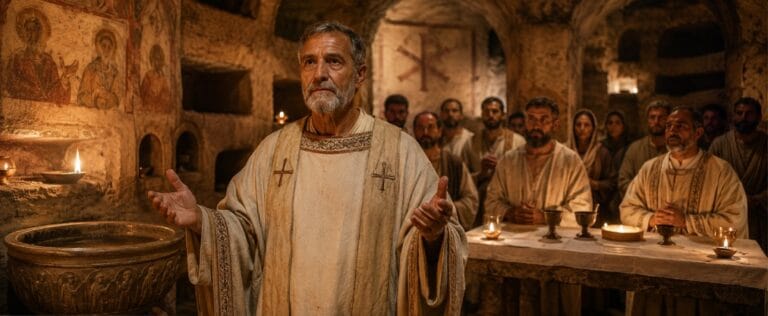
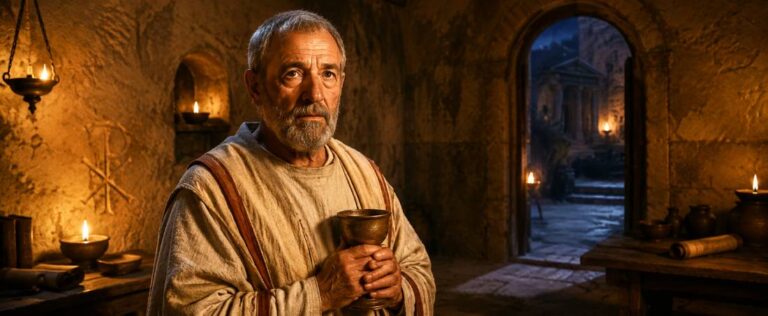
The Roman Church of his youth was frequently forced underground to escape imperial detection. Faithful converts gathered in domestic house churches (domus ecclesiae), private dwellings, and subterranean catacombs to pray and celebrate the Holy Eucharist. Embracing Christianity required exceptional moral fortitude, as discovery brought social ostracism, confiscation of goods, imprisonment, or death.
Petrine Election Under Nerva and Trajan
Saint Evaristus was elected Bishop of Rome around 97 AD, following the death of Pope Saint Clement I. His election occurred during the brief principate of Emperor Nerva and the subsequent reign of Emperor Trajan. While Trajan did not issue an active empire-wide edict of extermination, imperial policy mandated that any Christian who refused to venerate Roman pagan gods or the emperor was guilty of capital treason.
During this period, the Catholic Church faced rapidly expanding pastoral demands. Christianity was growing across the empire, yet believers possessed no legal standing or civil protections. Sudden, violent persecutions erupted at the whim of local provincial magistrates and suspicious civic mobs.
Simultaneously, the Church faced internal threats from early speculative errors and Gnostic divisions. Faithful oversight was urgently required to maintain uniformity in liturgical worship and theological belief. Evaristus was elevated to the Petrine See due to his proven wisdom, pastoral prudence, and steadfast faith. His governing authority proceeded directly from the Petrine Office through unbroken apostolic succession (CCC 861, 882), while his moral authority and pastoral fruitfulness were magnified by heroic personal sanctity and humility (cf. St. Thomas Aquinas, Summa Theologiae, II-II, q. 10, a. 10).
Structural Governance: The Roman Tituli and the Diaconate
As the Christian population in Rome multiplied, informal domestic gatherings no longer sufficed for systematic pastoral care. Saint Evaristus initiated two structural developments that laid the groundwork for modern diocesan organization.
Division of Rome into Parish Tituli
According to historical traditions recorded in the Liber Pontificalis, Pope Saint Evaristus formally divided the City of Rome into distinct parish boundaries known as tituli. He assigned ordained presbyters to govern these individual territorial titles. Prior to this arrangement, priests ministered across disparate household churches without clearly assigned canonical jurisdictions.
By establishing specific presbyteral charges, Evaristus ensured that the faithful received consistent sacramental administration and catechetical instruction. These tituli functioned as authentic centers of Christian communion, preserving sacramental unity with the Bishop of Rome despite recurring imperial threats.
Ordering the Seven Regional Deacons
Early historical sources also credit Pope Evaristus with formally appointing seven deacons to assist the Bishop of Rome in his episcopal ministry. This structural decision mirrored the apostolic archetype established in Acts 6:1–6, where the Apostles ordained seven men to oversee charitable assistance.
These ordained deacons exercised essential liturgical, administrative, and charitable responsibilities (CCC 1569–1570). Liturgically, they served alongside the Pope during the Holy Sacrifice of the Mass, proclaimed the Gospel, and guarded the sacred mysteries. Administratively, they directed the Church’s charitable works, distributing alms, caring for poor widows, and ministering to confessors imprisoned for the faith.
Preserving the Deposit of Faith and Apostolic Succession
Governing during the immediate post-apostolic era, Saint Evaristus carried the grave responsibility of preserving the apostolic deposit (depositum fidei) intact. Early theological aberrations, including Docetic denial of Christ’s true human body, threatened the nascent Church.
By exercising his Petrine office and securing orderly ministerial succession, Pope Evaristus fulfilled the apostolic mandate to entrust revealed truth to faithful men (2 Timothy 2:2; CCC 861). His papacy solidified the doctrinal authority of the Roman See as the reference point for authentic apostolic tradition.
This unbroken succession was later cited as the premier refutation of heresy by Saint Irenaeus of Lyons in Adversus Haereses (c. 180 AD). Demonstrating that true doctrine is guaranteed by public episcopal lineage, Saint Irenaeus explicitly catalogued the Roman succession:
- Saint Peter and Saint Paul founded and built up the Church of Rome.
- The Apostles committed the episcopal office to Linus.
- Linus was succeeded by Anacletus.
- After him, Clement received the bishopric.
- To Clement succeeded Evaristus.
Through this documented succession, Saint Irenaeus proved that Pope Evaristus was not merely an isolated early pastor, but an essential historical link preserving pure apostolic revelation against all doctrinal corruption.
Eucharistic Realism in the Underground Church
The interior life of Saint Evaristus and the persecuted Roman flock centered on the celebration of the Eucharistic mystery. Assembled in catacombs and private residences under imminent danger of arrest, the early Christians encountered the risen Christ at the altar.
The Holy Eucharist was received in its full dogmatic reality as the true Body, Blood, Soul, and Divinity of Jesus Christ (Council of Trent, DS 1636, 1651; CCC 1374)—the “source and summit of the Christian life” (Lumen Gentium, no. 11; CCC 1324) from which early Christians drew supernatural fortitude to withstand persecution. For Pope Evaristus, the Blessed Sacrament was never a mere fraternal fellowship meal or symbolic commemoration. It was the unbloody re-presentation of the Sacrifice of Calvary, imparting the sanctifying grace necessary to persevere through trial.
By partaking of the one Bread and one Chalice, the underground faithful were forged into an indissoluble spiritual union (1 Corinthians 10:16–17; CCC 1396). The Eucharistic life strengthened believers to endure Roman interrogations and refuse pagan compromise, knowing they shared in eternal life.
The Tradition of Martyrdom and Patristic Evidence
Ancient Catholic tradition, reflected in the Liber Pontificalis and the traditional Martyrologium Romanum, venerates Saint Evaristus as a martyr who shed his blood under Emperor Trajan. His earthly life came to a close around 105–107 AD in Rome.
Objective historical analysis, however, requires a precise theological distinction. While Saint Irenaeus of Lyons singles out Pope Saint Telesphorus as a crowned martyr (Adversus Haereses, III, 3, 3), he does not explicitly detail the exact manner of Saint Evaristus’ death. Nevertheless, authentic Catholic theology recognizes that enduring the persistent threat of death in continuous defense of the Gospel constitutes an authentic heroic witness to the faith (CCC 2473).
Whether Evaristus underwent physical execution or succumbed to the immense physical hardships of shepherding an underground Church during Trajan’s reign, the Church reveres him as a faithful confessor. His mortal remains were buried near the Tomb of Saint Peter on Vatican Hill, uniting him in death with the Prince of the Apostles.
Enduring Lessons for Contemporary Catholic Life
The witness of Pope Saint Evaristus provides practical guidance for modern Catholics navigating cultural hostility and secular indifference:
- Unwavering Fidelity to Revealed Truth: Evaristus maintained apostolic teaching without compromise or human respect (2 Timothy 1:13–14).
- Reverence for the Eucharistic Sacrifice: Finding strength in the Real Presence, Catholics are called to center their spiritual lives around the Mass and Holy Communion (CCC 1384).
- Commitment to Ecclesial Hierarchy: The institutional organization of parishes and the diaconate reminds the faithful that visible structure serves supernatural communion and charitable mission (CCC 771).
- Perseverance in Hidden Sanctity: Evaristus achieved heroic virtue not through secular applause, but through patient, humble prayer and quiet dedication to the flock of Christ.
Frequently Asked Questions
Pope Saint Evaristus was the fifth Bishop of Rome, reigning from approximately 97 AD to 105 AD as the successor to Pope Saint Clement I. He is historically credited with dividing Rome into its first parish territories (tituli) and formalizing the college of seven Roman deacons.
The tituli were distinct territorial properties and domestic churches assigned to specific presbyters by Pope Saint Evaristus. This structural division laid the foundation for modern diocesan parishes, ensuring regular administration of the Sacraments and pastoral care during imperial persecution.
Traditional sources like the Liber Pontificalis venerate Saint Evaristus as a martyr under Emperor Trajan. While early patristic texts by Saint Irenaeus do not detail his physical execution, the Church honors his complete self-oblation and endurance under lethal persecution as heroic Christian witness (CCC 2473).
Saint Evaristus forms an unbroken historical link between the Apostles and the early Church. In Adversus Haereses, Saint Irenaeus of Lyons explicitly cites Evaristus in the direct Petrine succession (Peter -> Linus -> Anacletus -> Clement -> Evaristus) to prove the apostolic authenticity of Catholic doctrine against early heresies.
Related Popes